 You just have to let yourself drift with this one – it is beautifully written and nicely plotted, but a little heavy handed with the symbolism and message. Elizabeth is slowly fading away in her Stockholm apartment when a neighbour, Elias, intrudes by way of an incorrectly delivered parcel (they share the same surname). The intrusion spreads to an upstairs neighbour, Otto, when Elizabeth has to approach him for help when disaster strikes Elias. And the three rather sad loners, one young, one middle aged and one approaching seventy, tentatively enter into friendship. Of the three we get to know Otto the most and he is the caterer and organiser of most of their gatherings. Otto comes from a literary background and there are nice literary quotes throughout. Elias is a talented artist with severe dyslexia – so Otto has taken on the role of literature interpreter for him – and we find out about him mainly from his new art project, inspired by his first glimpse of Elizabeth. We discover Elizabeth has had a large and eventful past, but her present has been purposely reduced and we just have to accept her as Otto and Elias find her. It is a sad and minor key read – the sort that has you dreading a happy outcome. The Swedish setting allows effective use of seasons to aid mood and the sense of ‘not quite fitting in’ that is expressed by each of the three characters. And of course the presence and absence of the blackbird – prefigured very nicely by a Wallace Stevens’ epigraph – is used to good effect.

 A character in The Quiet Spectacular declares that the literary establishment considers men to be the north on the compass and “…it’s only by sending the whole compass completely haywire that anyone other than Western men get a look-in.” And the book, if not breaking any literary boundaries, does concentrate solely on female concerns and actions. Loretta is a school librarian going through a bit of a crisis. Her greatest sense of danger comes from a gang of teenage girls who visit her library, and from her husband casually mentioning every now and again that he wants to ditch his job and live off her part-time earnings. She once charmingly decided to re-name the male geographic names of the South Island with the names of remarkable, but often unheard-of, women – and thinking of these women she worries that she is of the generation who are “Too young to belong to the solo yachtsmen and moon explorers, too old to identify with the backpackers, the round-the-world mountain-bikers or base-jumpers.” And as a friend points out: “… women or, rather, menopausal women, aren’t really expected to do dangerous things, are they?” So Loretta is almost resigned to “The cow is my spirit animal”, and “I’m no lady when I change lanes” when a desire to recapture her joy as a child observing birds in her single member bird-watching club takes her walking on the nearby wetlands. Young Chance also ends up on the wetlands, she attends the school where Loretta works and due to a misunderstanding has to produce a taxidermy trinket in order to ask Loretta to suggest a book she might read – her attempt to escape her mother’s tyrannical book-reading regime where “a good reader was obligated to approach a text with the same energy that a [racing] driver negotiated a track”. Chance, who through a male misunderstanding is named Porsche, finds herself isolated from her peers at school as well as from her mainly male family on their goat farm. Her only potential ally, her mother, is frustrated with her life having gone straight from school into marriage, and takes her frustrations out on Chance. Even the books her mother makes her read provides no outlet for Chance: “Her mother’s books touched on every type of life except their own.” A third woman is Riva, once a successful business woman, now the owner and developer of the wetlands. Riva is coming to the end of the permitted mourning period for her younger sister and she must come up with a spectacular way to acknowledge the end of her mourning. So The Quiet Spectacular is the story of these three women who, I suspect like most women, feel they don’t quite fit the world they were born into. I was a little disappointed at the end – I was still mentally thinking of dangers writ large – but I think that was missing the point. The saving of wetlands, the taking charge of your own projects, the negotiations of everyday life and the willingness to enter into friendships are all quietly spectacular.
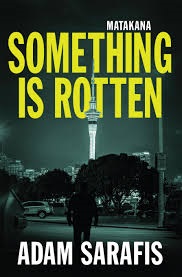 I loved this book from when one of the wheeler dealer characters arrives back from London and as he makes his way towards the Beehive muses how he is now “Smack in the centre of power”. This New Zealand is the one emerging from the Panama Papers, the one where politics, big business and the media are in cahoots, and one where something is definitely rotten. This particular rotten conspiracy – Whitehall, Wellington, Paris, Brussels, Baghdad – involves contra contra deals involving oil, money, meat quotas and war crimes. It is wonderfully complex and even more wonderful is that what gets our main protagonists – ex security advisor Sam and ace reporter Lynette – onto the case is the mysterious death of an aspiring writer working after hours in the Auckland University Library. His unpublished manuscript is at the heart of the mystery – his fictionalised version of events too inflammatory to be allowed to get into circulation. Against the power of the written word – the manuscript, Lynette being a journalist and Sam’s reading of Hamlet giving themes to the chapters – is pitted the great repeated phrase: “We all work for the government.” The pace is lively – lively enough to get you over some pretty unlikely scenarios – and the characters refreshing. We read about the looks and style of the men as well as the women, and the main two instigators are flawed and interesting. We get enough tantalising bits of Sam’s back-story to want to read more about him, and get to respect Lynette enough to want her to get working on another story. And as Something is Rotten is the first in the Matakana series by popular novelist Linda Olsson and scriptwriter Thomas Sainsbury, we’re good on both counts.
 Nordic noir with a kiwi twang! The Mistake is a great jigsaw puzzle of a murder mystery. A terrible car crash on a snow-covered lava field; nine years later in Reykjavík a man blacks out and when he comes to, discovers he is near a woman’s mutilated body – what is the connection? And the slam dunk of a case, where the man with a dodgy story has been found right next to the victim, turns murky for Detective Grímur Karlsson when a vengeful father, a controlling psychiatrist and two illegal immigrant working girls are thrown into the mix. The Mistake is novella length – it can be read in one sitting – and suffers for it. It would have made a great full length novel where we could have really got to know Grant’s characters, saving them from the “all women are victims, prostitutes or evil; all men are well meaning, just following orders or psychologically damaged” array. The resolution of the mystery is told rather than revealed, and the creepy ending – where we question who are the victims and who the psychopaths – although well done, doesn’t have the impact it might have had in a fuller novel. Still well worth a read.
 I have been reading a lot about narrative arc lately – and against the tide of my reading have been picking up novels that don’t really have one. Dad Art is such a novel, it follows Wellington based sound engineer Michael from when he is undergoing a minor procedure to remove a suspected carcinoma on his chest, through to his reminiscing about recent events and moving into his next set of circumstances. Michael separated from his wife of 20 years a year after their daughter Sam left home to move to Auckland. He is missing his daughter, visiting his father who is descending into dementia, learning Te Reo, living in an up-market complex and trying out options for new relationships. The carcinoma threat is a worry, as is the thought of his latest relationship prospect – a younger woman with a young son. But the biggest discord arrives when Sam visits attached (literally) to Matiu as part of Matiu’s private art experiment a la Linda Montano. I think the point of the book is that our lives are performance pieces and it is up to us to make them interesting to others and ourselves. Michael isn’t really doing that; he is disparaging and constantly joking about the flag referendum, his is dismissive of the Peter Jackson WW1 art exhibition he visits with Cassie, the new ‘possible’ and her son and his friend. He is suspicious and unsure of Cassie. He can’t really articulate his feeling to Sam and ends alienating her for a while. He has regrets for mild sins of omission – not really sticking up for a bullied boy at school, never really talking to his father about the sadness of his father’s past while he had the chance. He was a bit slow off the mark in moving to Auckland to be with Sam and not feeling able to after his wife did fearing he would appear “grasping and weird”. He is slightly peripheral to the Te Reo experience, not confident in his engagement and realising that knowing the Te Reo name of the Hutt River will never give him the knowledge that Matui has because “Like a lot of Māori stuff. Context is everything, yeah.” Michael is moving slowly towards old age and has an experience where “Jesus, he was turning into his father”, but you do feel he is still working on shaping his life to make it better. I can’t say Dad Art is a riveting read – as Michael is really a minor character – but he is one I am glad I spent some time with.
 This novel claims to provide ‘insight into the very sensitive issues surrounding the unmarried mother and adoption’. The main character, Janice, falls pregnant at 18 and ends up in Sunnyvale, a home for unmarried mothers in Auckland. It is the early 1960s, it will be over 10 years before New Zealand provides Government support for single mothers, and in many cases adoption is seen as the only practical option. But not the community adoption such as whāngai in Maori culture; adoption where the babies are taken from the mothers at birth and from then on the mothers are legally forbidden to ever have contact with their children again. Great subject matter for a novel – particularly when the stigma of being an unwed mother continued in fine form throughout the years of DPB (now Sole Parent Support). Elaine Blick’s mother was the secretary at a home like Sunnyvale for many years, and Blick met a number of young women in the home and has used their stories in this book. But what she has also used front and centre is her belief in the guiding hand of God in all our destinies. All the many characters in the book are kind, generous and at one time or another devout and swayed by faith in God. I grew up in the 1960s – I recall friends who “went up North for a while” – and the wholesale acceptance of the patriarchal ‘solution’ to this social issue was definitely not meekly and gratefully accepted by all, as it is by all the young women in this novel. Added to the list of things a prayer or two can resolve are: enlightened care for Down Syndrome children, the dealing with miscarriage and loss of childbearing, and the death of those close to you. When the ‘solutions’ are so simple there is no tension; no exploration of human tragedy and the ways that people find to continue. I am not saying you can’t have great fiction written from the premise of Christian faith – Marilynne Robinson, a committed Christian, writes wonderfully challenging books about faith. But where adoption is suddenly accepted because “Jesus was actually adopted. He was the son of God but he was brought up by Joseph, a carpenter”, a chance is lost to really get to grips with this extraordinary social phenomenon. I’m not sure who I can recommend this book to – I think even those with firm faith might find it a bit contrived.
 glacier guiding is no longer a promising career, so she is maintaining tourist tracks for DOC in Paparoa National Park. She isn’t too worried about the political unrest she finds when she arrives in Punakaiki – a new DOC manager is planning a major tourism venture in the region, much to the horror of the locals – she is just there to make some money before heading back to Franz and starting a low key tourist venture of her own. But when the new manager is found dead, and the Police announce it is murder, Philippa ends up once again drawn into the mystery. And there are suspects galore – and a body count rising to rival an episode of Midsomer Murders. The backdrop of the Punakaiki pancake rocks and blowholes and the Park’s limestone cave systems is perfect for the creation and stashing of corpses, and the wild West Coast’s reputation as a haven for people escaping all sorts of situations adds to the rich mix. The wild and mysterious environment is a nice metaphor for the personal secrets and tragedies Philippa uncovers while trying to connect the dots that link the murders. And she is a nicely flawed character – having personal history to deal with – and sometimes being quite indiscreet with the gossip/information she is given. Cold hard murder is a good murder mystery – there are enough clues for the reader to keep coming up with possible solutions, but I am not convinced that there are quite enough for the reader to guess the correct one. A gripping read – and one that made me want to re-visit the spectacular Paparoa region.
 “What had changed so abruptly to discard logic and calculation?”, Brian Duncan, an ex US undercover cop and now a NZ PI, asks this of himself as he heads off into the bush alone at one point in this fast paced thriller – but many of the characters might ask it many times through the story. Duncan has been contracted to see if Toni Bourke, who runs the Black Horse Bar and Casino in Rotorua, was complicit in the violent robbery of her own premises. Duncan expects a quick job and a bit of sightseeing before heading back to Auckland – but is in for a shock. Not only is Toni’s TAB “a lot closer to Detroit than to Ellerslie”, Toni herself knocks Duncan for six emotionally – and there appears to be lot more going on than the theft of slightly less than $115.000 can account for. The reader knows exactly what is going on – that the heist is the work of Pio, a hapless kid who inadvertently takes off with a $500,000 bag of methamphetamine as well as the money – all after accidentally shooting a patron in the head. This unfortunate mess gets two local gangs involved in trying to find the dope and the money, as well as the police and the PI. The latter secretly engaged by a gambling company bureaucrat in Auckland madly trying to save his job. The more fearsome of the two Rotorua gangs is headed up by Kingi, Pio’s brother, and his desperate handling of the situation is heightened by his illicit P habit and the increasing criticism of his off-sider and suspicion of his crew. It is hard to believe this is Berards’ first published novel; it is remarkable how he keeps the reader aware of what is going on while all his characters are flapping around in the dark. And that amidst the rapid pace of the plot he still allows the reader time to feel for Toni – who deserves a break rather than the black hole she finds herself in, for Duncan – who is fighting demons, for Pio when he is found, and for Henry – an ageing gangbanger whose body is starting to fail him and for whom the public health service is probably only accessible from inside a prison. The characters are great, the use of nature as a backdrop – both the beauty and the violence, effective, and the message of the evils of methamphetamine clearly stated. As Kingi says: “This, folks, is the other Aotearoa. The one they don’t put in the travel brochures.” Highly recommended.
-
Archives
- September 2026
- March 2026
- November 2025
- July 2025
- May 2025
- April 2025
- February 2025
- January 2025
- December 2024
- November 2024
- October 2024
- September 2024
- August 2024
- July 2024
- June 2024
- May 2024
- April 2024
- March 2024
- February 2024
- January 2024
- December 2023
- November 2023
- August 2023
- July 2023
- June 2023
- May 2023
- April 2023
- March 2023
- February 2023
- January 2023
- December 2022
- November 2022
- October 2022
- September 2022
- July 2022
- June 2022
- May 2022
- April 2022
- March 2022
- February 2022
- January 2022
- December 2021
- November 2021
- October 2021
- September 2021
- August 2021
- July 2021
- June 2021
- May 2021
- April 2021
- March 2021
- February 2021
- January 2021
- November 2020
- October 2020
- September 2020
- August 2020
- July 2020
- April 2020
- March 2020
- February 2020
- January 2020
- December 2019
- November 2019
- October 2019
- September 2019
- August 2019
- July 2019
- June 2019
- May 2019
- April 2019
- March 2019
- February 2019
- January 2019
- December 2018
- November 2018
- October 2018
- September 2018
- August 2018
- July 2018
- June 2018
- May 2018
- April 2018
- March 2018
- February 2018
- January 2018
- December 2017
- November 2017
- October 2017
- September 2017
- August 2017
- July 2017
- June 2017
- May 2017
- April 2017
- March 2017
- February 2017
- January 2017
- December 2016
- November 2016
- October 2016
- September 2016
- August 2016
- July 2016
- June 2016
- May 2016
- April 2016
- March 2016
- February 2016
- December 2015
- November 2015
- October 2015
- September 2015
- July 2015
- June 2015
- May 2015
- March 2015
- February 2015
- January 2015
- December 2014
- November 2014
-
Meta

