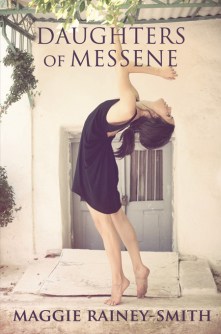
 Artemis’ mother, Nysa, was one of the ‘Greek Girls’ who arrived in Wellington in the 1960s to provide domestic staff for hotels and hospitals. Many years later she is finally going to return to Greece, and Artemis is going to fly over from Melbourne to take care of the house in her absence. Artemis herself had fled to Melbourne to escape an ‘arranged marriage’ and has ended up an ‘other woman’ in a relationship with her history Professor. Artemis is looking forward to time out and a chance to get some perspective on her relationship – but when she arrives Nysa has passed away; Artemis travels to Greece in her place and finds herself amidst a family and a history that explains a lot about her mother and gives her a new perspective on herself.
Daughters of Messene is an engaging book, and you do get a real feel of being elsewhere amongst people with difficult and shared experiences. I would have liked more content about the classical and turbulent more recent past amongst the remnants of which Artemis finds herself. And although I liked Artemis I found it hard to accept her as a PHD level History student. I also found that the ‘po po po’, ‘tsk tsk tsk’, and repetition of Greek aphorisms moved from creating atmosphere to just a bit annoying.
What I really liked about this novel was the filament that separates those people who give in in times of terror for the sake of their families – collaborating to be able to keep farming to feed their families, recanting to be allowed to be reunited with their children – and those who sing through torture and never give up. “There are three sides to every story” – and courage is found in many guises.
The New Zealand involvement in both the Greek and Turkish conflicts, and the various waves of migrations to New Zealand from Greece also makes Artemis’ history relevant to all of us.
 Sometimes you pick a novel up at just the right time – after a string of adrenaline reads and rich historical dramas I was in the right mood for Joanna King’s debut novel; an introspective piece about what it is that influences our relationships, our reactions to other people and our views on gender politics. Is it our childhood experience of a happy / unhappy family? Our first sexual encounter? Our position vis a vis other siblings – youngest child / oldest child? Do we ever know others, even those very close to us? Do we even know ourselves enough to predict our actions or re-actions? Or do we only catch glimpses of ourselves or others in moments of crisis – much as the narrator keeps catching glimpses of herself and others in mirrors or darkened windows? Four sisters, one accompanied by her husband, are on holiday in a little village in Italy. When one of the sisters doesn’t arrive for a planned dinner the anxieties round her non-appearance play out to expose the tensions between the siblings. Told from the point of view of the youngest daughter, Absence takes a leisurely stroll through the human condition of social relationships through time: The village is situated beneath an ancient site of fertility worship, it is suggested ancient bacchanalian festivals might have been a societal solution to male infertility, one of the sisters is working up an idea for a film about Lucrezia Borgia… Each sister is in a different type of relationship with a man – and there is the constant re-hashing of what their parents’ break-up has done to their mother, their father, and to the daughters. We are intimately within the dynamics of the characters – when the narrator does finally make a decision about her own relationship the text starts to trip up and stutter before gaining equilibrium and perspective on her choice. I found it not a perfect read – but definitely an absorbing one.
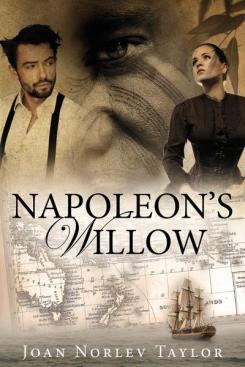 Bishop Pompallier says in this book: “We do not live in the Garden of Eden, though we may try to make our small corner resemble it” – but as well as the Tree of Life, the forbidden Tree of the Knowledge of Good and Evil also grew in the Garden and evil is hard to avoid when you arrive in a land and see it “like a spread of new cloth, waiting to be cut and formed, full of promise.” The three main protagonists in Napoleon’s willow each has a relationship with the willow tree – for young Frenchman Francoise the willow is a symbol of life and hope; he gathers a cutting from the willow planted on St Helena by Napoleon and later plants it in what was to become Akaroa – hoping to instil the ideals of his hero in the new nation. For Marianne the willow symbolises dread and downfall – she makes a life-changing mistake under a willow tree in England, and sees a willow during all the moments of great tragedy in her life from then on. For New Zealander Manako-uri it is up to Tāne whether the willow planted in his soil is good or evil – a harbinger of peace or of even more bloodshed. Each of these characters is an outsider – we first meet Francoise when he is in exile for taking part in the failed Bonapartist uprising; Marianne has to continually lie about her past to keep what little status and respect she has in her community; and Manako-uri is a survivor from an almost wiped out hapū who isolates his remaining family to keep them from the scourges of European diseases. All three are in The Horomaka or Banks Peninsular in the 1840s when both England and France are laying claim to land that is already inhabited. And division is rife; the English separate themselves from the French, the French royalists separate themselves from the French republicans, the English and French administrators combine and separate themselves from the settlers and both the English and the French generally separate themselves from the New Zealanders – who are under neither’s jurisdiction, as that is what is in question. All of which leads to an absolutely fascinating tale. Central to what frustrates them in creating or preserving their Garden of Eden is a lack of political power. The French settlers lack it – one is put in chains when trying to stand up for settler rights; the administrators lack it, having to wait for political decisions made elsewhere; the New Zealanders’ lack it – they are being decimated by disease and their land is being sold under spurious and confusing processes; and women lack it – being at the mercy of men physically, economically and socially. “She looked at boat parties going backwards and forwards from ship to ship as matters in the world of men played out in the cabins of European captains: great matters of diplomacy and trade, economics and empires, nations and government, all being decided while they floated on the water, in suspension, watched by the people of the land.” But against this backdrop – in a country new to some and very old to others – there is also tapu – those things sacred, forbidden, those things red like blood: “The untouchables are the ones with the power”. These are the other than political powers arising from a vision of a new order, from a confidence in nature and one’s ancestors, from a woman discovering she doesn’t have to conform … Yet another great piece of New Zealand historical fiction.
 The Chain takes us into the privacy / security debate, it is set in 2043 where the democratising power of the Internet has gone ballistic – with no national borders or jingoistic-causing historical place names, and where all information exchange and debate happens in an open online environment: “… all of it was meant to connect us, to tear down walls of insecurity and intolerance, to reveal that we are all the same …” – if all the peoples of the world freely communicate with each other and openly debate with one another online there will be no basis for conflict or disharmony. But it is a dystopian world – not everyone is happy to lose their privacy, and no-matter how democratic the outward philosophy “Someone always has to be in control”, someone has to run the infrastructure and enforce the new order, and to do that the rulers need an invasive surveillance system and rules such as a limit of 6 people allowed to congregate in the flesh at any one time. The Chain was written for a YA audience – the main protagonists are two young brothers – but the themes of the book will appeal to a much wider group, I was very aware of how many times I checked my various online devices while reading it! The brothers, Topia and Lukan, live in the King Country in what was once New Zealand – one prefers being out in the bush riding his horse, the other embraces the world he was born into and spends most of his time gaming online. They are a little embarrassed by their Canadian father, knowing that at one point in his past he had been in trouble due to his free speech blogging. But just before their father dies they find out that his past might not be over and done with – a chain of clues has been left for them to collect around the world that will lead them to information that will bring down the mass surveillance system that controls their lives; the system their father warned about at its inception many years before. Neither boy is keen – Topia not wanting to leave his home and Lukan not thinking bringing down his online world is a good idea! But the boys set out on a course similar to that of ill-gotten gains being transferred via multiple locations to evade detection. And as the boys travel they discover what life is really like for the off-liners and people in other ‘colocation centres’. More worrying still is their discovery that not all the information shared in the online environment is preserved – there is censorship – the systematic wiping of anything that might lead to individuality or other than ‘eartizen’ identity, such as minority languages, cultures and beliefs: “Why do we need an all-seeing god, when we can see all ourselves?” At one point the boys resort to speaking in Te Reo to preserve their privacy, and also to writing notes to each other on paper; with a lack of online encryption the only safe way to communicate – “Stupidest thing this world ever did, getting rid of books.” And the boys puzzle over imponderables such as: “What does individual privacy have to do with replenishing caribou herds?” There are plenty of ‘our world’ references in the book: an Edward Snowdenesque whistle blower, the end result of the austerity measures in Greece, there is even reference to the New Zealand flag referendum! But what I particularly liked was the theme that the complexity we lose when we lose our privacy is the complexity of our storytelling. The clues are symbolic and mythical and carried in old books and manuscripts – and ironically derive from the fact that there are common themes running through our different cultural stories – but the way to find commonality is through exploring complexity and not through an ersatz simplicity. I enjoyed the read and the ideas.
 running her cabins up North in native bush by the beach – and the operation, although improved from the time of The Cabin by the Sea, is still less luxurious than her previous establishment: The Three Suites of The Murder Suite. But one thing hasn’t changed: Audrey’s solving of all of her problems, real or imagined, by knocking off the offenders, getting rid of their bodies and implicating others for her crimes. The first in the series had dope growing in the Far North as a backdrop, the second underage prostitution and The Murder Trail brings a Mexican drug cartel to our shores. Audrey has previously been a man-hater looking for the perfect man – but now she becomes enamoured of a woman, but when she realises this is maybe not be the answer to all her prayers – well you just wouldn’t want to be anyone Audrey feels let down by. The writing is plain and the pacing that of farce – but the plotting is clever and Audrey always manages to stay one step ahead of those suspicious cops and fellow fiends. And from the ending of The Murder Trail I think Audrey has more ghastly adventures ahead of her.
 Want a good old American thriller with cops and killers with ice in their veins and a confusing line between right and wrong? – American Blood is for you, and it is written by Kiwi author Ben Sanders. Sanders’ new character is an OCD ex undercover cop from New York in Witness Protection in New Mexico – but not playing by the rules – and even sort of keeping his name, Marshall. The sighting in a newspaper of a young woman in a missing person case, who reminds Marshall of his disastrous past, compels him to get involved in the case – putting him the crosshairs of the hit man hired by New York gangsters who want him killed, and getting him involved with local drug dealers and low lifes. But Marshall isn’t the only character we follow – there is Lauren Stone, an off duty cop trying to deal with her own personal tragedy; Troy Rojas, ex-army, ex-prison and current drug dealer; Lucas Cohen, the deputy marshal on the tail of Troy and his associates and the local witness protection contact; and Wayne Banister, the hitman from New York. And all these characters swirl around and gradually wash up together. And the good/bad thing is irrelevant – one of the most thrilling segments is when Rojas (a baddy) is sneaking around a house while his psychotic buddies are up to no good in the basement – and Wayne Banister is actually quite a nice guy – and Marshall racks up quite a body count. Motive is a bit blurry and I would have liked more texture to Marshall’s character – but the action and hardware are meticulously described. And wanting to find out more about Marshall can’t be a bad thing when I am sure we can look forward to more novels in the series.
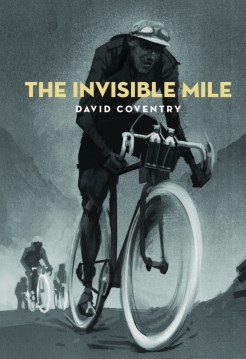 What a breath-taking book! Coventry has seamlessly inserted a rider into the historical Australia / New Zealand Ravat-Wonder-Dunlop cycling team that took part in the 1928 Tour de France. The first English-speaking team to take part, they rode in one of the toughest races in the history of the race. And Coventry leaves nothing out from their gruelling experiences: “to drop is to die” – and the (even then) heavy reliance on drugs to endure. But The Invisible Mile isn’t really about the Tour de France – it is the quest of one man to make sense of the recent war and his post-war experiences – a pilgrimage: “But I hunt it out. I look for it everywhere.” He was too young to fight but his brother went, and he co-opts his brother’s horrendous wartime experiences as his own for a while. The relationship between the brothers has been fraught, as the shock of their sister’s death leads them to find blame in each other to make sense of it. As we follow our rider through the Tour – a metaphor in itself as it is a race that is ridden in teams but measured in individual achievement – we slip into the stream of his thoughts and his perceptions, often warped by drugs and grief. We eavesdrop on conversations he has with the ghost of a rider (who is still alive and injured in a previous town), and their talk is as real or unreal as the conversations he has with his team mates, people he meets along the way, or the mysterious woman who follows the race, providing drugs and intrigue throughout – for “Some part of you, it is always turning into a ghost.” The focus of the narrative goes from the microscopic of torn skin and broken bones to the vast dioramas of the trenches imagined from the air, the stones of Carnac, the discovery of Troy: “That resonance of the past with the now, is that what we call history?” Just as a rider is alone and isolated amongst a field of other riders, individuals are real but defenceless against the onset of war, history and the re-drawing of maps. The speed that men turn into monsters: “Count the weeks on your hand”, and it is only in retrospect that we seem to have a choice: “We’re only ever half here anyway.” Our rider struggles to find a line through his own memories and experiences, “… it is not time that holds memories but something quite other. Hope, love, blind anger. Such things.” And parts of the book are heart breaking – the woman recounting the madness in Belgium as she fled; the description of the impact of the death of a loved one, when shared memories, those that only exist between those two people, are lost, “Memory that goes; this is the longest, deepest pain.” Our rider finds some solace along the way, camaraderie, human touch, “Talk and how talk shifts the unknown into the real. How real we seem when conversation repurposes the mundane for tasks of rehabilitation.” But when he realises that his words might had led to more pain even talk fails. The Invisible Mile is a wonderful achievement, at times quite sublime. I found some of the prose a bit purple early on: “His own eyes are quite distant, their whites bloodshot with coffee and sugar and a hundred varying queries.” “She speaks a fine English, though the accent leaves its trace like a snail’s trail over glass.”. But this soon fell away as we hit the road, and although a gruelling ride it is more than worth the effort.
 How to grow an addict
 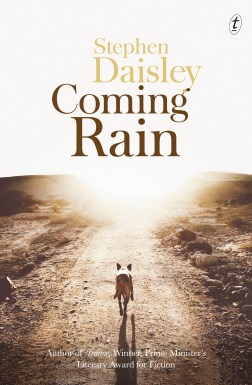 What a dismal tale! Set in the outback of Australia in the 1950’s Coming Rain is the intertwined stories of two itinerant workers, Lew and Painter, and of the trials of a pregnant dingo. The structure of the novel is lovely – with the tales weaving past each other and occasionally intersecting. But the remorseless harshness of the landscape and situations, the relentlessly misogynistic and xenophobic language, and the tragedies left in the wake of war and sickness are wearying. Lew has been travelling with Painter since he was a young kid without shoes, when Painter showed him how to make a pair out of sacking for work in the shearing sheds. Ever since then they have been together – burning charcoal, shearing, picking up any work going. The details of their daily routine are meticulously described – with a few too many brand names for me – and a relaxed camaraderie gets them through their many disagreements. But when they arrive at John Drysdale’s farm to shear and Lew meets Drysdale’s daughter Clara, things start to fall apart. Daisley has given us a ‘slice of grueling life’ – bleak for both humans and animals, and even bleaker for the previous human inhabitants of the area. But oddly with all the details provided I felt no sympathy with or understanding of any of the characters, except perhaps the dingo. Worth a read for the relentlessness of the storytelling.
 alysontheblog