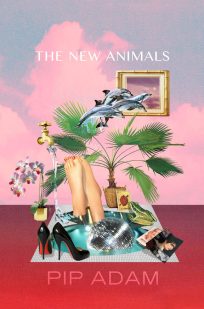
The New Animals by Pip Adam – 2017

The_New_Animals“All this sweet hope lost. Lost to time, to dust, to heat. Like the dinosaurs’ hopes, like the fish that left the sea, like the fish that stayed in the sea knew they wouldn’t see one another again” – but can hope be regained?  Is there somewhere we can start again?

The new animals follows a group of people who work for an Auckland cutting edge fashion house through the day and night prior to an unscheduled photoshoot.  The company is the creation of three young males, Kurt, Cal and Tommy, who represent “the new sincere, the anti-irony” generation who respect their parents, and who live online where they believe they are “part of the global conversation.”

Carla and Sharona are the previous generation – they are ‘old’ – in their 40s – one a contract hairdresser and the other the woman who creates the fashions.  The young men treat them like shit, complaining that they “would bitch and moan about the way they ran things and where did they go to get paid?”  When Kurt talked to women he “sounded like he was talking to a small child he was trying to coax down from a tree”.  And Tommy “wasn’t talking to Sharona, he was talking to everyone else in the room, well, all the people who had penises”.

Carla on the outside is “polite and engaged” but inside she is an insecure wreck.  She escaped for a few years and now she is back and “didn’t want to look naggy. That was the worst thing a woman could look, especially an old woman”.  All the women are on edge, and Sharona momentarily tips over when Cal “wanted to cut the hem off the T-shirt … he doesn’t even know you can’t leave an unfinished edge on a weft-cut knit.”

Carla has a friend Duey, the only calm one, and the only one not sure about young make-up artist, Elodie: “Duey wasn’t sure she could be relied on as much as everyone thought. Young women were strange.”  All the others are in Elodie’s thrall, in awe of her youth, and don’t realise she is using them to get information – information about where Carla had been when she escaped for all those years …

This is where we realise The new animals isn’t about the fashion industry at all: “everyone thought what they were doing was making the difference, when really, when everything went to shit, it became clear it was just money. You really couldn’t do anything wrong when there was a lot of money around.”  If you have money you have a chance, if not you are a victim, a victim to bosses, to climate change, to homelessness.

Fashion is a metaphor for the disposable society, those things we reject when they go out of style, not when they wear out.  And for the money gap: “There were people sleeping in the street … The bright, bright shops keeping the merchandise warm and the people outside them under cardboard and newspaper.”  Shoes are $1000 shoes, a necklace is a $4000 necklace.  I also really, really had to read the descriptions of Carla’s dog Doug as though they were symbolic of all “the intense boredom mixed with nerve-electrifying stress” wrapped up in an aggressive, frustrated, potential killer bundle of muscle.  The alternative was too awful.

Clear headed Duey knows “The world was ending … It wasn’t just cynicism, or because she was old. It felt like the end. They’d all be underwater, soon enough. There was nothing anyone could do about it.”  And all through the novel the sea is leaking in: “The fountain at Mission Bay was going, the water, the water, the water. Carla looked away from it and down at her phone. In Duey’s periphery it looked like she was diving into the sea.”

Elodie is young, unknowable, estranged from her politician father who thinks whatever the world’s problems “someone will find a way to tidy it up.’  And Elodie wants to escape the way she thinks Carla did: Carla who came back: “Cold, wet, naked. Quietly, without any attention, and she’d fit back in again, eyes fucked, skin awful, bung feet. She’d come back, washed away the salt, got dressed, and fallen back in line” – but Elodie won’t make the mistake of returning.

Elodie gets what she wants by being nice, appearing optimistic and being young.  And she heads for the sea, believing in nothing but “fate and natural selection”.  But after Carla, Sharona and Duey’s rebelliousness, and Kurt, Cal and Tommy’s vacuous outlook, does Elodie’s vision reach beyond the journey away?   We love and fear the ocean as we love and fear our origins, the cold of the sea takes our thoughts away, but our curse on the land is taking over the sea.  No, poor Elodie is as lost as all the others, and her destination, as we guess where that is towards the end, is the real-world horror we have conjured up by our rituals of excess.

Can hope be regained?  Is there somewhere we can start again?  Probably not, we just do whatever small thing we can and read amazing books like The new animals!

Posted in Book Review | Leave a comment

Sodden Downstream by Branavan Gnanalingam – 2017

sodden_downstream_coverSita is on a zero-hours cleaning contract and is the only wage earner in her family.  Her husband, Thiru, is currently only able to contribute a Work and Income benefit, and her son, Satish, is still at school. So, when her boss demands she turn up for work in Wellington, despite a cyclone, road closures and no public transport, she leaves Naenae and heads South.

Sita is an Everyman on a journey, talking to those she encounters on the way.  Sita is a Sri Lankan refugee who finds the speed and slang of Kiwi English a mystery and she feels herself a “village bumpkin who didn’t know how New Zealand operated”.  At one stage in her journey Sita circles back to Naenae; another member of the Sri Lankan community picks her up and drops her back home – Sita is too embarrassed to explain her predicament. Financial and racial snobbery is alive and well within the community as well as outside of it.  Sita has dark skin – you wouldn’t see her in the dark unless she smiled quips a co-worker – Sita doesn’t understand.  And Sita feels inferior to those Sri Lankans who arrived as immigrants as opposed to refugees and who have made comfortable lives.

Sita is frail and in chronic pain from injuries she sustained in the Sri Lankan civil war: “There was so much that made her feel like she was a dandelion seed floating in the wind, waiting for someone else to rip it apart to make a wish”.  But somewhere inside Sita is a tough core, and she is determined to make a good life for Satish, and to make up for his early experiences in Sri Lanka, for which she feels responsible.  She is calm in the face of those things she can do nothing to stop, unlike Thiru who is petrified by his helplessness.  Sita repeats things to herself to keep herself on track, and to keep her memories at bay.  Memories that force their way through sometimes, and when she is alone and walking in the dark they rush over her like a torrent.

The water of the cyclone that soaks Sita as she travels is just one source of cold, wet and fear.  The swollen rivers she passes menace her as well, with their threat of bursting their banks and engulfing her – at one stage the water is described as having “paws.”  But the people she spends time with on her quest provide warmth, they are also on the periphery of society – those who aren’t don’t register her, or only enough to hurl abuse at her out their car windows.  Sita’s fellow travelers know nothing of Sri Lanka apart from cricket, they know nothing of the horrors of the war.  But they know what it is to be marginalised and financially powerless: the kid who can’t get a break from the Police, the homeless men, the prostitute, the transgender woman, the man just out of prison, the Māori mechanic who is used to casual racism – they are all in one way or another disenfranchised and poor.

Sita feels she should be grateful that New Zealand allowed her and Satish in to be reunited with Thiru, but she also knows that those in power don’t “give a shit” about her.  One homeless man offers her advice: “Don’t ever let them make you feel grateful” – but then he comments he is living on the streets and advises she might not want to take his advice.  Sodden downstream is a wonderfully moving portrait of an individual, a great description of what it might be like to be a refugee in a country whose language and rules are a mystery, and a really really good read.


Posted in Book Review | 1 Comment

Alignment by Tracy Chollet – 2017

alignmentIsabeau Martin is a lonely, insecure woman whose life has been shaped by a deserting father and chronically depressed mother.  She is asthmatic and grew up with the standing stones of Carnac as her only friends, avoiding other children, and sharing her thoughts with a massive menhir called the Manio giant.  After her father left, her mother took Isabeau away from Carnac.  At the start of this novel she has returned after her mother’s death and taken up the post of the Carnac Deputy Postmaster.  She is still shy, reclusive and asthmatic, and hoping to discover what happened to her father.
One day, when the Postmaster is not at work, Isabeau receives a parcel from New Zealand addressed to the Postmaster. She opens it and discovers a container of ashes and a request from a man for his father’s remains to be scattered amongst the standing stones.  We know the author of the request, Joseph, as the first sections of the book alternates between the story of Isabeau and that of Joseph.  Joseph was all set to carry out the task of scattering the ashes himself, when fate intervened.

Most of the book is written from Isabeau’s point of view, and after the first section we only hear from Joseph via the correspondence that starts up between the two.  Isabeau grows attached to Joseph’s father, George, or rather to his remains, and George joins the Manio Giant as another confidant for Isabeau.  She does make some live friends; she is drawn to a woman from the local bakery, Marianne, and through her to Pierrot, a potential love interest who offers to help Isabeau renovate her family house, which has fallen into disrepair.  There are also the Morel’s, neighbours from Isabeau’s childhood.

Despite these warm, welcoming, supportive people, Isabeau is still a fragile loner pursuing her mission to find her missing father.  But an epistolary relationship grows between her and Joseph, and when Joseph writes announcing that he and his cousin are planning to visit France, and Carnac, Isabeau is thrown into a bit of a tizz.  All of a sudden, she has Marianne’s wedding approaching, Pierrot expressing romantic interest in her, leads arising in the hunt for her father, a looming visit from Joseph – and the minor matter of un-scattered ashes.  Joseph is a musician, and she also has his recorded voice as the sound track to her anxiety.

I don’t want to relate exactly how this plays out – it has the typical romance arc, but quite a few unexpected moves along the way to the denouement.  There is lots of delicious French food described, and the French towns and environs are lovingly evoked.  It is a moving tale as Isabeau has been so damaged by her childhood, but I did struggle a bit with this damage playing out not only with some terrible decision-making on her part, but also with a lack of backbone where it comes to saying the important things that need to be said.  I recognise this is a plot structure requirement but still I found it trying.  The other gripe I had was with a character in her mid-sixties who is described as though she is one trembling step away from her timely grave!  But I was interested in how things were going to work out for the rather odd character Isabeau, and the book definitely made me want to visit Carnac – and there is helpful tourist information about the standing stones at the end of the novel.

Posted in Book Review | Leave a comment

All This by Chance by Vincent O’Sullivan – 2018

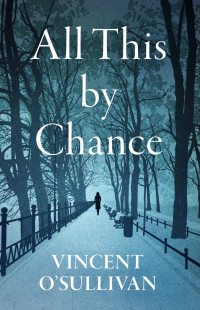
All_This_by_ChanceAll this by chance is a beautiful, beautiful book about memory and identity.  One of the characters muses at one point on how much of us is us, and how much is made up from the photos and paintings and books we surround ourselves with: “The before people” – “No one ever quite works out the mix”.

Stephen leaves New Zealand in the late 40s and travels to London to train as a pharmacist.  He falls in love with Eva, a young woman raised by a Quaker couple and keen to join him in his home country to start a new life.  But prior to leaving they received notification about Eva’s past – that she came from a German Jewish family, many of whom died in the camps, and that one survivor of that family is in London.

Despite Stephen wanting to “Deny that their lives were already somewhere else, where there was no going back from”, their lives are now on a new trajectory.  Babcia, Eva’s Aunt Ruth, travels with them to Auckland, to a house where the ghosts of the past move in with them and are engaged with in different ways: the son David eager to know all about his past and his faith; the daughter Lisa growing up closer to her father’s view that the past is best left to leave the present in peace; Eva spending hours silently keeping her aunt company.  Babcia for the most part sitting quietly day after day, the only person she can talk to a friend from the same camp who they meet on the voyage over, a friend Stephen hates for bringing unwanted information into his life.

All this by chance moves through the generations, with the point of view altering as we read.  It is a beautifully structured novel with the style and voice subtly changing with time and character.  “The past is always waiting to happen” – a thought O’Sullivan echoes in the novel, where names are mentioned before we catch up with who those people are and the roles they play.  And that is the central question – are they just roles?  What is an authentic self-determined existence, and what one that just emerges through time, place and acquaintance?

All the characters struggle with articulating who they ‘are’, Stephen when he first meets Eva, “unable to give her what she hoped to hear, some privileged understanding of what made him the man she loved.”  Lisa leaving her boyfriend Fergus when she sees him shy away from a dead body and lie on a principle of supporting the workers against the rich – recognising he sees everything as a performance and not real life.  Esther, David’s daughter: “I’m the sort of end to a long story I don’t even know”.  And when we catch up with Fergus, he is a bitter man still not able to fathom the role he played in his own and others’ lives.

The mystery of Babcia is in the heart of many of the characters; was she sitting there in a pleasant haze of not-remembering, or in a nightmare of the opposite?  Stephen hoping the former and David wracked with guilt over the latter and convinced “they could have done much more”.  David who wants so much to be part of the faith and people of Babcia “aware he was on the edge of so much yet believing himself at the centre”.

Lisa left Fergus due to his distancing himself from the world, but she ends up suspecting that there is an inevitability in such distance, that “If nothing is known about a person, then anything is possible. If anything is possible, there is no guessing with substance.”  It is fruitless to think of “The end of life that must be there in the beginning, somehow, surely?”  Life is too random, too full of agnostic Jewish fathers, silent African children, Australian librarians in London and Czech PhD students taking time out in New South Wales.

All this by chance is a novel to savour, to be moved by, and one to make you ponder your own place in the blurry selection of memories each one of us calls our past.

Posted in Book Review | 3 Comments

Doctor Perry by Kirsten McKenzie – 2018

Doctor+Perry+Final+CoverYeuwww! Do not read this book if you are squeamish!  But do if you want a hoot of a creepy read – and one that will make you think more about paying attention to your kids and looking after the old folk!!

Doctor Perry is always on the lookout for new patients – he has to be, so many of them disappear.  He is ageist, sexist, and a psychopath – none of which rings warning bells when you are in pain or powerless, and faced with a suave GP.  It even took Myra, his wife (the latest in a number), a fair while to think something was decidedly not right with her home situation – given the endless number of foster children she has had to look after.  And his office assistant (the latest in a number) just thinks he’s a typical arrogant boss.

On Doctor Perry’s rounds – and part of his demonic enterprise – is the Rose Haven Retirement Resort, where the poor inmates are treated appallingly.  One resident is Elijah Cone, suffering from arthritis, a guilty conscience and a ruined reputation.  Elijah’s happy just keeping to his own misery and ignoring the terrible things happening around him.  But when Sulia Patel comes to Rose Haven, the last thing on her mind is minding her own business – and there’s maybe a particular reason she has decided on moving in.  Added to all the machinations of Doctor Perry and the businesses opportunities spurned from his endeavours, are the latest foster children he brings home to Myra, a pair that could give Doctor Perry a run for his money in creep and gore.

Doctor Perry is set in Florida “where you were either retired or planning for your retirement” and is a no-nonsense thriller/horror, the plot clips along, the stories all lock together, and the characters are varied.  My only complaints are that it ends bit abruptly, I would have liked a bit more background and context to the Doctor’s evil enterprise, and I also thought there would be more involving Emily Jesmond, the copper who had a reputation in the force of being a nuisance but getting the job done. And the eBook version does have a lot of text errors.  But aside from these minor points, I squirmed and winced my way through Doctor Perry with glee.    

Posted in #yeahnoir, Book Review | 1 Comment

Money in the Morgue by Ngaio Marsh and Stella Duffy – 2018

Money in the morgueDame Ngaio Marsh wrote the first few chapters, the title and the timeframe for this novel, which is set in New Zealand during the Second World War, and Stella Duffy has solved the crime and completed the novel for publication.  And you would be hard pressed to find where one stops and the other starts.

With a storm raging and rivers rising, a hospital in the Canterbury highlands is the scene of a robbery, then of murder – and is also where Chief Detective Inspector Roderick Alleyn of Scotland Yard is holed up on an espionage-related assignment.  Alleyn comes out of hiding to take on the solving of the robbery and the murder, as the hospital is cut off by the storm and unreachable by the local constabulary, and the denouement of the treasonous plot he is trying to halt is scheduled for the next daybreak.  Confined by space, time and a limited cast of characters, Alleyn enlists Army Sergeant Bix to help him sort out the multiple crimes.

Money in the morgue is a golden age whodunnit, full of clues and interesting characters and quite farcical revelations.  But the story and all the crimes are underpinned by the horrors of the war and the impact it is having on New Zealand and on those who have served, and who are waiting to get back to the fray.  And it is also full of the love of the New Zealand environment, nicely gawped at by Alleyn as he wearily works through the night to solve the smaller crimes and forestall a much bigger one.

The characters are great, just a few: the overweight and overwrought Mr Glossop, a payroll delivery man; Sarah Warne, a competent bus driver who has had a previous relationship with the resident young doctor, Luke Hughes, who is suffering a form of PTSD; another independent young woman, Rosamund Farquharson, who occasionally lets her confident demeanour slip … and many more.  We get to know them as the night wears on, and we also get to know the wonderfully textured Alleyn.  Missing his wife, his home and his partner, Alleyn is puzzled by this strange country, and by its people with their odd turns of phrase.  But armed with the insights of Shakespeare, he realises the tragedies, the longings and the failings of people are universal and he gets the job done.

Money in the morgue is pacey and at times quite thrilling.  All the clues are there to solve the crime and the descriptions of the New Zealand bush etc. are sumptuous.  It is at once a nostalgic and a thoroughly engaging read.  So do read it!

Posted in #yeahnoir, Book Review, Historical | Leave a comment

Baby by Annaleese Jochems – 2017

BabyCynthia, 21 but looks younger, thinks her dreams have come true when she takes off with her dog, her beautiful yoga instructor and her Dad’s money.  She buys a boat called Baby to live on off shore from beautiful Paihia, and cuts all ties with her friends and relations – what could go wrong?
Well quite a lot, quite quickly; Baby is told from Cynthia’s point of view and Cynthia’s point of view is informed mainly from reality TV, YouTube and online sex sites.  She is an unreliable narrator of her own life – fantasising constantly and getting pouty and churlish when the real world doesn’t conform.  As well as Anahera, the fitness instructor, there are three other significant characters in the novel, but we have no idea really who they are and what they are thinking – Cynthia’s perception of things being so self-obsessed.

Baby is quite mundanely horrific – Anahera’s fitness weights roll around above their heads inside the boat – an ominous noise that becomes more so when Gordon anchors them so the threat is still there but silent.  Gordon is a man they pick up, or are picked up by, on a nearby island – is he German?, a fake?, known to Anahera?, a threat?  All we have to go on is Cynthia’s warping thoughts.  The boat becomes a claustrophobic container of Cynthia’s psyche – within which she tells us of Anahera’s comings and goings (she is always swimming away and back), their daily routines, their childish diet and the annoying intrusions of those they invite in – a young boy from a Paihia school, Gordon, a man who lives on a nearby boat.

Cynthia is also really an unknown – she is either extremely attractive or not and overweight. She might have been blond but the roots are showing.  She might have been to university but has been unemployed and living on her father’s money.  She also might never have been able to secure a job, not being able to convince potential employers of her trustworthiness, so has been unemployed and living on her father’s money. She is extremely modern in the worst way, abandoning what she says she loves for something else she says she loves, being emotionless and mercenary about online sex related sites, being more interested in the image of herself than the reality of others.

The psychological suspense in Baby arises from not knowing whether Cynthia’s fantasy is complete – is it all in Cynthia’s mind – or will her negative thoughts towards others be expressed as violent action?  It can go either way for quite some claustrophobic time.  You will have to read Baby to find out the answer!


Posted in #yeahnoir, Book Review | Leave a comment

On a Bodgie Bike by David McGill – 2018

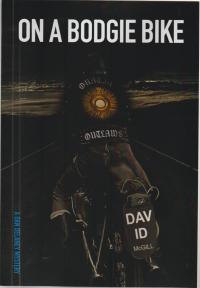
bodgie bike cover scan (1)Dan Delaney is back, but he’s not the earnest young lad who longed to be a detective who we first met in 1935, nor the more mature Dan we next met in Wellington in the mid-1940s. It is now 1955, and Dan is living back with his Dad in Auckland and working in the “choking confines” of a wool store, having given up on a brief stint at teaching when the liberal use of the strap reminded him too much of the Nazi atrocities he witnessed in a POW camp during WW2.  This Dan doesn’t want a bar of getting back into security work, and is turning into a cynical and prejudiced man of his times.

The New Zealand Dan now lives in is bleak: there is a generational divide with not much respect given either side, society is conservative and homophobic, most people are ugly, there is corruption in the Police Force, and politics are post-war weary, nervous of the ‘yellow peril’, and fraught with the baggage brought in by various immigrant groups.

Dan’s brother has scarpered to Australia, leaving his wife and two children behind. Dan grudgingly keeps in touch with Janet, with whom he had a pre-war one-night stand, and with her sons, Matt and Malcolm.  He quite likes Matt but he has no time for poor Malcolm, the overweight younger son, who is suffering under a depressed, drinking and therefore neglectful mother.

Matt is a bit of a larrikin, and he gets into all kinds of trouble when he agrees to help an idiot friend steal a Catholic monstrance, hoping to make money.  The monstrance, if genuine, is extremely valuable both monetarily and politically.  It hails from Croatia, and if it finds its way back there it could strengthen the rallying cry for revolt against Tito’s Communist rule.  Ante, the ‘brains’ behind the theft, is Dalmatian, as is his sister, Mira, who Matt has fallen crazily for after seeing her in a production of Romeo and Juliet, and after discovering teenage hormones and a vocabulary from the Bard to declare his love and feed his deliriums.

When the theft goes horribly wrong, and Mira and Ante’s uncle is killed and the monstrance goes missing, all parties – the Church, the Dalmatians, and Dan’s bête noire, Haas – who could be working for any number of foreign governments, the fall of Tito’s independent Communist regime being of benefit to both the left and right – all join the fray to capture Matt and find the treasure.  And Janet pleads with Dan to try and help her son.

On a bodgie bike is told at breakneck speed from the point of view of Matt as well as Dan, and is a gripping read full of fascinating history – it is also quite a distasteful read given how far social sensibilities have moved since the 1950s, and there are some very violent scenes.  The narrative is thick with 1950s slang and outlook, the only relief coming in the form of a couple who live out of the mainstream, and who help Matt and his mates when they are on the run.  The contrast between the kids’ own lives and Robbie and Wai’s is extreme, and the fact that Robbie and Wai “were no friends of the authorities”, reinforces the feeling that society is unstable and untrustworthy.

I thought On a bodgie bike was going to be a story of redemption – after all there is a lot of Catholicism and lost faith described.  But at the end, although the mystery has been resolved, there are still many unanswered questions and unresolved issues for Dan Delaney, for example his relationship with his brother and his nephew Malcolm, his guilt over Janet, his unhappiness with his work.  There is a glimmer of an improvement for Dan personally, albeit involving a Dalmatian Policewoman “just about young enough to be his daughter”, and some possibly transformative news about his own family situation.  On a bodgie bike is a good gripping read about a depressing post-war New Zealand, but I did miss the feisty idealistic Dan of old – maybe his story of redemption is in a future outing?


Posted in #yeahnoir, Book Review | Leave a comment

The Cage by Lloyd Jones – 2018

TwoThe cage strangers arrive at a hotel in an unnamed and unplaced town.  They need help, but before providing help, the townsfolk want to know who they are and what has happened to them.  If the strangers can’t provide that information what are the townsfolk to do?
The cage is an extraordinarily intense metaphor for the dynamics of modern human communities: who belongs, who can join and what rights the community members have regarding their self-defence.  The strangers, who are initially given a room and food, become of concern when they cannot provide their names, place of origin, or nature of the disaster that has caused them to flee on foot and in rags.  They are invited to make a piece of art with wire to indicate that nature of their origins, and then that piece of art is copied and turned against them, turned into a cage, where they are trapped within their own otherness.  They are given nicknames (Doctor and Mole), but these are purely so the townsfolk can refer to each one – when there is only one, they are referred to as ‘the stranger’.

Throughout The cage, the strangers are likened to animals.  They become like exhibits in a zoo, they develop stereotypic movements in their cage, and they become defined by their excrement, the sight and smells the source of fun for scatalogically minded children.  They are also likened to domestic livestock, Doctor at one stage being compared to a thirsty cow, and they suffer the injuries and indignities of neglected domestic animals.  The other comparison frequently made is that they are seen as images or statues, inanimate things it is easy to look at and talk about with no compunction.  As the novel progresses plans are made for a stone memorial of the strangers’ tragedy, a monument that will replace the living beings that are an inconvenience to the smooth life of the town.

The narrator of the story is the nephew of the hotel owners, himself a ‘refugee’ who has been offered a home and from whom “some gratitude was expected”.  We also don’t learn his name, just his nickname, Sport. He also shares with the strangers our knowing about his toilet habits, he often makes his observations while visiting the loo.  Sport has memories of avoiding visits to his aunt and uncle when a child, not wanting to witness the ridiculing of his father, a school teacher who upset the community pattern by becoming a farmer.  Sport visits an aquarium and comments on the “the complete absence of interest by one creature in another”.  And that is how The cage sees our modern communities – a story is told of a boat trip where someone falls in the sea and the first call is for photos to be taken.

You would think that Sport, who has experienced entering a new community, to be sympathetic to the plight of the strangers, but, “With the strangers, I feel I am caught between looking at a crisis and wanting to solve it.”  A Trust is formed, and Sport is tasked with observation and reporting, he starts a ledger, he hides behind the rules laid down and decisions made by the Trust regarding the treatment of the strangers, and the responses to their requests.  Sport has sympathy, however “What is the point in sympathy that does not produce a change in circumstances?”, missing the point that he could make such a change.  But as his aunt reminds him, “You are not the strangers’ keeper”, a lovely pun on one in charge of lesser being and a protector or guardian of an equal.  In choosing this path of reporting within the confines of the Trust’s rules, Sport is also trapped, finding no way of reporting on the “strange new contortions of personality I find myself going through.”

The cage is set nowhere and everywhere, it is where school children sing Pōkarekare ana but also where they keep hamsters – so both hemispheres.  The Trust wants to know everything about the strangers and what happened to them, so they might know what steps to take to avoid it happening to them.  They put Sport in place to give them information much as we might watch the TV nightly, impassively watching the plight of refugees and those in war torn countries, calculating where any danger might be relevant to us.  When the wall for the memorial is being built, Sport looks out the window and sees a split screen, the strangers filthy in the mud on one side and his uncle playing tennis in tennis whites against the wall on the other.  With just a slight adjustment of our eyes, or the channel, the misery of others is gone.  Like Sport, we decide to see how ‘they’ will get on left to their own devices.

The strangers cannot tell of their experiences, and the Trust lays down rules that they in turn must not be informed – Sport gives them his nickname but they know no other names, or whether authorities have been informed, or when their incarceration will end.  The Trust does not even admit to incarceration, the strangers entered the cage (as a piece of sculpture) willingly, they won’t give their identities, so strictly speaking there is no-one detained.  As with the animals in the zoo that Sport frequently visits, “…there is a price to pay for not being local.”  In The cage communities can’t be sympathetic with people if they don’t know what has happened to them, but the comparisons between the strangers and the rough sleepers in the town suggest that sympathy can only really arises when the community-as-a-whole experiences a problem directly, just seeing it in their midst isn’t enough.  The haunted look of the strangers is put down to whatever they have experienced, not what they are experiencing.

What do we find out about the strangers?  They aren’t used to electric light, they are resilient when experiencing atrocious weather, they refuse to swap their clothes for new (seen as a refusal to assimilate), and give the reason as not wanting to dishonor those whose clothes they are – those who “in a moment of great misfortune had lost everything, all their possessions, in some cases even their skins”, they have nightmares of airborne dangers, and they are used to dealing with  those in authority.  And they are themselves sympathetic and conscientious, Doctor often offers to help the townsfolk (hence his nickname), he is courteous and polite, and at one point Mole ushers a child who has climbed onto the cage, to the safety of his father (reminiscent of Koola, the gorilla who carried an unconscious three year old boy to safety after he had fallen into Koola’s enclosure at Brooklyn Zoo).  But none of this makes the strangers into ‘one of the community’, even when Mole joins in to help the town in a crisis, he is not accepted as anything other than ‘other’.

The cage is a disturbing read – and sad to say, a totally transparent one, we know immediately what is being referred to, and how unjust and unfair communities can be.  It is a tale about what is demanded for what should be free: care and support.  The price for these is full disclosure, no space for healing, and a lack of privacy.  The price is those things that those who have lost everything might chose to hold onto – an observation once again from the zoo: “There is not much the ibex may keep to itself, except for what it is to be an ibex.”  Highly recommended.

Posted in Book Review | 3 Comments

Into the World by Stephanie Parkyn – 2017

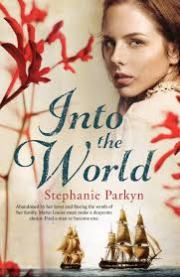
Into the worldInto the World is an historical adventure on the high seas with great characters and an interesting plot.  From the beginning of the novel, when Marie-Louise Girardin brands herself and her infant son before leaving him to the fate of an orphan and fleeing France, we are drawn into her story.  What could drive a woman to do such a thing?

Marie-Louise Girardin transforms into Louis Girardin and becomes a steward on the Recherche, one of two vessels under the command of The General, Admiral Bruni d’Entrecasteaux, who has been tasked by King Louis XVI to discover what happened to the La Perouse expedition to the South Pacific, whose ships have failed to return to France.  But it is 1791, and the revolution is in full swing – and the d’Entrecasteaux expedition has many inner conflicts – with both loyalists and revolutionaries on the Recherche and on her sister ship the Esperance.  Adding to the tension on board, are the arguments between those who see their priority as finding the remnants of the La Perouse expedition, those who see it as mapping coasts around Van Dieman’s Land and New Holland, and those naturalists on board who see it as discovering new plants and animals.

Marie-Louise, who has played a role in the revolution, treads a cautious path between the various opposing groups, managing to keep onside with everyone apart from the sinister Raoul, who seems to know more about ‘Louis’ than he should.  There are a number of potential romantic involvements on board, especially the Captain of the Esperance, Huon de Kermadec – Kermadec and The General are the only two on the expedition who know that Louis is really Marie-Louise.

The expedition travels for two years, visiting exotic ports, enduring perilous periods with little food and fresh water (many chapter headings are maritime location co-ordinates), and landing on some of the South Pacific islands.  The story flows well, and Marie-Louise’ back story is smoothly woven into the narrative.  There is a nice balance between the sensibilities of the time and the growing awareness of the injustices that underpin exploration and colonisation.  Marie-Louise has nice character development through the story, realising that revolutionary progress does not always mean a better deal for women, and finding an inner strength and resiliance which she didn’t know she had.  Although there are romantic elements to the story, there is a nice gritty realism to the outcomes of many of the storylines – not surprisingly, as it is based on a true story.  A good solid debut novel.


Posted in Historical | Leave a comment