
 Well they just keep coming – The Agency is another excellent Kiwi mystery/thriller. The murders are part of a canny scheme of revenge and greed, perpetrated by an angry woman with a facility for disguise that would make The Jackal weep. The solving of the mystery falls to an ex-cop with baggage – who has ‘escaped’ to New Zealand, and who ends up teaching the local force a thing or two about detective procedures. Dan Calder has an attitude problem, the reason he is an ex-cop, and is also prone to depression – which makes him fair game for V. Stenning – who scopes her victims by hacking into depression-related websites. Dan’s neighbour is an unemployed social worker who is keeping herself busy trying to find a romantic interest for her lonely neighbour. Her success in this field, Tara, leads to them doubling up on Dan’s suspicion that there is a serial killer on the loose. Austin is very aware that his plotting is thick with coincidences – and throws in the ‘six degrees of separation is much less in New Zealand’ argument to cover them, plus overstating the problem so you think it’s not that bad: “… the coincidences, freakish events and downright unbelievable twists beggared all rational explanation …” – which is all good fun. The story has the frame of Dan’s Auckland Marathon aspirations, which works well and provides a nail-biting denouement. Some of the other plotting is a bit uneven, and the book would have benefitted from a good proof read. The procedural passages, where Dan is tutoring the task force, are really well done, as are the passages dealing with depression, which are quite moving. The irony of Austin emphasising the gender differences between Dan’s approach and Tara’s approach is nicely placed against the complexity of the villain – all adding to the tension of the story and characterisation. The Agency also doesn’t answer all the questions about Dan and his murky past – so there are undoubtedly more Dan Calder tales on the way.
 I really liked Dan Delaney in his first outing in McGill’s The Death Ray Debacle, and was thrilled to hear he was back. And I wasn’t disappointed with The Plot to Kill Peter Fraser. Not only is Dan back, but so too are some of his adversaries from his pre-war stint protecting an amateur scientist on Somes Island. This latest outing is post the war with Germany and in the last stages of the conflict with the Japanese, and Dan is back in New Zealand having spent most of his war years in a POW camp. He has married the nurse who cared for him after his release – a German Jewish refugee – an old trope to be sure, but Rina is much more than a cipher in this novel. Delaney is sworn back into the police force to help track down those behind a plot to assassinate Prime Minister Peter Fraser – and as with Death Ray there are many potential suspects. Fraser is unpopular internationally, as he has been instrumental in setting up the new United Nations, and is not only lobbying against the veto powers of the newly emerged ‘great powers’, he is also denying those powers their wish to divvy up smaller nations as spoils of war, arguing for self-determination. The Yanks are furious he is not allowing them permanent military bases in New Zealand. He also has powerful enemies within New Zealand due to his nationalisation policies, and ironically his socialist policies are not favoured by the Soviets – as many of them highlight the advantages enjoyed by the ruling elite in the Communist Bloc. So, Dan and Rina head down to Wellington – and a mysterious death and a coded report leads Dan once again to Somes Island, where the disaffected interned from all sides of the political spectrum would be prime targets for enlistment in an assassination conspiracy. The plot unfolds with twists, turns and lots of action, is very complex, and towards the end you want to yell at poor old Dan the equivalent of “look out behind you!!”. Some of the tangential plots are cleared up a little too rapidly, but the line runs through to the final denouement nicely. What I really loved about this book is the way it presents New Zealand plonk in the middle of international political history. This is great if you are part of the generation who was taught New Zealand history as a sideline to international history; the latter something that happened overseas in the ‘important’ arenas of the world, and not something of which our country was an integral part. Wellington is depicted as a cosmopolitan city of cabarets, cliques and conspiracies. As with Death Ray, there is heaps of historical exposition, but it is folded into the flow reasonably well and is fascinating. And the narrative features a previous friend of mine when she was a little girl – which made it even more special for me. I am really hoping this isn’t the last outing for Dan Delaney!
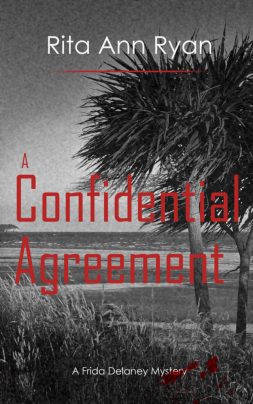 Woohoo this is great: Interesting characters, complex plotting, multiple storylines – and hints at future volumes! Frida Delaney has come home to her family’s small Kawa Bay home for her mother’s funeral. She is haunted by a traumatic past and has an uneasy relationship with her ex-cop father. Also new to the Hawke’s Bay region is Detective Sergeant Kelso Chang, an ex-Wellington cop. Frida and Chang’s paths cross when Frida discovers the man in the neighbouring beach house has been brutally murdered. The search to discover the murderer, and Frida’s efforts to clear a woman who is suspected, provide the thread through the story. Left and right politics, institutional corruption, the fine line between eccentricity and madness, between ambition and greed, and the secrets held within families and organisations – it is a long and involved tale but keeps you guessing and intrigued throughout, and you keep changing your mind about characters the more you learn about them. There is a theme of division: a group of key characters first got together during that watershed of national division: the 1981 Springbok Tour; there is division between and within the political spectrum (the son in law of the murder victim is putting himself up as a contender for the Wellington Central National Party seat; the victim worked for the National Union of Teachers – and they are a preparing for a strike due to the failure of pay negotiations with a Labour Government); there is division within families too, dysfunctionality common; and both Frida and Kel Chang are working out who they will align with in their new environments. I don’t want to give any of the plot away as there are secrets to uncover and be shocked by – and cover-ups to be appalled by. All I can say is read it, and like me you will want to read more about Frida Delaney and DS Kel Chang!
 Well I was hoping there was going to be a good murder mystery in here somewhere – buried beneath at least two history books, one books of Greek philosophy and a small collection of extremely offensive Greek proverbs. Moisa tells the reader up front what his novel does (never a good sign): “It explores the clash of mores as an outer majority, and inner-minority communities try to adjust to a near violent past and a prospering post-war economy”. The setting is very promising; post-Second World War Wellington as experienced by the Greek and Cypriot communities, many of whose members are still suffering the effects of the war and the various other conflicts affecting Greece and Cyprus. A fascinating period in New Zealand history and a complex migrant group – Greeks and Cypriots having different immigrant statuses. And lots of the establishments named in the book were familiar to me from my Wellington childhood, and I would have enjoyed reading more of their owners and patrons. Overcast Sunday has two main protagonists: Hari, a haunted war veteran and university student who at one time intended to become a priest, and who is now working for a tailor. And Jimmy, also a veteran and a bit of a lad about town, with a reputation that makes him not that popular with many in his community. The novel opens with Jimmy discovering the body of a young girl outside the Wellington Greek club – OK – but then we start to meet the various characters major and minor inside the Club. And as each character appears he is introduced with a long history of his difficult past and how he ended up in New Zealand, and details of the wider political context of his history, all of which is exposition and not folded into the narrative. These historical lectures require jumping about all over the place timewise – and remember this is while a young girl lies dead in an alley outside. And such disrespect is not all that out of place given the misogynist banter inside the club. When a short time later Jimmy and Hari are taken in by the police under suspicion of having something to do with the murder, I thought things were finally going to come together and the narrative would really get going. But alas there is just more historical paragraphs triggered by more characters or snippets of information. And there is no real murder mystery, just a death and a sad explanation. And the latter nothing to get that distracted by, after all she was only “the town bicycle”. I was obviously not the intended audience for this book, but it is hard to say who would be. Those interested in the fascinating history of the period and the migrant group might enjoy the straight-out history – which makes up about 80% of the book. But I have read lots of riveting fiction where you can enjoy the story while absorbing the history – and try to work out a mystery along the way. This certainly isn’t one of those books.
 macabre will all find something to like about Psychobyte! It is the eighth in the …byte series, featuring FBI Agent Ellie Conway. I found much to really like and a few things to not like about it: it totally aces the Bechdel test, being full of named female characters who operate as fully functioning adults really liked; two of Conway’s staff call her ‘Chicky Babe’ and ‘Chicky’ really really didn’t like, especially as tolerated by Conway who says things like: “I don’t like cute names for killers. It trivializes their actions.” I really liked the writing style: the reader is totally inside Conway’s head throughout with Connor’s use of Conway’s interior / exterior dialogue. And Conway’s head is a pretty weird place to be: Faced with a series of bizarre murders, Conway talks to the deceased to find out more about the crimes, mentally communicates with some of the other characters, and communes with an imaginary but handy being who provides vital clues – or maybe he just jolts them into the forefront of her brain. The supernatural stuff worked OK for me – especially when matched with Conway’s visceral descriptions of her internal and external environments, which give her perceptions real texture – “The thoughts sloshed from side to side and spilled over the edges of my brain”, “A low drone rippled down the wall and undulated across the floor when I stepped into the busy room” – really liked. The plotting is complex and rips along – liked; there were many coincidental connections between the characters, which was a little disorienting – didn’t really like. The victims (unfortunately very un-Bechdel) are all young women and all bloodless blondes who have been stabbed in very clean bathrooms, and there are enough clues through the book for you to work out the motive for the crimes – but the solution is so bizarre kudos to you if you do! The chicklit elements come from Conway’s upcoming nuptials and the personal challenges she faces as she works to solve the crime before more young women are killed. The whole package is quite zany – and I can imagine you could get into following the … byte series. Psychobyte also comes with a YouTube trailer:
 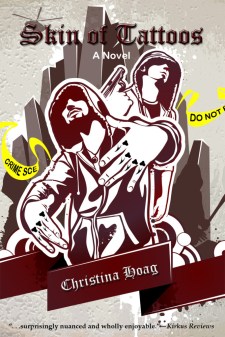 When I first started reading this book, I was thinking there are only so many stories you can tell – and that this was the one about the guy that gets out of prison, wants to go straight, can’t due to societal stigma and intolerance, so he gets back into the criminal life big time and things do not go well. The story was being told by ‘the guy’, in this case Mags (Magdeleno) a Salvadoran LA gangbanger. I was enjoying his narrative style – salted with patois that was exotic, but also familiar from all the movies and TV programmes I have seen about LA gangs. But then, as well as just cruising through the book, I started to become totally engrossed in Mags’ world; the characters Mags engages with are flawed and have agendas, which make them untrustworthy and far from predictable, and Mags himself is a complex character who makes some very bad decisions about what and what not to do. Mags’ gang is the Cyco Lokos, and while he has been locked up, the ‘shotcaller’ of the gang, Chivas, has also been imprisoned. Mags was Chivas’ lieutenant, but that place has been taken by Rico – the guy who set Mags up to take his wrap for illegal firearm possession – and with Chivas locked up, Rico is calling the shots. Although angry at this, Mags has decided to go straight, not wanting to go back inside and also wanting to grow his relationship with Paloma, his best friend’s sister. But he gets pushed back into gang action – and into confrontation with Rico. And there is a comfort in this: “Revenge is the regaining of control. There’s nothing so empowering, so elating.” But truly terrible things occur as Mags tries to set things straight and get his homies back on track, and he starts to realise that the gang code gets more flexible the higher you go up ranks. If everyone is out for themselves, who can you ever totally trust to be on your side? Even within his family, his alcoholic father, his hotshot firefighter brother, his Catholic turned Pentecostal Mother, and his sisters, one of whom has got involved with a banger from a rival gang – who will see him for who he is and not just see the gang tattoos that scream out what he is. The tattoos are a great metaphor “They were a part of me, but not the whole of me”, they are a comfort as they give Mags identity, but they are a burden as they don’t allow others to want to see who he is and to what he might aspire. Along Mags’ journey, as well as the fear and violence, there are some lovely moments: the family dinner where Mags felt “No matter what had happened in the past, I belonged at that table”, and when Mags’ clica crew sat around telling stories about a dead homeboy “til the wind blew through our clothes and the sea turned nimbus grey”. Skin of tattoos is full of the inevitability of lost lives; of those who can’t escape the deeply worn tracks of their predecessors, even those “moving up the food chain who thought they were leaving the ghetto behind when they arrived in the San Fernando suburbs, but they just bought the ghetto with them”. The sympathy Hoag has for her unsympathetic characters is effective – whenever someone does something awful you find yourself thinking not that they are bad to the bone, but that something awful must have happened to them for this to be their reality. Mags even manages to conjure up sympathy for the despicable Rico: “For an instant I felt sorry for Rico. Just an instant.” And it’s those instants that have you rooting for Mags and worrying about him – so, have a read and get to know him. This is a great debut novel from Hoag, who is an LA-based Kiwi writer.
 Warning: Not for the faint-hearted! Snark: being a true history of the expedition that discovered the Snark and the Jabberwock … and its tragic aftermath is the delightful filling out of Lewis Carroll’s poems The Hunting of the Snark (an Agony in 8 Fits) and Jabberwocky, the latter from his Through the Looking-Glass and What Alice Found There. Elliot tells of the discovery of an old journal written by the youngest crew member on the Snark expedition: The Boots. The journal tells of the organising of the expedition (and the reasons for it) right through to its end, folding in the Carroll poems along the way. This is all fun enough but the real joy of the volume is Dunedin-based Elliot’s wonderful illustrations – calling on Australian fauna for the design of his Jabberwocks and Bandersnatches, and delightfully portraying the expedition members: Bellman and his Beaver et al. As an added bonus the finder of The Boot’s journal published it some years before the present volume – which allows for a notes section at the end, made up of the many comments the author received from scholars who had studied the text. But as advised in the author’s introduction read the book before the notes. It is a lovely, lovely read – but be warned it is truly scary at the end!
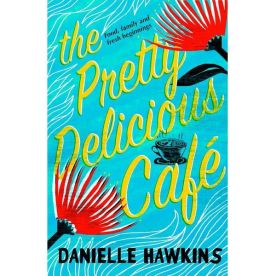 I picked up this book for a light feel-good romantic break from a run of bleak tales. It started exactly as I had hoped, but then turned into a darker yet still sugar-coated read. Set in a coastal town in northern New Zealand, The Pretty Delicious Café is the story of Lia, who runs the café of the title with her friend Anna, who is about to marry Lia’s twin brother Rob. The opening sequence is brilliant – with Lia scaring herself silly by reading a thriller – not only are we firmly placed in another genre, we learn that the twins have a psychic connection and we also meet Jed, the romantic interest. There are many great characters in the book; Lia and Rob’s hippy mum, the local mechanic, their lovely lonely half-brother, Lia’s loser ex and Jed’s delightful son, to name a few. The writing is light and witty and the story an interesting one of friendships strained under pressure but solid at their core, and love blossoming against the odds. But The Pretty Delicious Café gets pretty shocking in places and deals with post-traumatic stress; the conflict between partner loyalty and self-preservation; and what to do when love goes against societal norms – all without veering from its light romantic comedy style. The settings are finely drawn – the assumption that a beach house book collection will include “a selection of Catherine Cookson novels, The Clan of the Cave Bear and Future Shock”, and the reading choices in a hospital waiting room being “Mother Goose’s Nursery Rhymes and a March 2006 Woman’s Day”. And no matter how distracted Lia gets, she still manages to throw together a menu, and a wedding cake. Lia, Rob and Jed don’t use their real names – which links them as the main core of the story and also indicates their wanting to control their own lives. All of which gives you confidence in the characters and allows you to believe things will work out well for them – despite the dark shadows around their lives – which made this the feel-good romantic read I was looking for.
-
Archives
- March 2026
- November 2025
- July 2025
- May 2025
- April 2025
- February 2025
- January 2025
- December 2024
- November 2024
- October 2024
- September 2024
- August 2024
- July 2024
- June 2024
- May 2024
- April 2024
- March 2024
- February 2024
- January 2024
- December 2023
- November 2023
- August 2023
- July 2023
- June 2023
- May 2023
- April 2023
- March 2023
- February 2023
- January 2023
- December 2022
- November 2022
- October 2022
- September 2022
- July 2022
- June 2022
- May 2022
- April 2022
- March 2022
- February 2022
- January 2022
- December 2021
- November 2021
- October 2021
- September 2021
- August 2021
- July 2021
- June 2021
- May 2021
- April 2021
- March 2021
- February 2021
- January 2021
- November 2020
- October 2020
- September 2020
- August 2020
- July 2020
- April 2020
- March 2020
- February 2020
- January 2020
- December 2019
- November 2019
- October 2019
- September 2019
- August 2019
- July 2019
- June 2019
- May 2019
- April 2019
- March 2019
- February 2019
- January 2019
- December 2018
- November 2018
- October 2018
- September 2018
- August 2018
- July 2018
- June 2018
- May 2018
- April 2018
- March 2018
- February 2018
- January 2018
- December 2017
- November 2017
- October 2017
- September 2017
- August 2017
- July 2017
- June 2017
- May 2017
- April 2017
- March 2017
- February 2017
- January 2017
- December 2016
- November 2016
- October 2016
- September 2016
- August 2016
- July 2016
- June 2016
- May 2016
- April 2016
- March 2016
- February 2016
- December 2015
- November 2015
- October 2015
- September 2015
- July 2015
- June 2015
- May 2015
- March 2015
- February 2015
- January 2015
- December 2014
- November 2014
-
Meta
 alysontheblog