Miller Hatcher is getting over a relationship and the recent death of her mother, with the help of alcohol, when she gets the opportunity to write a feature story that might land her the job of head reporter for the national magazine she works for, First Look. Sergeant Kahu Parata is a local cop at the small Coromandel town of Castle Bay, where Miller will hopefully write her masterpiece. Kahu knows all the locals and turns a blind eye to some of their misdemeanours, and he is annoyed when a team from Auckland are sent to work the case that Miller intends to cover – the discovery of the body of a missing tourist, Bethany Haliwell.
Miller in her sensitive state, and Kahu with his local knowledge, end up trying to get justice for Bethany amidst the prejudices and complacency of the locals, and the arrogance and impatience of the outsider cops and journalists. The only place Miller can find to stay is a local retreat, Haven, and when another woman goes missing from there, the possibility that the murderer is still around the town increases.
Nothing bad happens here creepily highlights the level of danger women face in our society – how so many people can become suspects when harm is done to a woman, and how often women don’t feel able to come forward and speak out about abuse, but just put up with it as part of life. It also – echoed in its wonderful title – deals with the tendency of tourist spots to downplay local danger in order to maintain business, the irresponsibility of the press when boosting circulation comes before reporting facts, and the way people are drawn to gruesome tragedy at the same time as being repelled by it.
It is a well plotted mystery, and just when you think you have guessed the final twist you are gazumped with a totally unexpected scenario. The characters are great, and are given enough background to give you a chance at understanding some pretty outrageous behaviour. I particularly liked Miller, she rapidly moves from being just one of the visiting journalists to being a concerned human being, and at times works more like a PI than a journo, and her compassion for the victims stops the story from just one where the female body count keeps clicking up. The writing is very straight forward, but this in a way works nicely against the complex plotting. A good New Zealand murder mystery.
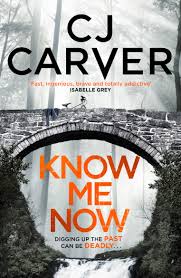 In Know me now, partial amnesiac Dan Forrester is back, back in another adventure for our enjoyment, and also back with his wife, Jenny, and their daughter Aimee. The family is eagerly awaiting the imminent birth of Dan and Jenny’s second son. Dan is also dealing with the sudden death of his father, Bill, who was visiting Germany when he had a massive heart attack. In the midst of making arrangements for the repatriation of his father’s body, Dan hears that his 13-year-old godson, Connor, has also died. Connor’s death is being dealt with as a suicide, but the local doctor in the Scottish village where he died is not so sure. Two deaths so close together – and as the delightful DC Lucy Davies says: “In my job, we don’t believe in coincidences”.
 the Hokitika goldfields. He has been making a nuisance of himself in Hokitika and other gold mining areas, trying to gather information about the infamous Burgess Gang – Richard Burgess, Philip Levy, Thomas Kelly and Joseph Sullivan. The man is obsessed with the case, Burgess, Kelly and Levy having been hanged years before. As an ex-journalist (hence the alcohol problem) he has stumbled across information that makes him doubt the evidence of Sullivan – the fourth member of the gang – evidence that was used to convict the other three. Once he realises he will be held in the asylum until he can prove his ravings about the case have a logical and fact-based foundation, he sets about to record his research and his findings. Not a straight forwards task when: “The reader should be aware … that members of the criminal classes can be consummate liars”.
 A hostage crisis in the small Otago town of Lawrence in the South Island goes horribly wrong. A woman is shot, her children traumatised, four guys are fatally shot by police snipers, and another is killed by an explosion that blows the house to smithereens. Not only that, the father of the house has been taken hostage, and he and his kidnapper have headed into the bush.
 words – from conversations, from the Internet, from TV and movies – wrote The beat of the pendulum. The title comes from a Proust quote, where he described novelists as ‘wildly accelerating the beat of the pendulum’. There is an actual pendulum in Chidgey’s novel, it is of the old style that needs adjusting occasionally for it to keep time accurately, and the year of the novel – 2016 – had to have a second added to make it a full year. Time may be adjusted for accuracy, but it is inexorable.
 Why do people become obsessed with places, things or other people? What has evolved in us that enables us to continue to desire unrequited relationships, when to do so brings great suffering to ourselves? And what hyperactive flourish of male arrogance through the ages has ended up with the cruelty men are capable of towards women?
 on a cold case. A skeleton is discovered by an idiot looting houses that have been evacuated due to the hills of Christchurch being ablaze. The skeleton is in a shallow grave, and from a protest badge close to the remains, appears to date from the time of the 1981 Springbok Tour. An autopsy finds evidence that the young man was killed by a Police baton. Added to this, when the deceased is identified it looks like the investigation into his death was virtually non-existent. So, was this a cover up of Police brutality? As Blakes investigates, she discovers divisions between families, the racism that is still alive and well in our society, and the sad and complex lives of those whose lives don’t fit “the norm”, like the victim: “A prince of oddities in a community where being the same is a commodity”. Sam, the victim, had a girlfriend, Shannon, who has served 15 years for brutally killing two teen-aged boys. Shannon’s father is wracked with guilt over something. Down in Dunedin a Christian counsellor is helping men stay true to the lifestyle God intended for them. How does this all fit together? – wonderfully. The only secret left to keep is a cleverly plotted and sad satisfying mystery, one you have to think your way through to put all the pieces together. And the unravelling reveals more of Blakes, her traumatic history, and her determination to face her demons. You could read this as a stand-alone, but I am glad I read the series from the beginning.
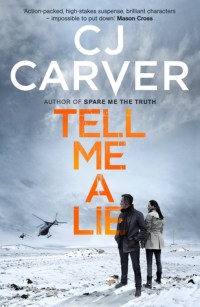 After reading Carver’s Spare me the truth, I was really looking forward to the second in her Dan Forrester series. And for brilliant plotting and a full on adrenalin read, Tell me a lie didn’t disappoint. There is one coincidence the size of Russia in the plot, one which I found myself trying to rationalise throughout most of the novel. But that aside, it is a great yarn, and the interesting characters from the first installment are all back. Dan Forrester is still suffering from his patchy amnesia, but he now knows he was a spy, and has remembered some of his craft. He is working for a ‘global political analyst specialist service’, and travels to Russia when a previous espionage contact says they have vital information, but will only speak with him. Meanwhile, the wonderful synesthetic PC Lucy Davies is also back and as irrepressible as ever, as is her slavishly devoted soon to be future boss DI Faris MacDonald. Lucy gets called into what appears to be a cut and dried case of familicide – but is not so sure the prime suspect is guilty. Lucy starts to put a few random cases together, and that suggests a much bigger disaster is unfolding. Meanwhile we get to learn more about Dan’s wife Jenny, their young daughter, Aimee, and Poppy the RSPCA re-homed Rottweiler. All the above become embroiled in a conspiracy that goes back to the horrors of Stalinist Russia, and which has spread across the globe. It involves sadistic Russian oligarchs, beautiful women trying to do the right thing, feisty women trying to save their own lives and the lives of others, and lots and lots of danger. And if you buy into the logic of the conspiracy, there are intriguing future possibilities which emerge at the end of the novel. So roll on number 3 in the series!
 Jarulan is a sprawling saga sporadically following the Jarulan residents from before the First World War to the present. Much of the physical character of the mansion house and surrounds is the legacy of the American, Min Fenchurch, already deceased at the opening of the novel. Min met Matthew Fenchurch, the heir to Jarulan, when they were both on an OE in France. Min suffered from being confined in remote Jarulan, to the point of bouts of madness, and she imported large marble statutory of Greek and Roman gods and Catholic saints for the house and gardens – all of which observe the waxing and waning of the generations.
 Three young people, one mistakenly named, two self-named, have all experienced childhood trauma. As a result they feel abandoned, are haunted by horrific memories, or experience hyper-sensitivity due to early injuries. All three are extremely gifted: either with beauty, with inventiveness, or with imagination. All suffer from depression and tend towards self-harm, from milder forms of self-abuse through to suicide.
