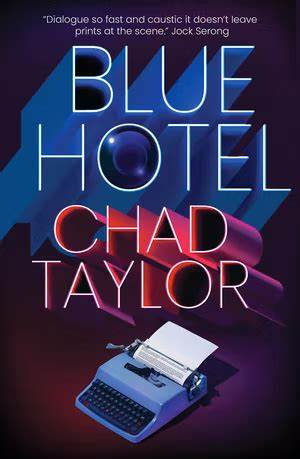
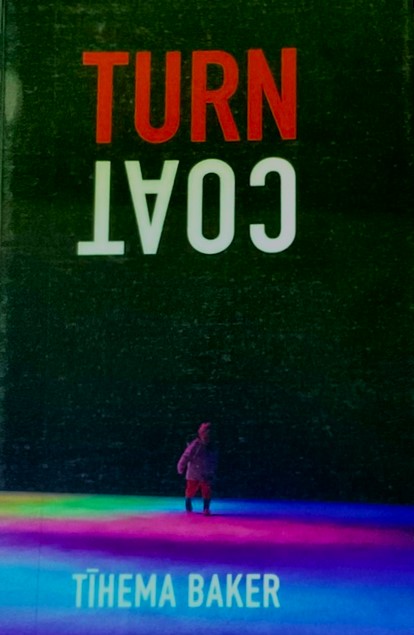
Blue Hotel by Chad Taylor – 2022

If you want to cruise through a tale of classic noir, Blue Hotel is the book for you. The late 1980s, a busted up “old fashioned reporter”, an underbelly of sex-traps and blackmail, characters being hidden away in a mysterious psychiatric hospital. The privileged rich paying their way out of grief and covering for damaged children, and a plot so complex you lose it before it is all drawn together. The plot including a ‘vamp’ – a goth, or maybe a series of them: Blanca, Krystal, Amber, Cherry, Veronica …

The first to lure Ray Moody into the story, is Blanca Nul. She is Danish and makes herself memorable before disappearing, and her disappearance causes quite a stir for journalists, “a missing female tourist was gold”. Most leads as to her whereabout are to nowhere, and the story dies. Then a year later a woman looking and acting like Blanca Nul is seen again – but is it her? Ray, in a characteristic slump, is determined to find out the truth – mainly as a distraction from the wreck of his life.

Ray is pining after his wife, Eva. Is she dead, with someone else, just somewhere else? Her story drips into the main plot from time to time, and she is never far from Ray’s mind. Ray finds solace in drink, before getting badly injured in a car accident. He tries going straight, attending meetings set up by the charitable Welkin Foundation. A lawyer connected to the Foundation has helped him and many of his fellow addicts. Ray continues with his enquiries into Blanca’s disappearance, despite having lost his respectable job for the Examiner and then his less respectable job for the Beacon.

Ray hobbles around on a bum leg, wearing a wrecked overcoat, driving his beat-up car through “New Zealand … a series of wildernesses connected by fast roads”. He has some helpers, such as a librarian who works late watching porn on a computer. Ray prefers microfiche when looking for links between players – he’s got no time for computers and is glad the “news would always be in print”. Another of those who help Ray is an ex-cop, bearing the consequences of living a double life. He’s working for a security company, the same company that seems to turn up everywhere Ray does.

Ray follows the leads he finds, and he ends up in some strange places: in abandoned night clubs, in the homes of the wealthy, in a soup kitchen, in a BDSM dungeon that used to be a pet shop – the owners making the logical shift when they noticed some of their customers were “looking at the large breed gear”. He starts linking people, companies, and proclivities together. “The world was nothing more than gradations of shade: one big long slide from light to dark.”

Ray is careful not to fall into the trap of inadvertently being bribed or being played, but maybe … The plot has people taking on others’ identities, people who have made one bad decision that repeats until they find they are a person they don’t know anymore. People who are addicted, desperate, scared. The title of the book is yet another ambiguity, is it a code for suicide, the scene of a crime, or a place of hiding?

The characters in Blue Hotel are great, finely drawn, and you wouldn’t want to spend time with any of them – unless perhaps the kind-hearted vampire who works as a minder for one of the goths. It is a pacy novel with plenty of tense moments, some in fast cars on wet greasy streets, others in very dark places. The rain is relentless, and the run-down environments are tactile. The plotting builds, goes haywire, and then gets pulled together.

The reader starts to think there are maybe a few too many coincidences, and then remembers the novel is set in Aotearoa and “New Zealand’s such a small country sometimes all you need to do to create a conflict of interest is walk into a room”. And more sinister is the fact that there may be strands of the story that are manipulating Ray, rather than him driving the plot. And who cares anyway when we happen upon lines such as: “In this business it’s all about being close to the ground and Richard could crawl under a snake.”

I loved reading Blue Hotel #YeahNoir!

Posted in #yeahnoir, Book Review | Leave a comment

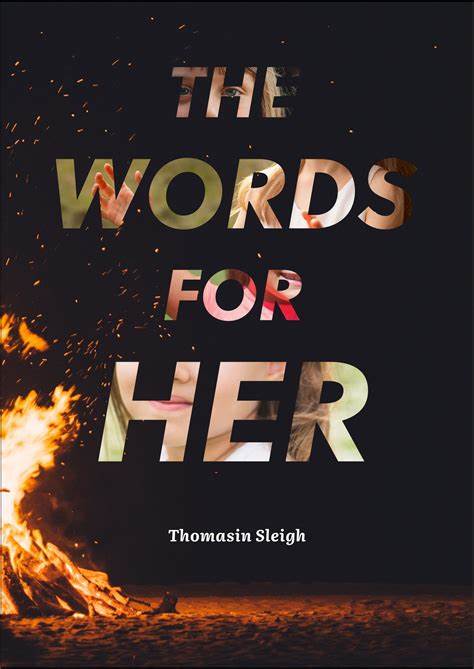
The Words for Her by Thomasin Sleigh – 2023

The words are pouring out of Jodie Pascoe, she is desperate to get them down, to tell her story. She needs to describe her daughter Jade. The words are for her blind father, who always wanted her to “to tell him what was happening and what things looked like”. The words are for herself. The words are for the world – as words are increasingly all there is. Images are going, the gaps are multiplying. Jodie is telling the story of what happened, how the world started to fall apart.

The words for her is one of those wonderful books you read many ways. It is a sci-fi mystery, a who-done-it, and a thriller: “Who were we running from? What were we running towards?”. But it is also deeply disturbing social commentary. Telling the story of how increasingly we only exist as our digital images, we only exist online. A strange epidemic is spreading geographically and demographically – eventually reaching for the unborn and the dead. People are scared, and governments are scrambling to understand what’s happening. In the vacuum of scientific knowledge, the rumours start – spreading fear and uncertainty.

When I first started reading The words for her I was so full of questions, and just like the characters, I was impatient to know what was going on. But as the story progressed, I was continually surprised by the logical chaos that was unrolling once the ‘gaps’ appeared. International travel, law and order, politics, international relations, education, social cohesion, all fading away like the images in photographs and on video. Businesses closing with the collapse of international trade, and with the depletion of staff. All so reminiscent of the Covid responses around the world. “Everyone was turning inwards. Countries were turning inwards.”

And reminiscent too are the deep divisions within society. With the government responses to the ‘gone’ getting more and more oppressive. And the various responses from the affected; camps and refuges being set up – some as a way of supporting each other away from their increasingly hostile communities. Others becoming increasingly hostile themselves, “Gaps have rights too”. On the one side everyone is constantly taking pictures of themselves, their loved ones, each other – on the other are those carrying mirrors so they can at least glimpse their image occasionally.

A theme running through and driving the plot is the vulnerability of women. Their invisibility in society, their victimisation by insecure and controlling men: “I wanted him to look away, to stop seeing me so that he wouldn’t get angry”. Men who are willing to betray, who only look out for themselves. Contrasted with this is Jodie who would do anything to protect her daughter Jade from whatever it is that’s happening to the world, who is trying to help her parents in the crisis. Jodie who has been speaking her words describing things to her father, who has been blind for 20 years. Jodie who uses the magic of words to hide behind, to confuse people.

“It felt like a contract had been broken.” The total disorientation of the events is captured well in this book. As is the power of language, how richly we could communicate if we wanted: “A word can mean too many things, a ‘star’ is a starfish, a light in the sky, and a necklace, and everyone sees something different in their mind.” But how vacuous we have become under the sway of social media. And the contract of a routine life is broken, as Jodie’s finances reach crisis point: “I looked up at the sky, holding back tears. Seagulls circled overhead.”

The thriller aspect of the book also works well. The breakdown of society coming closer to home for Jodie; a house ransacked, her car being followed, mysterious men asking about her. Jodie becomes suspicious of herself, of what she had done, as well as of everyone else. As histories become re-written, she increasingly worries about exactly what her friend Miri forced her to do that night on the beach …

The words for her is inventive, thought-provoking, engrossing and a really good read.

Posted in #yeahnoir, Book Review, Science Fiction | Leave a comment

You Are My Sunshine by Octavia Cade – 2023

You are my sunshine is an anthology set in a completely recognisable world of ecological and environmental collapse, brought about by corporate greed and general apathy. But as brutal as the descriptions are, it is a hopeful collection, even if that hope springs from pragmatic necessity. Many of the stories take place during the wilding of cities, overground and underground, using the ‘coral’ of their broken infrastructure to create reefs of life. “The reef was a metaphor, when the future came, it was the only metaphor that mattered.”

María Pía Lara writes of using old stories in new ways, to shock readers out of their hopeless numbness caused by atrocities – to enable action to resist. Octavia Cade is using stories the same way regarding anthropogenic environmental disasters. For example, the trope of human sacrifice to appease and balance: “We feed the bears of fire and ice, we feed them lies, we feed them twice.” And a retelling of Kafka’s Metamorphosis: “I wonder at the selfishness that made us think houses should be homes for nothing but people.”

The rhythm through all the stories is that of shame and then action, “Look at what we woke. Look at what we woke in us.” The items uncovered by melting ice, the horrors witnessed by those researching ecosystems. Readers of Cade’s previous works will recognise those who succumb to the Grief, and those who form underground activist networks to protect shameful truths. In this anthology there is a re-envisioning of relationships – there are those who sacrifice themselves, or parts of themselves, for other species, rather than have their sanity turn “to salt water and suicide”.

“When fish stocks collapsed the sea birds went with them” – in the stories the ghosts of the lost remain, haunting people to despair or to action – either on Earth or elsewhere. One story highlights the impossibility of the latter, humans are Earthlings, with deep connections to the land and ecosystems, on a sterile planet, “the sheer towering emptiness of the place was something to shrink from, not fill up”. However, there is also a story, my favourite I think, about ‘bioforming’ planets. Again, it is a story of individual sacrifice, and of coming to terms with your opportunities, “… her lips and the corners of her eyes, tickling under tears” … “it’s been marvellous”.

There are also tales of heartbreaking sacrifice, but even then there is the solace of continuity, a woman grieves for her child, and the grief is not less when others benefit, but the mother knows her daughter “had been able to make her own contribution”. Throughout the stories is the yearning for connection. AI is mentioned, the caring programme who “lacks imagination, fails to appreciate quirk”, and is stuck dumb with the realisation of its own isolation. And the bereaved: “I find myself explaining pollen to the goose” – later walking forwards then backwards on a mudflat to look at the footprints and imagine there are two people walking. Grief arising from the spread of disease vectors and illness, and the loss of loved ones, “You are missed”.

And there is connection not only to other individuals but to the environment. The granting of legal personhood to rivers was a different move entirely from its precedent: personhood given to corporations. “The rivers aren’t a ducking stool, but they’ll do for all that. There are always people in need of drowning”. It is a book about growth and change: “Littoral environments are not what they were. Then again, none of us are.”

Although You are my sunshine is about catastrophic collapse, it also a comforting read, “boundaries are based on accidents of biology, based on shades and degradations of greed”, boundaries can be re-drawn or erased. Two children are growing up in a wilded city: “There were kākāriki in the woodland that had been the town square, and a woman gave them pieces of honeycomb from the library hives.” I loved reading You are my sunshine.

Posted in Book Review, Science Fiction, Short Stories | 1 Comment

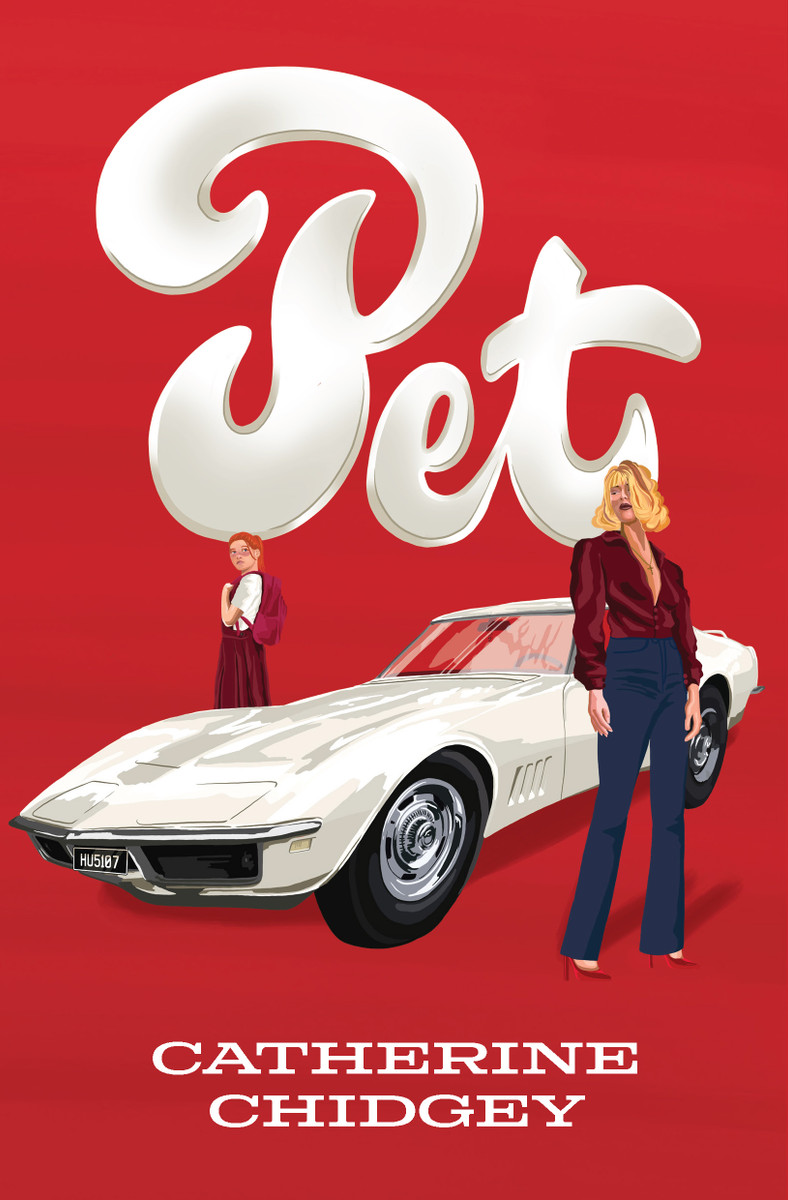
Pet by Catherine Chidgey – 2023

“We would have done anything for her”: Mrs Price, a glamorous teacher in a Catholic primary school in the 1980s, who has her students in thrall. They yearn to be her pet – a position bestowed randomly on a chosen few, and often withdrawn for no reason. Justine is twelve, her mother has recently died, and she longs to be among the chosen. The story of her and her classmates is one of manipulation, cruelty, and grief. It is told in retrospect by her adult self in 2014 – her memories prompted by a nurse in her father’s nursing home having an uncanny resemblance to Mrs Price.

For bullying and jealousy to thrive in the school, there is no need for Mrs Price. The prettiest girls have a clique. Most of the girls have a crush on the most attractive boy, who is cruel and arrogant, and has an entourage. Racism is expressed openly, often to get a laugh. The children are at the edge of puberty – “Blood was coming” – they know their year of being the oldest cohort is coming to an end. They are children but aware of right and wrong, and there is often conflict between their wanting to belong, and their knowing belonging will mean not doing the right thing. But with Mrs. Price exploiting these cruel inclinations and rivalries, the kids don’t stand a chance.

Justine is so finely drawn; she finds pieces of her mother’s writing around the house, but they start to fade away, just as Justine’s memories of her mother are fading – as events in the story start to get out of control, Justine desperately searches for her mother’s words for guidance. Justine has a close friend, Amy. The girls are almost inseparable, but a wedge is pushing down between them. Justine is torn between having Amy or Mrs. Price in her life – she can’t have both. When the latter seems possible, and Amy asks her why she is lying about Mrs Price, Justine weakly replies, it is because if she tells the truth, “She might not like me any more”.

The reader really wants to help Amy, a child who is losing her friend, and who can’t find anyone to be on her side. Another sympathetically drawn character is Dom. Dom is kind, considerate, and sensible – but then we are reading of him through Justine’s memories, so maybe a rose-tinted view? Pet has the reader often wondering about the reliability of memory. Justine’s memories are of a time when she was grieving for her mother, and she also has a condition that sometimes blanks out her knowledge of events. There is a stunning ambiguity in the text at one point: “And then she said I …” committed a crime – who is the “I”, the speaker, or the person reporting what they said?

There is physical cruelty in the book, at one point Mrs Price illustrates biological regeneration by getting a child (as a punishment!) to maim a live animal. But it is the mental cruelty which is incessant. The children writing: Why don’t you kill yourself, I hate you, I wish you were dead, etc. to the scapegoat of the moment. Mrs Price openly accusing a child of theft, shaming them in front of the class – forcing each child to declare an opinion. And her marking schoolwork subjectively, depending on who she fleetingly happens to like.

There is a vacuum of adult support when any of the children finally asks for help. From the headmaster, staff, from the clergy – even from parents who just want their child to “see out the year without making waves”. It is a book about sacrifice; the sacrifice of forgoing some of the things you want so you can do right by others – or failing to do so. And throughout is the sacrificial symbolism of the Catholic rituals. And the symbolism of Catholic art, which produced for me the most moving sentence of the book: The serpent under the feet of St Michael: “its mouth open to receive his golden spear.”

The manipulation of children, or of anyone, to the point where they are welcoming of abuse is disturbing and enraging. Pet is a tense read, one where readers know early on that there are some awful events ahead. And they come to know that Justine has been haunted by insecurity about her childhood experiences since she was twelve. Memories might be unreliable, but they are also unavoidable. Like that single strand of Mrs Price’s hair caught in a seam of Justine’s clothing – “not even washing had dislodged it”.

Pet is beautifully written: the fading of Justine’s mother’s writing, Amy’s family’s garden gradually succumbing to weeds and disorder. Yet other things persisting: the trauma of a nun who had witnessed the shooting of her whole family, the longing of a woman who was abandoned by her mother as a four-year-old, the innocence and cruelty of children, how malleable people can be due to their yearning to be noticed, to be part of an inner circle. Pet is also a murder mystery, and it is plotted accordingly, with some thrilling moments – mostly to do with a locked room! Pet is an amazing combination of genres, and I can’t recommend it highly enough!

Posted in #yeahnoir, Book Review | 2 Comments

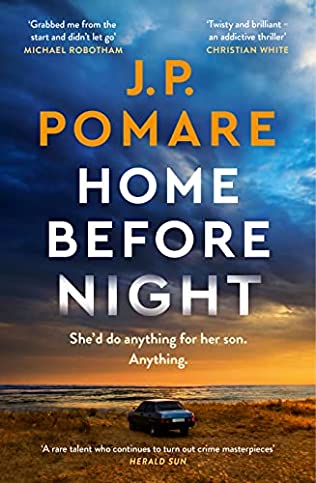
Home Before Night by J.P. Pomare – 2023

Lou is a good judge of character – she was a Customs Officer at the airport before yet another wave of “the virus” sent Melbourne back into lockdown, and she was made redundant. Her life now revolves around her nineteen-year-old son, Samuel. She’s suspicious of his girlfriend, Jessica, knowing instantly her perfect manners and sweet smile are fake. But despite her misgivings, she hopes that Samuel is staying with Jessica when yet another lockdown is announced, and he doesn’t return home in time for the eight-o’clock curfew. When she can’t contact Samuel at all, she starts to panic, despite Samuel’s father, Marko, telling her it’s just the alcohol she’s quaffing.

Lou is an interesting character, aware that the life she feels nostalgia for, is “a life I never really had”. Samuel is her focus, yet she is realistic about him and knows he is of an age when he will soon strike out on his own – hopefully eventually with a granny-flat for her. Lou thinks she has raised her son well: “I’d always, always, taught him to do the right thing, to be honest.” Samuel does contact her, but her instincts tell her something is off: “I’m trained to spot these things”.

Getting no help from Marko, who now has a family of his own and sees Lou as a nuisance that threatens their stability, Lou contacts a private investigator to help her find out what has really happened to Samuel. When they find out things are seriously amiss, the PI encourages her to contact the police. The reader discovers there are reasons why she is reluctant to do that, multiple reasons in fact – and finds that Lou herself might not be following her own advice regarding openness: What if the truth doesn’t set you free?

The setting of a pandemic lock-down adds a dimension of claustrophobia and familiarity to the atmosphere. And this is a ratcheted-up lock-down, with police and the military patrolling the streets. And despite there being plenty of traffic around, there are few pedestrians, so being followed home from a permitted exercise session, or seeing the shadow of someone at your door, are very creepy experiences.

The plot races along, with plenty of mis-directions, and reveal after reveal. The reader (well this one anyway) finds themself going back to re-read bits to see how they have misconstrued events. Lou really is the main character, the only other one that gets some depth is Samuel, but fleetingly. Marko is manipulative and selfish, and hard to understand. We find out a bit about Jessica, but don’t get to know her. Given the seriousness of the subject matter, and the horrendously bad decisions that have been made, only seeing things from Lou’s, unreliable, point of view means that heavy subjects are glossed over.

The most disappointing thing for me about Home Before Night is that I read it in paperback form, where almost a third of the book is a “sneak peek” at Pomare’s next novel. So, I was mentally unprepared for the novel ending where it did, as I was holding the heft of the remainder of the book in my hand. I was fully expecting more reveals and twists to come. Despite this, and some lack of depth in the novel, Home Before Night is a good atmospheric twisty thriller. 

Posted in #yeahnoir, Book Review | 1 Comment

I, Object by Stella Chrysostomou – 2023

A mechanic in one of Eliot Pattison’s Inspector Shan novels, set in Tibet, sees his job as facilitating the reincarnation of motor vehicles, patching them into their next incarnations. Stella Chrysostomou similarly gives life to jewellery objects in I, Object, giving them a voice to tell us of their lives and their aspirations – “I wanted to be loved forever.”

The selection of objects is inclusive, from unique gems to rank-and-file links, from rare pearls to humble clasps. We read of their adventures, triumphs, and joy, but also of the boredom of days spent in: “So many darks” – the dark of boxes, of velvet bags, of pockets, and of dirt. There are love affairs between objects and their makers and bearers, but also the heartbreak of rejection and discarding, “to land unnoticed on wooden floors, on linoleum, on the outdoors of your childhood”.

The avarice of humans is throughout the book, the acquisitiveness, the greed in their eyes; “Apparently, I am worth something.” There is a string of heists woven through the stories, based on real events, where jewels are grabbed and fenced by differing methods. In contrast to human randomness are the earnest pieces, “We are honest workers”. They are always trying hard, although perhaps occasionally considering rebellion, like the clasp who wonders about “Just letting go”.

The pieces relate to each other, they have hierarchies and loyalties, and are also aware that other might “tarnish your reputation”. They know the agony of creation; the tumbling, cleaving, and sanding required in the hopes of not being cast aside, of being able to say: “We had made the grade”. There is the loneliness of your fellow earring being out of sight. The resentment when further charms are added to a bracelet. The occasional weariness of being a symbol, “I get tired of holding my arms out all day”.

I, Object makes the reader, if a jewellery-wearer, aware of their own un-worn treasures. I often think of two anniversary pieces long lost, but this book made me think of the losses from their point of view – one ring lying hidden in the dirt of a property in Rarangi, the other wedged somewhere in between the bleachers of the Richmond Aquatic Centre.

The stories are varied, some even in verse, and the book has extensive explanatory notes. There are tales in the style of Melville, Dickens, and Dostoevsky – “If only he hadn’t lost at the card table”. The collection is whimsical and delightful, the objects in the stories often “the only spark of brightness”. As well as uniqueness and life-long relationships, it evokes mass production and often soul-less consumerism “how would you like it if you were just treated like a thing? An object”.

Posted in Book Review, Short Stories | Leave a comment

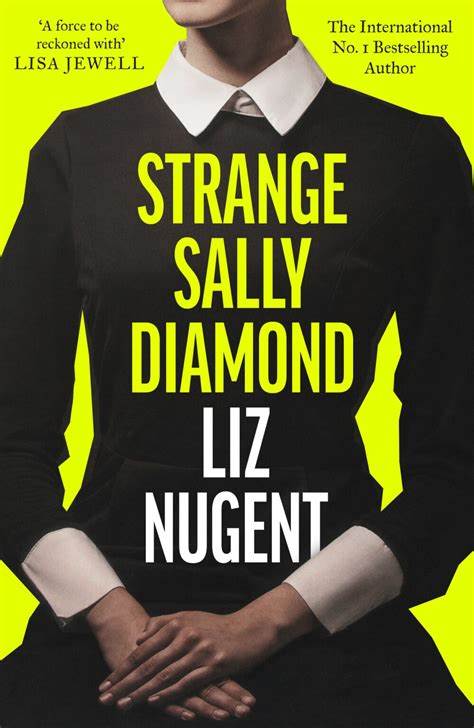
Strange Sally Diamond by Liz Nugent – 2023

Sally Diamond lives on the outskirts of the village of Carricksheedy, Ireland. Peter Geary is living in Rotorua, Aotearoa New Zealand. Sally is in her 40s, she has been living with her father since her mother died when Sally was eighteen. Her father has kept her quite isolated, due to her being “socially deficient”. Peter was 14 when he and his father arrived in Rotorua, his father keeps him isolated for his own good, telling Peter it was because of his rare health condition: “Dad obviously had a kind heart.”

Sally doesn’t like engaging with others, often feigning deafness during her brief trips into the village. It is only when her father dies that the extent of her disconnect with the world becomes apparent. Sally knew that her parents were not her real parents, but after her father’s death she, and the reader, learn of her unconscionable origins. She receives support as well as death threats – “Hell is where you belong” – from the community. The support comes mainly from those who themselves experience prejudice and bigotry.

We read of Peter as a child in Ireland, and his disturbing interactions with “the ghost” in the locked room next to the one he is often confined to. We read with horror the behaviours he picks up from his father – due to his isolation he has no other role models. When he fled Ireland with his father, Peter did start to wonder about his situation, and when in Rotorua he openly questions his father’s misogyny and racial prejudice. However, there is a fair amount of wilful ignorance about Peter, he only finds agency when he discovers just how deceived he has been.

It is hard to write a review of Strange Sally Diamond and not give away any of the ‘reveals’ of the plot – and that would be unforgivable as it is such a gripping experience to read the book without knowing anything about it. As you read, a complex story unfolds. A story of abuse spawning abuse, of men controlling women and children with physical abuse, mental abuse, and drugs, of the awful plight of young children and young women, of unimaginable cruelty. It is also the story of extraordinary patience and kindness.

As enthralling as the plot is, it is the characters that move the story. As you read, it is hard to tell who is attentive to Sally because they are kind and who because they are psychotic. Who is Mark who appears suddenly with an almost unhealthy interest in Sally’s past? And who sends her Toby the teddy bear? And why does she have such a strong reaction to the bear? The character of Sally Diamond is a brilliant creation, with her idiosyncrasies making her both endearing and downright terrifying.

The arc of Sally’s story reminds me of that of Charlie in Daniel Keyes’s Flowers for Algernon. As she progresses, she is funny: “Honestly, between therapy and yoga and learning to caress myself, I’ve enough on my plate.” She starts to flourish: “I liked the faint crinkly lines that came from the corners of my eyes when I smiled at myself. I was beautiful”. She starts to despair: “I finally had someone who was mine. I loved him, I wanted to protect him and keep him to myself. I couldn’t have known what he was capable of.”

Peter’s progression is in a minor key and raises questions about whether a person can be created solely by their experiences. Where do extremely bad, and exceptionally good, abilities come from? Peter is relatable but reprehensible. He is raised to think he is special, and he leans into his privilege while knowing right from wrong: “all three of them came out to play, both in my nightmares and in my waking hours … I could have saved them all.” He has that astonishing ability to assume what someone wants and be amazed when they are not grateful when he provides it, “‘I love you,’ I said as I locked the door behind me.”

There is a section in Strange Sally Diamond when the twists stop, when all is explained and when stories match up, almost – the reader knows when self-interest enters the re-telling of events. It is a puzzling time as you read this section, as though a time bomb is about to go off. There is comfort in thinking all the events are explainable, all originating from specific circumstances. And then the tragic tale picks up again, and the reader wonders once more if that is true – are the characters’ histories really a satisfactory explanation for their behaviour?

Strange Sally Diamond is a great disturbing read that haunts you long after you finish reading. It is sad and awful but also manages to be funny, and the author has some fun with a couple of the surnames in the text. There is a good sense of place in Ireland, London, and in Aotearoa New Zealand, and as the story spans many decades, there is a sense of time as well, with the Covid 19 pandemic featuring towards the end.

Part of the horror of Strange Sally Diamond comes from the duration of the various crimes. They are not crimes of passion; they are a way of life for the perpetrators: “The need for connection could never be satisfied by strangers”. The ending of the novel is exceptional, answering the question of nature versus nurture in a creepy way, by way of a piano and Toby the teddy bear!

Posted in #yeahnoir, Book Review | 1 Comment

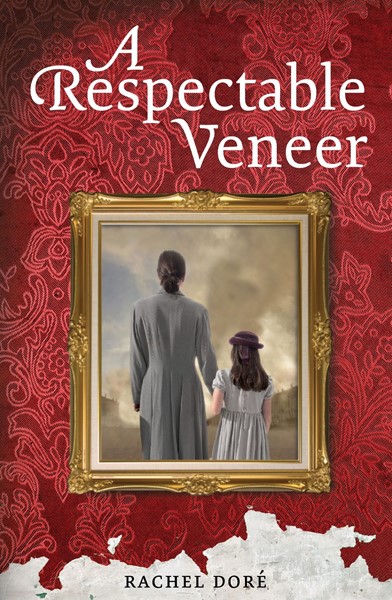
A Respectable Veneer by Rachel Doré – 2023

“When she and Edie had stepped out of the railway station, she’d stepped into a different country. Palmerston North seemed an innocent, shallow place.” Ruby has fled Auckland with her ten-year-old daughter, hoping to start afresh. But with little money and only the clothes they are wearing, Palmerston North proves to be not so innocent, and the horrors of Ruby’s past not so easy to escape.

A respectable veneer is a portrait not just of a desperate woman and those she meets, but also of a time and place – 1950s New Zealand. With World War Two a recent memory, and causing ongoing trauma, the characters are a mixture of those who are optimistic and those who are despairing. There are those making a new start, and new plans, and those who are bitter over the loss of a loved one, or of lost opportunities, of necessarily abandoned future lives.

Ruby is a damaged woman, having grown up in fear, having had a child in a far from loving environment, having had to escape abuse where she should have received comfort. When she did find a place, in Freemans Bay, Auckland, she knew it wasn’t ideal, and that some would see her choices as reprehensible, but she had no idea how bad things would get. And for a while she had the friendship of a woman called Angel. In the end it had been Angel who helped her and Edie escape. When Ruby arrives in Palmerston North, she is traumatised, brittle and sharp-tongued, and she doesn’t trust a soul.

Having been victimised since she was a child, Ruby is not surprised by lecherous possible employers, or bitter judgmental women. She eventually grows to like some individuals, but knowing her circumstances could bring trouble to them, she can be quite cruel towards them. She is attracted to the Bon Brush man, Douglas, and to the hat-shaper, Janice. She is in awe of Madame, a stylish Albanian refugee with a sad history, and she has a sparring relationship with Frank, Douglas’ friend. And of course, she has rambunctious Edie, but: “As much as she loved her daughter, there were times…”

As the plot unfolds, Ruby ends up “holding onto each day with her fingernails”. The anxiety and concerns of all the characters, are seen against the backdrop of a society trying to rid itself of war. There is the ‘New Look’ fashion: “her smart blue coat, which fitted at the waist, flared from the hip and swung as she walked”. There are the movies with their glamorous stars, and an excuse to openly cry. And there are the jazzy expressions, not quite as coarse as those left behind by the American servicemen, but “Crikey dick!”

Just as Ruby arrived in Palmerston North wanting to think she had left the bad things of Auckland behind, servicemen arrived back from the war wanting to think they had left the horrors of war behind. You were a “commie” if you didn’t stand for the Queen in the cinema. The men had served their time and wanted things their way; “No one would take the word of a woman.” There is a head-in-the-sand attitude that “These things don’t happen here”. Not an environment in which anyone out of the ordinary can thrive.

Ruby is a great character, quite unpleasant in many ways, yet very sympathetic. She is trying so hard to fabricate a life for herself and Edie, just as she is constantly making clothes for them – things to make them appear they belong. Her friendship with Douglas and Frank is fragile; Frank has been physically injured during the war, both he and Douglas psychologically. Douglas stammers whenever he is putting on a front, which is most of the time, which infuriates Ruby, and the reader; “It took an effort not to despise him for it”. Wrapped up in his own sad situation, Douglas is so naïve about the dangerous place society can be for a single woman with a child.

As her past catches up with her, things close in around Ruby. The danger she has put herself and those she loves in, and seeing news of what happened to Angel back in Auckland, hits Ruby like a brick and she starts falling apart, “everything seemed scrambled”. As the tension builds, she becomes even more quick to anger, taking out her anxiety on all, including Edie. Then you remember Ruby is just a young woman who has never had anyone to look after her, something she craves. And she is not alone; all the characters want to find someone to blame for the tragedy that unfolds.

A respectable veneer is a great historical novel with a thriller element. A respectable veneer might be what Ruby is wanting, but the clever ending suggests that that it is what the whole of New Zealand took on after the war – most New Zealanders wanting to enjoy the post-war peace, rather than remember what that peace had cost, or acknowledge those left by the wayside. A great debut novel.

Posted in #yeahnoir, Book Review, Historical | Leave a comment

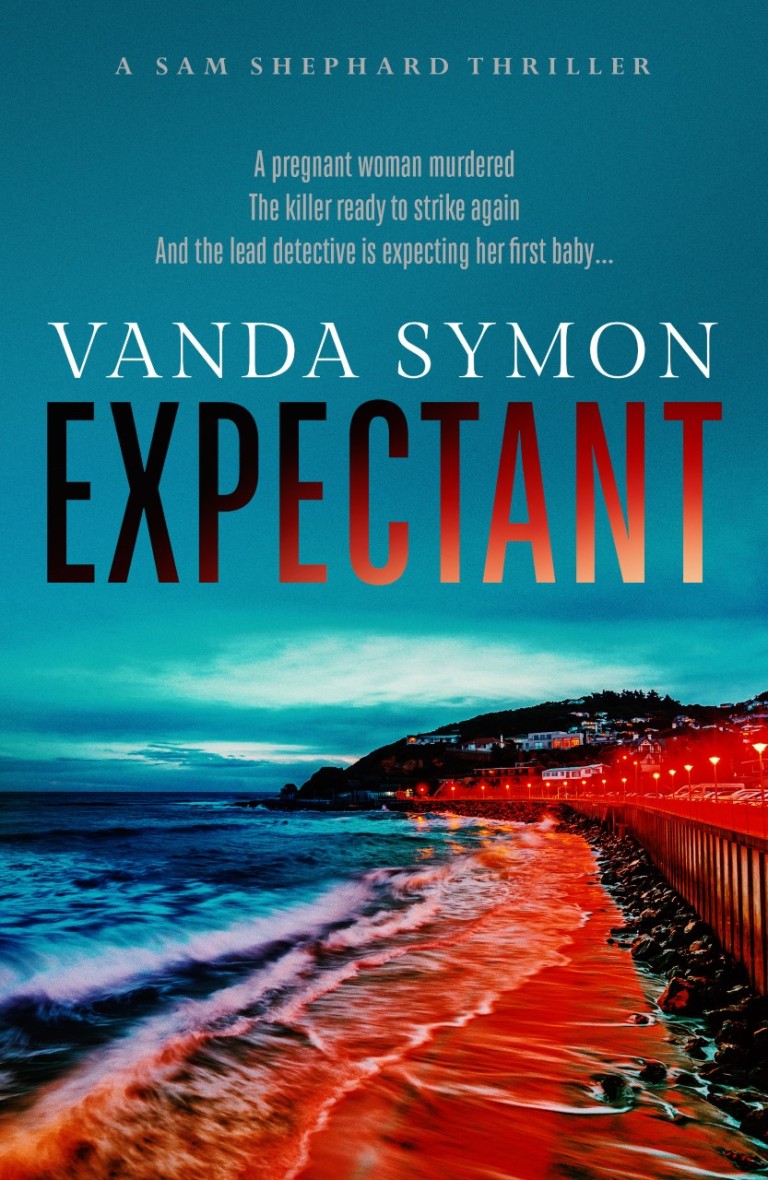
Expectant by Vanda Symon – 2023

When an atrocious murder of a pregnant woman is committed in Dunedin, Detective Sam Shephard’s boss wants her off the investigation – he doesn’t believe “because of your own advanced state of pregnancy, that you would be able to remain objective and emotionally detached from this case.” But Sam is not having a bar of it, it’s not that she can’t remain objective or detached, but because subjective and attached is how Sam does her best work.

Expectant deals with the most inhuman and the most human of crimes, those that involve babies. The book scans every case and scenario, from Minnie Dean in the 1800s, convicted of infanticide, through the various cases of new-born infants being stolen. They are taken from hospitals, cars, prams. Sometimes taken by desperate women who have lost children, or by those who can’t conceive or carry a baby to term. And then there are the darker motives, those taken for money, for exploitation, for medical purposes.

And the novel doesn’t shy away from Aotearoa / New Zealand having “some of the worst statistics in the world when it came to the domestic abuse of children”. Sam, who will give birth in just over three weeks, must confront these realities. But her condition, with the odd Braxton Hicks contraction, her frequent need of the loo, and the constant attacks of the munchies, spurs Sam on to find the culprit and their motive. Time is always of the essence in solving crimes, and Sam has her own deadline looming: “This week coming is my last one at work.”

Sam Shephard is one of my favourite crime-solving characters – she is outspoken, clumsy, off-side with many of her colleagues and most of her superiors, but she is caring and empathetic and doesn’t ignore her gut instincts. There are lovely moments in the book, such as when she is talking to the brave young man who, along with his tagging gang, found the dying woman – and who chose to stay with her as she died rather than scarpering with his mates. And when she sits with a young woman and her mother, the young woman having ended up being of interest to the police for doing something terrible, because she had been scared and feeling totally alone.

Sam is a fearless detective, and she is also funny – getting her baby bump wedged between stools and needing to be rescued (“Jesus, Sam, you’re a goon”), having a love/hate but mainly love relationship with her Mum, bantering with her best friend Maggie and partner Paul. Although Sam is a strong character, others are not completely eclipsed – even her unborn child demands attention, already displaying a temperament, much to the annoyance of Sam’s cat. One of the stars of Expectant is Dunedin. The spring flowers, the funky eateries, the oddly shaped streets, and the banks that even added all together couldn’t scrape up a million dollars in cash for a ransom. And the text is so familiar, with its use of Kiwi slang: “It wasn’t a ‘Dunner stunner’ day”, “the dungier the car the better”.

Sam’s respect for the victims and empathy with the perpetrators is compelling – she imagines the emptiness felt by the bereaved and those who have had people taken – the vacuums left by the loss of people, and by the loss of a feeling of safety. The neighbours who no longer know each other or care about each other, who might dob each other in if someone suddenly is seen with a baby, or who might do so in an act of petty revenge.

Contrasted with this lack of information about those near us are the dangers of social media, where it is easy to glean personal information about strangers, and the risk of official electronic records that can be manipulated and inappropriately accessed. Sam’s investment in the case given her pregnancy is a great device, not only on the emotional side, but the practical too – her knowing what it is to be a pregnant woman going through the health system. Sam might be a cipher in the health system, but she refuses to be one in the police system, and the reader feels her outrage when one of her bosses tells her off for contaminating a crime scene – when not to do so would have been an act of cruelty.

“This investigation was starting to feel like a juggling act in which, every few seconds, someone tossed in a new ball” – the plotting of Expectant is lively and intriguing. There is one of those lovely moments when you realise a possible outcome before the protagonist, and you must read about them moving into danger with no way to tell them! And in the final resolution, Sam must make the most amazing choice, a plot turn that would only work with a character as human and complex as Sam. Expectant can be read as a stand-alone, or first go back and read Overkill, The Ringmaster, Containment, and Bound – you won’t regret it!

Posted in #yeahnoir, Book Review | Leave a comment

Birnam Wood by Eleanor Catton – 2023

Birnam Wood starts with mellifluous prose revealing the motivations, attitudes, and self-doubts of three characters who started the gardening co-op that gives the novel its name. Birnam Wood was Mira Bunting’s idea, using unused land to grow vegetables, sometimes without the owners’ permission – some of the produce being donated “to the needy”. Shelley Noakes has always been Mira’s 2IC, and she is getting a bit tired of it. Tony Gallo left the co-op soon after it started five years ago, and has now returned, just as changes are afoot. Changes that will significantly alter Birnam Wood, affect all the characters, and turn this literary novel into an eco-thriller.

An encounter between Mira and billionaire Robert Lemoine triggers these changes. They meet when Mira is scouting out private land adjacent to the alpine beech forest of Korowai National Park. An earthquake has blocked the main pass into the area, killing five people, and thwarting the landowner’s plans to subdivide. Mira is excited at the prospect of setting up an illicit operation there – after all, Owen Darvish, the landowner, was about to be knighted for his contributions to conservation, surely he couldn’t object if he found out – they were an eco-collective after all. But as she is leaving, she encounters Robert, and, like Macbeth on the blasted heath, the fates of all are changed.

Birnam Wood explores hypocrisy through all forms of human action, whether that be political, commercial, or environmental. The motives of businesses launching green programmes, those of young women entering into arrangements with older rich men, those of the ultra-rich who are planning bolt holes in remote locations, are all exposed through the storytelling. Robert is charming and generous, but surely one of the “Crypto-fascist dirty tricksters”? His technology is helping the critically endangered Fairy terns in Northland, but it is also being used for less benign purposes.

Mira is walking the thin line between compromise and sell-out. Owen wants to retire in peace with his knighthood, ignoring his wife Jill’s concerns about his new business arrangements – the land is his through marriage, Jill’s family has owned the land for generations. Tony sees through everyone’s deception but his own – he is on a mission to expose wrongdoing, while dreaming “he saw himself on stage, at a podium, collecting an award”, and when he stumbles onto something so much worse than he had imagined “I am going to be so fucking famous.” Robert has a way with IT, and not much concern with other people’s privacy, but his wealth can be used for so many good purposes …

The plotting of Birnam Wood is like dynamite with a long fuse – a slow burn leading to a massive explosion. The Shakespearean allusion of the title is carried throughout the novel, with guilt-ridden women, unexpected coincidences, choruses of doom, themes of deceit and fate, and a bloody denouement. It is set in 2017, pre-pandemic, pre- the catastrophic results of anthropogenic climate change occurring in Aotearoa as I write this review, and it feels the more prescient as a result. Even the name Lemoine resonated for me – it is the name of the IT engineer who was stood down from Google last year for claiming the chatbot he had helped develop had become sentient and was in need of protection.

Birnam Wood has no innocent characters, except perhaps the endangered Fairy terns in Northland, or the few remaining Orange-fronted parakeets who live in Korowai National Park. And readers are implicit in the crimes too, for being consumers, for being pragmatic, for writing book reviews while parts of the North Island are disaster zones, for using their cell phones. To understand the cell phone connection, read Birnam Wood – you’ll feel part of those who’d “known that he was bad from the start. And still they’d courted his business. Still they’d courted his approval, his respect. Still they’d courted him.” A tour de force literary eco-thriller!

Posted in #yeahnoir, Book Review | Leave a comment