CJ Carver describes herself as “half-English, half-Kiwi” and Spare me the truth is the first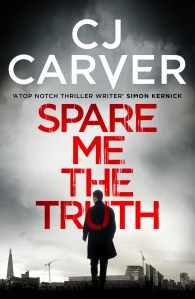 of her novels I have read, despite it being the eighth she has written. And I will be reading more! Spare me the truth is a complex thriller with brilliant plotting that keeps the reader guessing how all the various threads of the story are ever going to weave together. There are three main storylines, one involving G.P. Grace Reavey, who starts finding out about the secret life of her mother, after being threatened at her mother’s funeral. The second features Dan Forrester, a man suffering from amnesia, the nature of which is called into question after he is contacted by Grace’s mother prior to her death. And the third is the story of Lucy Davies, a young cop who has been sent to the boonies from the Met after she has exhibited some forthright behaviour at work. There are fragments of cases uncovered in each of the storylines – and there is a teaser Prologue as well, where we meet Stella, Grace’s mother, and that has to be fitted into the puzzle. The fragments involve grisly deaths, third world dumping, Big Pharma and sonic weapons – and yes they do all tie together in the end. And as well as the technicalities of the story we are drawn into the personal lives of the three main characters. Dan’s amnesia has resulted from extreme trauma – and his belief in his apparently stable and supportive family becomes very shaky as his accepted history is called into question. Grace is thrown by her discoveries about her mother, and also by the uncertainty resulting from her partner wanting to move to remote Scotland. And my favourite character, Lucy (“… didn’t want to get caught without a corkscrew or a sugar hit when the going got tough”) is constantly fighting her tendency to ‘liveliness’, knowing that this ‘problem’ is why she has been banished from the Met – to which she is desperate to return. But things get more complicated for Lucy when she realises her confusing condition might actually be part of the case she is working on – but that if she admits to her problem it might stymie her career plans for good. And to make matters more complicated still, the object of a haunting one night stand turns up to head her investigation. All so engrossing – the only slightly jarring note for me was the phone calls from Chennai, they were a great part of the puzzle solving but do young Indian men really constantly talk in the present progressive: “I cannot be telling you this, … I must to be taking him a message, … How can I be helping you?” Spare me the truth is a great read – and from CJ Carver’s website it would appear there are more Dan Forrester novels to come. Excellent!
 Another beautifully presented novel by Thom Conroy after his The Naturalist in 2014, an historical novel about the German naturalist Ernst Dieffenbach. The Salted Air is contemporary and takes the form of the journal of 28 years old Djuna, who is grieving after the suicide of Harvey, her partner. As it is a journal written by the daughter of literary parents: “Words are like light in a jar” her father once wrote – some of the novel’s short chapters read almost like prose poems. And there are some striking similes: “As I’m merging into traffic on the highway the sun disappears and a rattling downfall begins. It looks, for a moment, as if someone has spilled marbles across the surface of the road”. The changeability of the weather and landscape in the novel gives us a feel for Djuna’s inner turbulence – at one point she describes how the sun and daylight have become conditional to her, the night resolute. She is critical of herself “Why must I always cast stones?” and she talks of “the extravagance of my grief”. She is so human – declaring her apparent decisions while describing her contrary actions. I liked the mundaneness of some of her musings: “the pleasure of staying of other people’s houses is using their personal care products”. Djuna finds solace in her grief with the brother of her dead partner – triggering the main impetus of the novel: Djuna trying to work out if Bruce, the brother, is what she is looking for or what she should be running away from. She is also dealing with the split up of the ideal and idealised family unit she grew up in – with her mother in America and her father living in an abandoned East Coast camping ground; the coming into focus of Lyle, a friend of Harvey’s; and her grieving for the children she and Harvey will never have. There are lots of interesting characters along the way as she travels from Wellington to Palmerston North and then heads up North to find her father – with Bruce’s daughter Ella in tow. The personalised nature of the book makes for some frustrations in knowing what is going on with some of these other characters – Joanne (Bruce’s wife and Ella’s mother) in particular – would she really have let Djuna take Ella away? And what happens to her given how events eventually unfold? Having said that it is when the narrative stayed personal that I loved the book, but when it veered into general descriptions of Maori grievances it lost its focus for me – and Djuna appeared quite racist, which I doubt was intended. Some criticised The Naturalist for ranging too widely in his telling of Ernst Dieffenbach’s story, where I found it a fine portrait, but I would criticise The Salted Sea for doing something similar, adding too much into the mix that Djuna has to think through. The Salted Air is a really good book, but for me if Conroy had stuck to the ultra-personal, it would have been a great one.
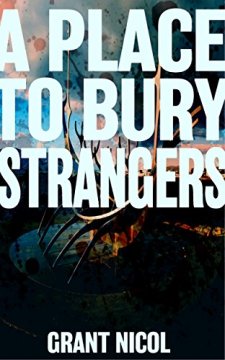 In my last review of a Grant Nicol book – The mistake, also set in Iceland – I suggested a longer novel might allow us more time to get to know his characters, saving them from the “all women are victims, prostitutes or evil; all men are well meaning, just following orders or psychologically damaged” array. A place to bury strangers is a full-length novel – but we haven’t really moved on in terms of characterisation. I had hopes for Eygló (no surname provided) – a woman copper who seemed to have a bit of nous, but she disappears from the narrative very early on – after having been called to the murder scene where a low-down-in-the-chain drug dealer has been incinerated, and a message in Norwegian written in black paint on the wall behind him. She is called off (from the crime scene and the novel) when she and her partner get word that a policeman has been shot. That policeman is Detective Grímur Karlsson, who we know from earlier novels. And Karlsson is even more depressed now – he is ageing, and unpopular at work from having a habit of not solving crimes (or rather letting perpetrators go due to a confused moral compass). Karlsson has been shot whilst following a young woman he fears is in danger and things not going well. Karlsson’s boss Ævar – worried about his job – focusses on a Norwegian for both crimes. This Norwegian’s frequent visits to Iceland are always accompanied by crimes that, until now, don’t really worry the Police, as they all involve damaging drug dealers. The novel jumps about all over the place time-wise (in part I suppose because of Karlsson being out of action for most of the ‘current’ timeline) – and the only way I could keep track was to memorise the date of the incineration and shooting and therefore knowing what events were ‘before’ and which ‘after’. Laid out in a line the novel is about illegal migrant workers and their vulnerability, women and their vulnerability, the evil of drugs, and the corruption of the elite – oddly enough in this case circling around Icelandic fishing quota. And all of these topics are relevant and worthy of a crime novel, and Iceland is a great setting, but with all combined A place to bury strangers doesn’t really get to the heart of any of them. We get the stories of many women, and their end is implied, but their journey ignored. We almost get to know Knut Vigeland ‘The Norwegian’, we almost get to know Svandís the young drug addict, we almost get to know many characters who I would have liked to know. And despite the long paragraphs on Karlsson’s world weariness I still didn’t get to understand him – some of his ethical calls sounding decidedly dodgy. And do they really talk of ‘lollies’ in Iceland? Despite this review there is much to enjoy in this novel – the atmosphere is good and the situations inventive – it was just too busy for my taste.
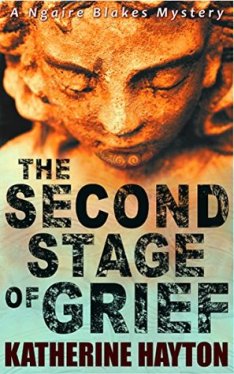 The second in Hayton’s Ngaire Blakes series and another great read! Ngaire is still coming to terms with traumas suffered prior to and during the first installment (The three deaths of Magdalene Lynton) and is working temporarily in a law firm. When two horrific murders put her in the frame as a suspect she bolts up North to seek refuge with her estranged father Patariki, and his just about off-the-grid mates. We learn more about Ngaire’s background – not only her Dad but also her wannabe actress Mum Maralyn, who lives in Los Angeles. With Ngaire up North the novel is run in parallel, with her police mates in Christchurch investigating the murders and her trying to piece things together in her new hostile environment. Both victims were counsellors Ngaire had consulted, and when a long ago former colleague is attacked the pieces start falling into place – but probably not soon enough for Ngaire to escape becoming a victim herself. Especially given that those back in Christchurch are following a false trail – or are they? The plotting is very clever, the resolutions of the various plot-lines satisfying – and in one case quite chilling – and there are some genuinely thrilling, and moving, moments. As with the previous book Ngaire is a flawed character who is not great at fitting in or reading those around her, but again those around her see her in a better light than she sees herself. The end hints at more Blakes mysteries – here’s hoping!
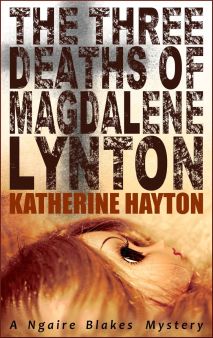 This is cold case mystery story telling at its best – in fact the case was determined not to be a case at all forty years ago when a determination of accidental drowning was made – but now there is more than one person claiming responsibility for the death of Magdalene Lynton, and a lot more suspects turning up. And what makes the solving of this cold case so satisfying is the character determined to sort out what actually happened – Detective Ngaire Blakes. Blakes is a cop with a traumatic incident in her recent history, and she encounters more such incidents as this story progresses. She is a physical and mental wreck, and does a good deal of the investigating while not officially working for the Police – off on sick leave. She carries guilt and fear, and misreads her work environment completely – she also does a quite reprehensible thing to her friend and colleague during the story. In other words: she is a mess, but she is also determined to give Magdalene some measure of justice. Blake becomes involved in Magdalene’s story when Paul Worthington, a frail man with terminal cancer, arrives at the Police Station to confess to the crime. When Blakes puts Worthington’s version of events alongside what was discovered at the time of the death, and all of that alongside the scant information gleaned from surviving witnesses, the pieces don’t fit. Blakes is assisted in her investigations (both official and unofficial) by two friends. First is her Police colleague Deb, and second a reporter Finlay – whose background knowledge of the victim and the religious community she came from was the only thing in the plot I found slightly contrived. We discover Blakes through her colleagues and the reaction of those she interviews – as her own appraisal of herself is tainted by trauma and guilt. She is compassionate and brave – worthy of forgiveness and loyalty – someone who looks beyond the obvious to try and get to the truth. She makes judgements about other characters by what she finds out about how they behave rather than what they tell her about themselves – and I really liked that the reader also starts to judge Blakes by her deeds and not what her thoughts ‘tell’ you about her. Forty years of silence about what happened to Magdalene testifies to the fact that Blakes is not the only character to err when judging their own culpability and worth. Magdalene’s story is tragic and the characters we meet: e.g. the lawyer William Glover who used to be Magdalene’s boyfriend Billy, Magdalene’s mother Mary, Isaiah who grew up in the religious community with Magdalene – are all complex and believable. Some of the Americanisms (presumably added for the US market) jarred a bit in the NZ setting, but I found The three deaths of Magdalene Lynton a great murder mystery, with a flawed but noble main character that I want more of.
 How a quick but catastrophic event can set lives careering off at tangents. For Carla Reid the traumatic events that take place on her farm on the night of her wedding anniversary – when the only glitch had been her son’s announcement he didn’t want to return from the city to help on the farm and her harsh words afterwards – lead to years of suffering. For Ben Toroa, one of the young perpetrators of the home invasion, it leads to years behind bars. Ben’s life did not have any expectation of future comfort, except maybe earning respect from his crew, so his life didn’t veer so much off course, but he still has a journey to make, and surprisingly Carla eventually becomes part of that journey. The last time we spoke alternates points of view, that of Carla, of Ben, of other characters who become part of the story – and most difficult for me the voice of Beyond – that world of continuity that Ben has become separated from due to urbanisation and a history of systemic racism. Sussman’s book is one of hope and redemption – but not saccharinely so; the journey the characters make is far from easy or smooth. If all we need is “to belong … to be loved” there is a way through. If we have that love and belonging and it is taken away from us the way back is hard. If we have never had it we try and create it: gangs, drugs, trying to earn respect. If we have never had it, we suffer from the ignorance of not knowing what it even is to be loved and cared for – especially if we are also literally ignorant through lack of education to help us understand and navigate. According to the Acknowledgements The last time we spoke took about eight years to write – nicely echoed in the text where a journalist has had Carla and Ben’s story in his mind for eight years. So maybe another message from this moving book is the importance of patience for those in trauma; to be patient themselves and also to realise the patience of the Beyond.
 “There was no puzzle to solve, like those lady crime writers devised. This was simply a matter of stopping another effort by other German agents … “ so Dan Delaney muses while holding the fort on Somes Island in Wellington Harbour in 1935 – but things are not that simple, and there is a mystery as to who is leaking intelligence and who is going to such violent lengths to get the plans for the ‘death ray’ that may be being developed on the island. Dan is a young Auckland lad who wants to be a detective and is determined not to muck up his first assignment. He is added to a team investigating the Auckland German Club and its growing sympathies to the Nazi regime. Dan’s task moves from casing out the Club to protecting an amateur scientist who may or may not have invented a way of remotely stalling airplane engines causing them to fall out of the sky – and whose invention is plausible enough for him to have been so viciously attacked at the Takapuna bus depot that he required hospitalisation. It is all pretty wacky stuff – but it is all true! The version of this book that I read started out with a precis of events and a description of historical context, which I initially thought a bit unfortunate, but it did mean that when Dan was dropped like a rat into a maze of investigating I had more information than the scurrying characters. As well as inter-nation rivalry there are inter-personal tensions and also a healthy lack of respect between the police and the army. Dan is a delightful protagonist, human and humble, not knowing if he is left- or right- leaning, just trying really earnestly to be a good detective. When he travels with Victor Penny, the inventor, to Somes Island – for Penny’s safety as well as so the government can keep tabs on his research – Dan ends up suspicious of everybody’s motives, including those of Penny. And as to the power who might be ‘turning’ the locals? – it’s not just Germany who would want the aircraft disabling technology with war looming. And of course there are always those idealists who want everyone to have the same technology to minimise the benefits of attack. And there is the charming suggestion that if the technology does work the Brits would want it as their own invention and not one coming out of the colonies. I had some issues with the writing: at first finding the dialogue a bit forced, but that soon settled down; I was puzzled by some similes: “His throat was as dry as a wooden god”, and there may be a few anachronisms – I’m fairly sure Kilroy didn’t start leaving graffiti until the Second World War, Foo was his predecessor, and lumbar rolls in the 1930s? I also got a bit lost in the personal pronouns – easily done when most of your characters are blokes. And as a social historian McGill crams as much historical detail he can into the book – but why not? – it is a fascinating time in New Zealand and global history, and Dan is totally plausible as someone who would be interested in what is going on around him. So read this book and learn about an amazing piece of New Zealand history, and at the same time try to work out who is after the plans and why, along with the lovely Dan Delaney.
 What a cracker! A noir novel set in tea-drenched 1950s New Zealand. With the 1951 waterfront strike as the backdrop, Red Herring sets PI Johnny Molloy on the track of a murky character who has supposedly drowned in the Gulf of Alaska but who has turned up in a photo taken in New Zealand alongside the organisers of the strike. Molloy’s case is one of probable insurance fraud but more nefarious stuff and interesting characters keep emerging – including a feisty Caitlin O’Carolan, a reporter with a dream of being a war correspondent for a UK paper. For this is a New Zealand where for many ‘home’ is still seen as somewhere else – the place we send frozen mutton to, or the place we may look to for political guidance. But the recent war has allowed some characters to gain a “New Zealand perspective” on those countries once thought to have all the answers. And having been in the conflict also allows guys like Molloy to have a gun, which comes in handy when his hunt puts him in the firing line. It is a dark and complex tale; people’s allegiances and choices of allies often not being what you would expect. The writing is solid and blokey: “A look passed between them of such intensity that two strong men could have carried a double bed across it”, and not without humour – Prime Minister Sid Holland spends a lot of his time in his underwear, and an historian might have called Fintan Patrick Walsh the closest New Zealand had to an American-style industrial gangster, but in the book Walsh is the one bemoaning the fact that people keep misinterpreting his desire for them to ‘get rid of’ people. Who was doing what to whom and why was never entirely clear to me, but I think that was part of why I liked this book – the reader is like the ordinary citizen at the end of whatever deals and decisions are being made, supposedly on their behalf, but without their knowledge or consent. A great debut novel – and hopefully we haven’t seen the last of Johnny Molloy.
 You just have to let yourself drift with this one – it is beautifully written and nicely plotted, but a little heavy handed with the symbolism and message. Elizabeth is slowly fading away in her Stockholm apartment when a neighbour, Elias, intrudes by way of an incorrectly delivered parcel (they share the same surname). The intrusion spreads to an upstairs neighbour, Otto, when Elizabeth has to approach him for help when disaster strikes Elias. And the three rather sad loners, one young, one middle aged and one approaching seventy, tentatively enter into friendship. Of the three we get to know Otto the most and he is the caterer and organiser of most of their gatherings. Otto comes from a literary background and there are nice literary quotes throughout. Elias is a talented artist with severe dyslexia – so Otto has taken on the role of literature interpreter for him – and we find out about him mainly from his new art project, inspired by his first glimpse of Elizabeth. We discover Elizabeth has had a large and eventful past, but her present has been purposely reduced and we just have to accept her as Otto and Elias find her. It is a sad and minor key read – the sort that has you dreading a happy outcome. The Swedish setting allows effective use of seasons to aid mood and the sense of ‘not quite fitting in’ that is expressed by each of the three characters. And of course the presence and absence of the blackbird – prefigured very nicely by a Wallace Stevens’ epigraph – is used to good effect.
-
Archives
- March 2026
- November 2025
- July 2025
- May 2025
- April 2025
- February 2025
- January 2025
- December 2024
- November 2024
- October 2024
- September 2024
- August 2024
- July 2024
- June 2024
- May 2024
- April 2024
- March 2024
- February 2024
- January 2024
- December 2023
- November 2023
- August 2023
- July 2023
- June 2023
- May 2023
- April 2023
- March 2023
- February 2023
- January 2023
- December 2022
- November 2022
- October 2022
- September 2022
- July 2022
- June 2022
- May 2022
- April 2022
- March 2022
- February 2022
- January 2022
- December 2021
- November 2021
- October 2021
- September 2021
- August 2021
- July 2021
- June 2021
- May 2021
- April 2021
- March 2021
- February 2021
- January 2021
- November 2020
- October 2020
- September 2020
- August 2020
- July 2020
- April 2020
- March 2020
- February 2020
- January 2020
- December 2019
- November 2019
- October 2019
- September 2019
- August 2019
- July 2019
- June 2019
- May 2019
- April 2019
- March 2019
- February 2019
- January 2019
- December 2018
- November 2018
- October 2018
- September 2018
- August 2018
- July 2018
- June 2018
- May 2018
- April 2018
- March 2018
- February 2018
- January 2018
- December 2017
- November 2017
- October 2017
- September 2017
- August 2017
- July 2017
- June 2017
- May 2017
- April 2017
- March 2017
- February 2017
- January 2017
- December 2016
- November 2016
- October 2016
- September 2016
- August 2016
- July 2016
- June 2016
- May 2016
- April 2016
- March 2016
- February 2016
- December 2015
- November 2015
- October 2015
- September 2015
- July 2015
- June 2015
- May 2015
- March 2015
- February 2015
- January 2015
- December 2014
- November 2014
-
Meta
 alysontheblog