Reading fiction fosters empathy – but rarely do you read a book where that process is so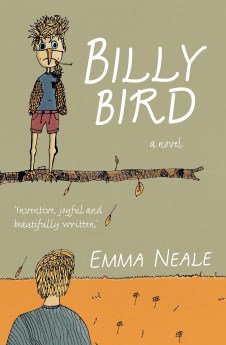 front and centre. Billy Bird is the story of a family, from its rather accidental beginning, through its weathering of a number of tragedies, and up to its positioning itself for the future. People react to life’s highs and lows quite differently and those grieving find it hard to understand the actions of their loved ones, or even understand that their own behaviour has changed. But throughout Billy Bird you are aware that all of the characters’ behaviours need to be taken in the context of the events of the book – and do not represent who those people ‘in repose’ truly are. This is quite an achievement when of course those people don’t exist outside the events of the book! Having said all that, it is not a ‘heavy’ book but a lovely read – mostly because of the depiction of precocious eight year old Billy. He is first named Billy Chatterbox due to his constant narrative on life, but when things go sad and Billy changes, his parents stop calling him that. Billy’s dad Liam buries himself in work, Iris his mum gets a bit obsessive around the house, and Billy? Well Billy turns into a bird. And in a delightful way, as things get more and more strained between his parents, Billy’s bizarre behaviour starts to be the only thing that really makes sense. It is a glorious book in many ways – depicting the wonderful intensity of childhood passions, and the experience of parents whose children can suddenly become total mysteries.

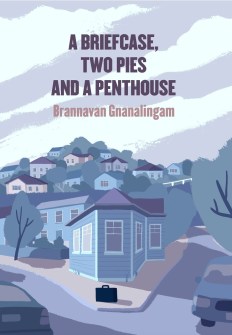 his briefcase; when it was discovered by a journalist it had been left in the Aro Valley and found to contain his business cards, a diary of scurrilous gossip, three mince pies, two fruit pies, the NZ Listener, and a Penthouse magazine. The novel isn’t about this embarrassing incident, it is however about the inanity of government agencies, especially those tasked with impossible jobs – like for example keeping all New Zealanders safe from an ill- defined threat. If you have ever worked in a government department, especially a risk-averse one, you will sympathise with Rachel McManus. Rachel has just started working for the New Zealand Alarm and Response Ministry. She has previously been a civil servant so isn’t totally unprepared for the experience – but this is a time of global panic in the face of the unfortunately termed ‘Islamic Threat’. Rachel faces the usual misogyny and racism – but writ large due to the ridiculously heightened stress levels. She suffers the lecherous co-workers, the embarrassing after-work drinks, the insane meetings where no one wants to admit they don’t know or don’t understand, the slavish subservience to hierarchy – but all dialled up to 11.5. Rachel is tasked – sort of – with tracking a terror suspect. Having the most invasive technologies at her fingertips she plunges in. The suspect is suspected of inculcating youth with radical ideas picked up overseas, and there is a consequential concern that he might be planning an attack somewhere in Wellington. The novel becomes farcical when the evidence and the suspicions grow further and further apart; and there is a crazy sequence where Rachel decides to do some old fashioned on-foot surveillance to try and clarify matters. She has no surveillance skills whatsoever. In fact, she has no skills full stop given her parlous training – but possibly because of this rather than despite it, she is the only one in the Ministry who has any common sense. But due to her being young and a woman, she might as well be yelling into a Wellington gale when attempting to inform her colleagues and bosses of her views. Given the novel’s inexorable style it has no real shape – but makes its point very compellingly regarding racial profiling and bureaucracy gone mad. And there are enough real world incidents thrown in (not out of place at all amongst the absurdity) to keep the novel worryingly grounded. So, given there are still questions to be answered around how a country should position itself in a world at threat from terror attacks, A Briefcase, Two Pies and a Penthouse is at once funny, tragic and disturbing.
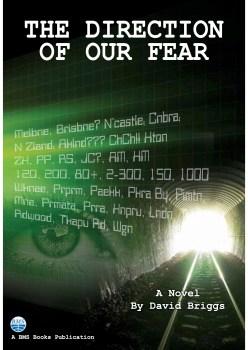 What a great book! The direction of our fear looks at the many many small decisions we make every day that result in benefit or harm, to ourselves or to others. Sometimes small harms and slights sometimes catastrophic. It deals with the networks we are a part of; those we know of and those we don’t – and the many alternative universes that shimmer before they collapse down to the one that we experience. It is a tense and absorbing story of four people. Three – Brendan an Irish widower, Sally a young school girl and Tamás a Hungarian immigrant – are all connected by their travelling on the morning commuter train to Wellington each day. The fourth protagonist is Farida a young Muslim woman working as a translator for the security services in Dunedin. We follow all of them and learn of their dreams, their regrets and their opportunities; they are all dealing with possible changes to their lives – Brendan thinking of starting a new relationship, Sally crossing into adulthood, Tamás trying to make a place in New Zealand for himself and his Hungary-based family, and Farida trying to make sense of her own world and that which she glimpses via her security work, and struggling with what to do when she thinks the two might be overlapping. And we read of all of this within the frame of terrorist threats. A sense of pending tragedy looms as you read of Brendan, Sally, Tamás and Farida – ordinary people whose lives may or may not soon be engulfed in disaster. Highly recommended.
 This is the first of Nalini Singh’s Guild Hunter novels I have read – despite it being the ninth in the series. But it is kind of fun to just jump in mid-stream – and there is a plethora of information about the archangel universe and the back-stories of all the characters to fill you in. And for a good while I was just engrossed in piecing together the backdrop to the series: It is an earth where archangels rule their territories, making vampires where appropriate (collective noun = “kiss”) and where to angels, humans are just those who are “… always living their lives in fast-forward.” Archangel Raphael is the Archangel of New York and his ‘heart’ is Elena – once a mortal guild hunter, now an angel in training and with powers that hint of something vampiric in her ancestry. The love between Raphael and Elena is the power that drives the novels. The angels are all beautiful: “Angelkind really won the genetic lottery”, but beauty is not such a good thing, it is used as a weapon and a subterfuge and further removes the immortals from the rest of their fellow creatures: “Many immortals are unforgiving of physical imperfections.” I liked the mechanics of angels in Danielle Trussoni’s Angelology books – where their wings are part of their pulmonary system and an indicator of health. The same fun is had here – the effort of vertical take-off as opposed to the fall from a height, the wing touching protocols, and the use of angelic singing for both coercive power and bestowing transient feeling of joy on mortals. Vampires and archangels both are very animalistic, driven by instinct, and more than a bit unstable – guild hunters exist to manage rogue vampires, and it seems it hasn’t been that unusual for archangels to take out other archangels who have gone berserk. But apart from the imaginative world-building there is also a great story. One of the archangels has gone missing, and one has awoken from a long sleep. There can only be ten archangels active at one time as their power is so immense and their instincts so territorial there isn’t enough geography for more. So, if the missing archangel has gone to sleep all could be well – but if not all hell will break loose – and with signs of unrest in the missing archangel’s territory (China) things are not looking hopeful. When archangels are not actively managing their vampires, the latter can get a blood lust up and go on the rampage (technical term = “twisted kiss”). To manage the situation the archangels are summoned to the retreat of an angelic religious sect – the Luminata, who have not only retreated to gain personal ‘luminescence’, they are also tasked with ensuring balance is kept on archangel-earth, by summoning meetings when an archangel goes AWOL. They meet at the Luminata compound in Morocco, and soon discover all is not well in this hallowed institution. While Raphael meets with the rest of the archangel cadre, Elena finds out disturbing things about the sect and its relationship with the nearby village – where she is taking the opportunity to do a bit of personal genealogical research. The three storylines – the wayward sect, the missing archangel, and Elena’s origins – are all resolved – although in one case with the hint of further installments. So the plotting is good, but what I really loved was the contemplations on the relative merits of immortality and mortality, perfection and weakness. Should it be of interest to angels if humans are being mistreated? To them humans are like the ‘lesser’ creatures we unfortunately often mistreat. Elena is a great character; she is down to earth, doesn’t “do heels”, only wears make-up as a weapon and isn’t cowed by status – and she enables some of the immortals to see the value in fleeting lives and flawed individuals: gives them “an awareness that mortality was but a shell and that the soul soared free in an immortality even the angels could not understand.” Paranormal romance not your thing? Get over it and give it a go!
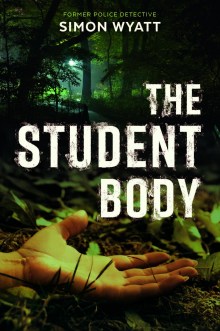 is found murdered at her school camp at Piha Beach. Newly promoted Detective Sergeant Nick Knight lands the job of managing the suspects side of the case, and he and his team have to sift through a number of likely suspects and persons of interest. Wyatt himself was a detective and wrote The student body while convalescing from an illness. He hasn’t quite got the knack of incorporating his detailed knowledge into the narrative – and at times the novel reads like a text book on police procedure. The writing, while at times quite thrilling, is very patchy: I found some of the similes clumsy: “The savagery of these attacks … still hung around the area like prostitutes around K Road in the early hours”; “Cunningham’s reaction was to storm out of the room as quick as a Nazi soldier invading Poland”. I also found the sex scenes out of place and gratuitous and wished that Wyatt agreed with José Saramago who once wrote “I don’t think it is worth explaining how a character’s nose or chin looks”, as Wyatt’s detailed descriptions of all of his many characters gets in the way of the narrative flow. And the plotting is good and deserves a good flow. There are parallel themes of domestic and student bullying, and a number of likely suspects for the initial horrific crime and others that ensue. I didn’t find the resolution totally satisfying, as the story was so driven by Knight we got the facts of what happened but no depth of motive – and an apparent lightness of attitude to statutory rape. With Wyatt’s background, it is understandable that the book is written from a police perspective – but along with this comes a slightly unhealthy view of the rest of society, and a dodgy view of women, which for me led to a loss of sympathy for Detective Sergeant Nick Knight. I suppose some of this might result from Knight’s tragic background that is alluded to, and we find out he has a strained relationship with his criminal lawyer father – so maybe future installments will redeem him, after all he does love his dogs, even if they do get left home alone a lot. And if there are future titles I think it would be interesting to see more of the criminal lawyer father – perhaps a way of giving the reader a bit more moral complexity.
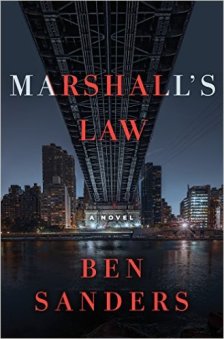 Grade has been laying low in witness protection after quite spectacularly not doing so in American Blood, the previous novel in the Marshall Grade series. But when he finds out U.S. Marshal Lucas Cohen, his witness protection contact, was kidnapped by someone trying to find him, he decides he’s going to be the one doing the finding. And as we are now coming to expect the ensuing story is revealed by a swirl of characters. And as with American Blood the ethics of the situation gets wonderfully blurry. The ‘baddies’ have complex lives and often do bad things for good reasons, and the ‘goodies’? – well they are few and far between, Cohen is the closest thing to a good guy but the good deeds are few, and the one truly good Samaritan turn in this story is taken by one of the scariest of the criminal groups. Marshall’s Law tells us more about Marshall’s difficult past; possibly the roots of his ongoing OCD tendencies – trying to keep order in a messy world. And we meet a hapless ex-con with a dangerous brother and a feisty wife, a drug dealer who colours everything in his life the white of his product, a man with a yappy dog who has got into serious debt, and a crook who feels bad at using his sick mother’s Honda for illegal purposes so punishes himself by leaving the radio on her gospel channel as penance: “Yeah, I’ve done some bad shit, but at least I left the radio on your station.” We also have characters from American Blood: Cohen the U.S. Marshal and of course somewhere is the Asaro family – the target of Marshall’s blown undercover job that landed him in WITSEC. The plot is complex and clever and unwinds slowly through to the explosive ending. And what is wonderful about Marshall’s Law is that it is an action-packed thriller that you want to read like a piece of literary fiction; savouring the writing as you go. The scenes are described in exquisite detail and the noir-ish tone hits just right. I wanted to know how all the characters and threads of the story fitted together, but at the same time didn’t want the book to end. Roll on the next installment!
 well as pushing the story along she packs it full of backstory for those new to the characters, or maybe to remind her readers who have read the series of what has gone before. It also includes the excellent characters from her Convict Girls series in one of the stops in Sydney. A preface has Amber and her two adoring mates from the vessel Katipo, Tahi and Israel, going ashore in Sydney to briefly re-unite with Amber’s best friend Bao, who is staying with her uncle. The story then starts a few years further on, the vessel is now Katipo III and Amber, Tahi and Israel are now in their twenties and the boys’ adoration of Amber is obviously going to cause trouble. Amber’s father Rian captains the vessel and Kitty, her mother, sails beside him. Rian takes them to Dunedin when he gets word that Bao has been kidnapped, and they go to visit Bao’s ailing father, their old friend Wong Fu, to find out how they can help. From there it is a rollicking adventure in stinky Dunedin, stinky Sydney and stinky Hong Kong. They find out surprising things about their old friend and his daughter and are drawn into the complicated web of Chinese politics, loyalties and deceptions. And there are pirates! As in all of Challinor’s books the history is interesting, the women strong and the action non-stop. Kitty, Amber and Bao are all great, and occasionally I wasn’t sure why Kitty just didn’t hurf Rian overboard when he kept pulling the big strong male act. Another strong installment in the series, and an ending that promises more.
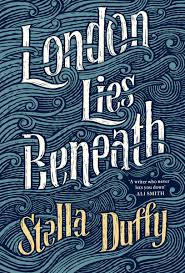 A tale of London – not the London of commerce, science and suffragettes but that of the slums of Walworth with its overcrowding, costermongers and kids scrounging through the mud of the Thames for the odd useful find; the “Real London, the London that is beneath”. It is also a London of superstition and charms, arriving with migrants from other countries and from rural Britain; a muddy taniwha even raises its lonely head. The book is lyrical and flows along like the tides of the Thames and the ebbing and flowing of human populations. Although swirling into focus from when the land was a boggy marsh and spinning out to the present, London lies beneath is set in 1912 and tells the story of an historical disaster. The many narratives we read revolve around the families of three 12-year-old friends: Tom, Itzhak and Jimmy. The boys skive off whenever they can and move between their London and glimpses of a far different life. The only outside view is that of Edward Lovett, an accountant in the city leading a solitary life after his wife has left him with two sons, and whose passion is the collection of the charms and amulets he buys from the barrow markets. The perspectives are broad but the main focus is that of the women: Tom’s mum Ida who sells charms and potions from her barrow; Itzhak’s mum Mimi who caters for her husband, three sons and two borders, and Jimmy’s mum Rose, who has the added burden/gift of her dying mother Emily in the house. There is a fantasy feel to the novel – the boys are all the treasures of their parents and are honourable lads, almost all of the characters are good hard working souls with hearts of gold, and underneath the bluster and gruffness all the blokes are solid as – they are too busy to be political but Ida’s husband Bill still thinks his wife should be allowed to vote. The memorial erected to the victims of the Leysdown disaster (if you don’t know the story read the book) was stolen in the 1960s, so Duffy has written her own memorial – not only to the victims but to the urban poor, whose fate is inexorable no matter how many charms they pretend to believe in. I found it a moving read.
-
Archives
- March 2026
- November 2025
- July 2025
- May 2025
- April 2025
- February 2025
- January 2025
- December 2024
- November 2024
- October 2024
- September 2024
- August 2024
- July 2024
- June 2024
- May 2024
- April 2024
- March 2024
- February 2024
- January 2024
- December 2023
- November 2023
- August 2023
- July 2023
- June 2023
- May 2023
- April 2023
- March 2023
- February 2023
- January 2023
- December 2022
- November 2022
- October 2022
- September 2022
- July 2022
- June 2022
- May 2022
- April 2022
- March 2022
- February 2022
- January 2022
- December 2021
- November 2021
- October 2021
- September 2021
- August 2021
- July 2021
- June 2021
- May 2021
- April 2021
- March 2021
- February 2021
- January 2021
- November 2020
- October 2020
- September 2020
- August 2020
- July 2020
- April 2020
- March 2020
- February 2020
- January 2020
- December 2019
- November 2019
- October 2019
- September 2019
- August 2019
- July 2019
- June 2019
- May 2019
- April 2019
- March 2019
- February 2019
- January 2019
- December 2018
- November 2018
- October 2018
- September 2018
- August 2018
- July 2018
- June 2018
- May 2018
- April 2018
- March 2018
- February 2018
- January 2018
- December 2017
- November 2017
- October 2017
- September 2017
- August 2017
- July 2017
- June 2017
- May 2017
- April 2017
- March 2017
- February 2017
- January 2017
- December 2016
- November 2016
- October 2016
- September 2016
- August 2016
- July 2016
- June 2016
- May 2016
- April 2016
- March 2016
- February 2016
- December 2015
- November 2015
- October 2015
- September 2015
- July 2015
- June 2015
- May 2015
- March 2015
- February 2015
- January 2015
- December 2014
- November 2014
-
Meta
 alysontheblog