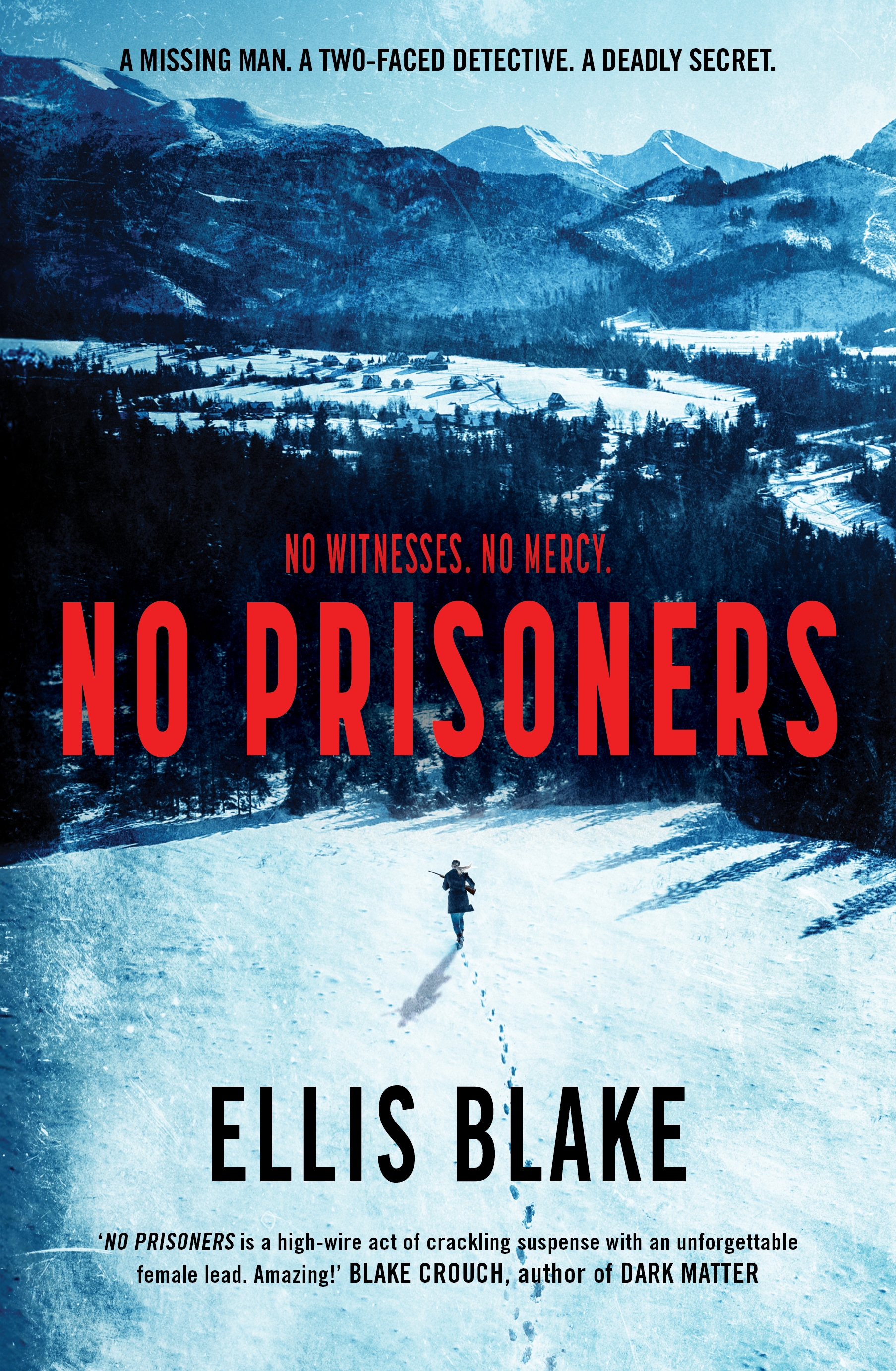
Hannah Lyon is a physicist; at one point in No Prisoners, she tells her young son, Joe, about the balance of energy in the universe — and how that balance can break down close to a black hole, allowing the appearance of radiation being emitted outside the event horizon. The heart of this novel is a little like that — when the laws that govern Hannah’s life start to break down spinning her into a black hole of doubt, are there enough traces left for her to explore what is happening, and why?
Hannah was a researcher at an interdisciplinary research institute, happily married to Adam, a mathematician. Admittedly he had been having a hard time with his work, but he and Hannah doted on their son, enjoying their lives while managing his type 1 diabetes; a team of three. But after Adam drove off one day and never returned, Hannah begins to discover things about her past, her husband, and herself.
The novel begins as things are starting to fade away. A bobcat: “the face simply vanished from the scope”; dropping Joe off at school: “The bobbing satchel diminished to a blurred pixel, one among hundreds, and then he was gone, absorbed by the perfect random motion of the schoolyard crowd”; her job: her department having already melted to an “office of one”, was starting to completely slip away from her. “If businesses are going to give us money, they want at least the suggestion that it’s an investment. Not just a way to glimpse the apocalypse.”
Searching for answers with her heightened awareness of the volatility of some things she thought were permanent, Hannah becomes aware that: “Every day there were more faces of the disappeared.” A significant loss is that of her ability to trust. In the aftermath of Adam’s disappearance, she has had a frustrating relationship with Detective Aloysius (Lou) Hunt. Despite Hannah knowing she is being followed, and that she and Joe are in danger, Hunt comes across to her as dismissive and unbelieving.
Hunt is managing his own health insecurity, if not to the standard that would satisfy Helen, his wife. He feels guilt about his attitude towards Helen, he is partnered by a smelly dog called Milo, and he adores his daughter Jen, who is disabled and a talented artist. But the reader’s sympathy for Hunt occasionally teeters: “Hunt sometimes wondered to what extent high blood pressure and heart issues could be attributed to guys getting nagged half to death by their wives.”
However, the more we read about Hunt, the more complex his intentions and actions become. Both his and Hannah’s efforts to find Adam, or at least what has happened to him, eventually converge: “If you want to keep getting nowhere by yourself, fine. But if you want help from someone who’s been a cop for most of his life …”
Then some of Hannah’s findings suggest answers may be found closer to home, and “her whole world had been reconfigured”. Her biggest hurdle is allowing herself to collapse into trusting someone who might help her. Amusingly, the only person she does trust without thinking about it, is her colleague/friend Carson Powel — a successful thriller writer.
“Did things appear with clarity simply because every now and then randomness looked meaningful, or because your life had an architecture to it.” Throughout the book, Hannah uses her analytical skills to investigate Adam’s disappearance, and to distinguish between solid information and chimeras, but eventually she finds herself being as deceptive as she suspects others are being, lying to protect the possibility that her perfect family might still somehow coalesce again.
No Prisoners is smart and engaging. Hannah and Hunt are great characters to weave a plot around, they are both conflicted and complicated. Hannah’s analytical skills are occasionally boosted by her instincts, and the trajectory of Hunt’s life pushes him into suddenly re-considering some of his choices. “Part of your brain never ran on logic, but that didn’t mean it was never right.”
I really enjoyed No Prisoners. It is both a thrilling crime novel, and an exploration of two people discovering their true nature; the lines they will not cross. Ellis Blake is the pseudonym of well-known #YeahNoir author Ben Sanders, and Sanders’ style of writing — crisp and intelligent — is unmistakable: Hannah looks in on her sleeping son: “A hand raised and curled beside him, like the fading gesture of a great idea.”

