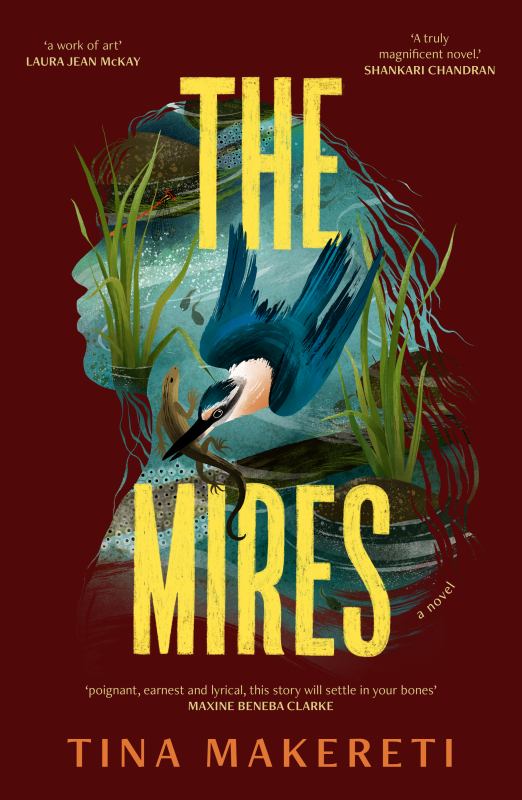
How small people are and how “they only mean something in relation to each other” – when they connect like streams of a river it is a glorious flow, when they separate and become more and more isolated from each other, it is tragic, for them and for their environments. The Mires captures this message through the stories of three families.
The area they live in, on the Kāpiti Coast, is near a swamp, whose waters once flowed freely through the area, and will do so again: “We are too old and wise and deep to trouble ourselves with the impermanence of your wood and concrete and steel.” The eldest daughter of one of the families, Wairere, has matakite – she sees immensity that can’t be put into words. She can sense the inner turmoil of others, which is: “Exhausting and confounding”. She often visits the swamp for some peace.
Wai’s mother, Keri, is a solo mum who is constantly trying to engage in a meaningful way with teenager Wai: “How can they manage to be so clever and so scathing and so harmful and so vulnerable at the same time?” Keri is kept very busy looking after her young son, Walty, a delightful character: “The boy fills her with sweet joy and dread at what the world might do to him.”
Keri negotiates the hurdles of the social welfare system: “There’s never a crossover period between when the food runs out and when the money comes in.” She must conform to policies that probably make sense on paper when applied to everyone, but that create a sense of helplessness in individuals in differing circumstances.
Janet is one of Keri’s neighbours, Keri thinks of her as “prejudiced but alright”. Janet has freed herself from an abusive relationship, and she is enjoying the freedom of being able to say whatever she wants, no matter how hurtful those utterances might be to those around her. After a family moves in next door, uprooted due to climate disasters: “they’re lucky … most New Zealanders can’t afford to travel anymore, but they’ve hit the jackpot – they got to travel the world and settle here.”
The new neighbours are Sare, Adam, and their daughter Aliana. They have finally arrived in Aotearoa after many traumatic years trying to achieve refugee status due to the relentless heatwaves and regular wildfires that have made their Mediterranean home uninhabitable. Adam is one of the few decent blokes in the story, and his name seems no coincidence, first man, untarnished by society or politics. Sare does not feel as settled in their new home as Adam and Aliana do – however, she and Keri find they have a lot in common: as Keri points out: “We’re all just being processed, aren’t we?”
Our bodies are made of water, and all water is connected, so we are all connected – Wai becomes aware of a darkness entering the area when Conor, Janet’s adult son, turns up two years after he last visited. Janet is pleased to see Conor, but soon realises he has changed: he sports a buzzcut, and when not locked in his room with his computers, he exercises, a lot. And then she enters his room and glimpses what is on the computer screens.
The Mires is a tense read, dealing with vulnerable people facing multiple threats. Aotearoa is regularly experiencing its own extreme weather events. Sare’s family is already experiencing racism in their new home, despite their simple aspiration being for a measure of autonomy “The best thing would be a choice”. And the reader reads of Conor and his increasingly warped views: “This is why the world has to change.”
Makereti does a great job of trying to understand men like Conor, he isn’t painted as a mindless thug. An incident early on with Keri doesn’t spiral out of control. As he reads more and more propaganda, Conor feels doubts and uncertainties, but he pushes them aside in favour of the feeling of belonging offered to him if he espouses the right views. He is so inner-oriented that he doesn’t notice that his ‘kind’ already are dominant and powerful, and that they are so at the expense of everyone else.
The plotting of The Mires advances towards an epic denouement of acts of destabilisation, torrential rain and flooding, a missing child, an overrun Police force, and an imminent danger about to affect all three families. And there are friends working together to hold things together. Water can be gentle and soothing and can also arrive like ”the foot of an elephant”. A young woman can be awkward and insecure and can also be a formidable power for change and disruption, backed up by ancestors, and vengeful ghosts, both Māori and Pākehā.
The Mires is a thoughtful book, and I think many readers will relate to the choice imagined for Janet: “Whether she will be able to sustain the unease for long enough to become something more than she is, or whether her discomfort will cause her to weave elaborate narratives as a protective shield.” A great read that flows like the waters that feature so prominently.
 alysontheblog
This sounds wonderful. I really liked Where the Rekohu Bone Sings so I hope this one makes its way across the Tasman too.
LikeLiked by 1 person
Update: Yay, my library has copies on order!
LikeLiked by 1 person
Have you read The Imaginary Lives of James Poneke? It’s wonderful 🙂
LikeLike
Yes, I’ve read them both, on your recommendation each time!
https://anzlitlovers.com/category/writers-editors-aust-nz-in-capitals/makereti-tina/
LikeLiked by 1 person