
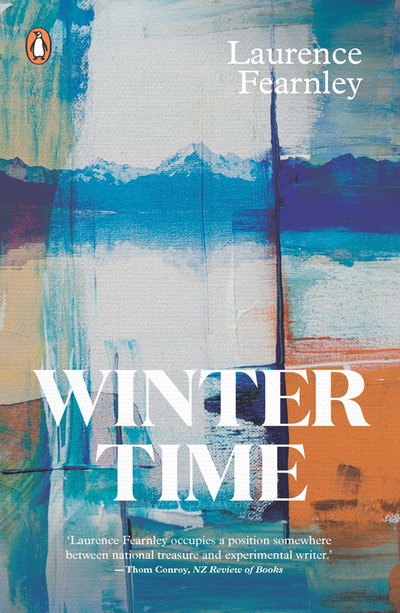
Winter Time by Laurence Fearnley – 2022

Laurence Fearnley transports us to places with her writing, whether it be the rocky coast (Reach 2014), wetlands (The Quiet Spectacular 2016), or, in the case of Winter Time, the Mackenzie Basin, in the centre of the South Island. Her characters are always intriguing, and in Winter Time Roland March is wonderfully drawn. He is back in his hometown of Matariki to carry out the awful business of managing the aftermath of a death – sorting out belongings, deciding on funerals or memorials, deciding what to do with the family home. Eddie, his brother, veered off the road into a canal, and Roland is in shock, “God, he missed Eddie.”

Eddie isn’t the first of the family to go. First their father left, then their mother died after a long illness. Roland stayed with his sister and younger brothers till they were old enough for him to go to Christchurch for a brief stint at university. Then his sister Casey died, then the youngest brother Isaac disappeared, presumed drowned. Roland eventually moved to Sydney, and opened Kernel, a wholefoods shop, with his partner Leon. Eddie stayed in Matariki and witnessed the spread of housing around their once secluded property, the new houses vacant for a large part of the year. He was bitter that his town had become a mecca for tourists: “His home was nothing but a series of photo opportunities.”

In Matariki, Roland rides Eddie’s bike, reconnecting with the town and its surrounds: The freezing winds, the treacherous snow falls, the breath-taking views, and the stunning night skies. “If you stood outside at night, the stars appeared to move, and cross the sky, never still, always shifting, one following the other in a constant migration.” Roland thinks of his family who had disappeared one by one just like the stars. And he regrets the time he didn’t spend with Eddie, the small kindnesses he failed to do for him. And he starts to wonder if his death was indeed an accident. And then Roland becomes the target of online abuse.

There is a sense of menace to Winter Time, the reader becomes uneasy along with Roland. He finds footprints, not his, in the snow around the house. He finds out that Eddie’s culling work for the Department of Conservation included the culling of tahr, and that some hunters thought taking tahr was taking what was rightly theirs. Was that motive enough for murder? Along with the tourists came the demand for property, the family home was now worth a fortune, was that a motive for murder? Even the local cop starts seeming a bit off. Roland even wonders, along with the reader, if the disappeared Isaac will re-appear, isn’t that a usual plot twist? “… it would have been wonderful to see him alive, and standing at the door – even if he did have a gun in his hands”.

Roland befriends an acquaintance of Eddie’s, Bay, whom none of Eddie’s friends have heard of, and whose business is renovating old houses. He also meets Mrs Linden down the road, a bossy woman who knew his parents, who hated his mother, and for whom Eddie would do chores. When Roland returns to Sydney, Leon is not very sympathetic to his helplessness regarding the online trolling. Their relationship is becoming quite strained. Roland wants Kernel to be a solid healthy wholefoods shop, Leon wants to expand and take advantage of the growing market for health supplements and remedies such as, in Roland’s terms, “the latest 5G immunity face serum”. Roland can’t seem to express the clarity he feels concerning what he thinks is right, and he is shocked to hear versions of what others think of him.

Roland travels back to Matariki when the family house has been broken into, and again when the online attacks escalate. He is both at home and a stranger in Matariki, he never did fit in as a child or growing up. He recalls his childhood when the horrors of the cold were shared with Eddie, and sort of fun. He recalls with amazement an incident where the three boys scuttled their father’s boat rather than face his anger. He finds traces of Eddie’s life he was completely unaware of. Roland feels unmoored, he bikes through a formless fog hardly knowing where he is going. He stands in the useless shower trying to thaw out, the cold shower curtain stuck to his back. Roland doesn’t recognise when he is in the presence of nasty bitterness, or when he is being genuinely helped.

The reader, and Roland, do find out what is happening eventually, but that isn’t really the heart of the book. At one point I thought it would end without any resolution, and I would have been fine with that, there are enough clues that the reader could choose from several scenarios. However, the resolution does allow Roland a bizarre act born of relief. What made Winter Time so compelling for me was the atmosphere, the landscape, the uncertainty, and Roland’s adriftness. Highly recommended.

Posted in #yeahnoir, Book Review | 1 Comment

Back Home in Derry by David McGill – 2022

Dan Delaney’s first adventure was as a young cop placed on assignment on Somes Island in 1935 (The death ray debacle, 2015). Since then, we have read of him in incidents every decade. In Back home in Derry, it is the mid-1990s, Dan is nearing 80, and he is reluctantly travelling around Ireland with Jas, his wife. Dan would rather be at home in New Zealand, safe with his family around him. The story starts in small rural villages in Ireland, and unfolds in Dublin, Belfast, and the walled Londonderry.

Dan’s world is closing in; he struggles to see through his graduated lenses, he hears through the squeal of his hearing aids, or the roar of his tinnitus, and he finds most of what is going on around him a puzzle. Dan and Jas’ spend some quiet days when there is an incident with their car, and they hire a “gypsy caravan” (from a village where Roma are not “permitted within village boundaries”). Jas takes photos of the countryside flowers as they amble along, Dan wishes he was at home, thinking “he had nothing in common with the place his ancestors fled”. Dan is increasingly living in his past, having nightmares, and worrying. One evening in a village pub they listen to a local band singing songs of rebellion. Dan finds himself inexplicably in tears when they sing the Bobby Sands poem, Back home in Derry.

After these “idyllically uneventful days”, Dan and Jas are dramatically embroiled in violence in Dublin. As their daughter, Ali, might have been the target, Dan and Jas are keen to work out who is behind the attack. A delicate job during the shaky ceasefire recently agreed between sectarian factions. Ali is a forensic linguistics expert and was meeting them in Dublin to help Jas research the genealogy of Dan’s Irish forebears. In the violent attack, her life is saved by a man called Jack McBride, who Dan is alarmed to discover is related to an old nemesis from Somes Island. Jas and Dan reconnect with the tear-inducing singer from the village pub, and things start to get very complicated. What is clear is that whether grudges are held for decades or for hundreds of years, they can still be the cause of violence and mayhem. And in Ireland those grudges are often held across religious divides.

Jas is a devout Catholic, and Dan becomes more and more irritated at her subservience to a Western-movie-loving priest they encounter, and strangely also to Jack’s wealthy English uncle. However, being ex-law enforcement, Jas and Dan are both suspicious of the local police, specifically the helpful Detective Inspector Gerry Murphy – who ends up being able to continue his investigation over the border in Northern Island due to agency cooperation during the ceasefire. Incidents pile on and adding to the tension is the nearing of the marching season in Derry. Dan and Jas run into an Ian Paisley rally on the way to the airport to pick up their other daughter, Maria. Jas manages to get some interesting photographs of people attending the rally – further complications.

Maria, a hyperactive human rights lawyer with the United Nations, arrives with Max, a journalist, in tow. Max has a prodigious appetite for alcohol when not working on a story, and an equally prodigious number of contacts, which enable him to source information on goings on and related police investigations. The plot proceeds with a possible kidnapping, a definite kidnapping, most of the characters getting trapped underground, and various explosions and threats of explosions. And despite all the chaos Jas and her daughters manage to fit in some sight-seeing and hitting the shops. Needless to say, Dan isn’t so sanguine, “he once again wished he had never come here”, and as old horrors come back to haunt him in the present, he realises how much of his past he has kept hidden from his wife and grown-up children.

The plotting of Back home in Derry is helped by a preface that sets up the motivation for two of the characters. The book has impetus, and although I did get a bit confused in places, McGill manages to keep the various strands of the story moving, and to finally resolve the mysteries. The book is full of allusions to 1990s popular culture, sometimes with too much exposition. But the various and varied characters work well, and mirror the political situation nicely, with some having to tiptoe around others for fear of causing offence. The uneasy relationship between Jas and Dan works too, as at its base they are a solid team.

Dan is, as always, a troublesome character. If you have read the Dan Delaney novels, you can’t help but think of the lovely young man who started the series. But this Dan has lived a long and difficult life. He has old attitudes, is slightly condescending towards Jas, and describes people in quite offensive ways. I found Back home in Derry a good final outing for Dan. He travels a long way in the novel, surprising himself as well as the reader with the possibility of future peace and reconciliation. And he finally claims a political position, although he will probably continue believing: “Bloody politics … another word for abdicating personal responsibility”. If you haven’t read the Dan Delaney books, give them a go.

Posted in #yeahnoir, Book Review, Historical | Leave a comment

Poor People With Money by Dominic Hoey – 2022

Monday Wooldridge is talking to her little brother, Eddy, who disappeared and never returned 15 years ago. She tells him about her life since he left. Their father decided to depart, their mother sort of did too. Monday became a fighter: “Fighting was the only thing I was ever good at”. She fights for money, to hurt other people to vent her anger, to hurt herself to numb her guilt. It isn’t a pretty story. The reader constantly wonders if it would have been a different story had Eddy been a part of it.

Poor People With Money is in three sections. In the first section Monday manages a bar in Auckland, and she fights. She takes on a roommate, JJ. JJ “understood what the universe was made of, but used to act like leaving the house was climbing Everest”. He is a recluse, spending most of his time on his computer, researching the science of ghosts. Monday doesn’t co-exist with rich people; people like her and JJ live in a parallel dimension from “people with so much money it was like a disability”.

When Monday needs more money than she can raise at the bar and from fighting, she comes up with a scheme and drags a reluctant JJ in as an accomplice. Things go well, things don’t go so well. “Everyone believes things will be as they are forever. The good and the bad. As if time is a rock pool rather than a fucking tidal wave”. When events get beyond Monday fighting her way out, she and JJ take off.

The second section of Poor People With Money is set in the tiny village that was once home for JJ. A place “where time moved slow and nobody gave a fuck about anything except what they loved”. Monday and JJ move into a shack on the property of JJ’s dad Tahi, his partner Frances, JJ’s sister Hope and his half-sister Aroha. Hope wants to be the next Parris Goebel. Aroha has visions of the future. Monday keeps finding out she hasn’t yet witnessed the deepest level of poverty.

“We never talked about you, Eddy. Dad wasn’t that kind of man, Mum was never awake, and I kept myself busy with violence.” Monday can never really relax, it’s hard to know who to trust, she’d trust Eddy, but he’s long gone. You know people better once they’ve gone “So much easier to figure someone out when they’re standing still in your memories”. A small mistake increases the sense of impending doom: “Black clouds were rolling in. I lay on my back for a while watching them spread over the blue sky, like blood over lino”.

The third section of the novel has growing momentum as Monday’s story plays out. The telling is tense and cruel, but you can’t help but root for Monday. There is a clarity to the writing that doesn’t allow judgement, the characters are just what they are, because of who they are and their histories. The reader wonders how different they might have been in a different timeline, but is also acutely aware that their lives are the only one they’ve got: “Being smart without opportunity is fucking cruel”.

When an extreme storm hits the village, it destroys homes of those with money as well as of those without. The reader feels everyone is locked into their roles, and escape is managed by a very few. Poor People With Money is a stark and compelling read. It deals with social inequality and the blurry line between right and wrong, and touches on the effects of land disputes, pollution, and climate change on rural communities. But mostly it’s about Monday Wooldridge, and I could happily have carried on reading and reading, until things turned out right for her and she could relax for a bit. Highly recommended.

Posted in #yeahnoir, Book Review | Leave a comment

Miracle by Jennifer Lane – 2022

Miracle Jamieson is negotiating being a teenager in small town Boorunga. She worries about her freckles, pines after her first love, Oli, and puts up with the school bullies. She obeys her cohort’s random rules: “For Year 9 girls, eating at school was even less cool than wearing a jumper”. She finds her dad embarrassing, and her mum hopeless. Things are pretty stink really, but Miracle has no idea how much worse things are going to get!

Miracle was born in the throes of a massive earthquake that caused her brother Julian chronic trauma. She is concerned about an upcoming school debate: the massive earthquake caused Boorunga’s curse V Boorunga was the site of the earthquake because it is cursed. If she caused the quake that caused the curse, she might be responsible for the alarming number of “weird deaths” occurring in Boorunga.  

She is worried about the debate and the deaths, but then Miracle’s father, Jim, is taken away under suspicion of having beaten a boy into a coma. The weight of another source of guilt is almost too much for Miracle to bear. When Jim lost his postie job it was sort of Miracle’s fault that he ended up working at Compassionate Cremations, where the beating occurred. The business had moved into town when Miller’s Funerals suddenly shut down, which raised questions about why, and the link between the crematorium and the rising death rate.

Miracle is a staunch young woman. She is determined to exonerate her father. Her family have become pariahs, and she longs to regain her friends. She fiercely protects her unstable mum and her strange, uncanny, beautiful brother. She thinks the only people on her side are her aunt’s family, but they just want to keep Miracle safe, and she won’t solve anything by being kept safe. She comes up with a series of suspects to clear her father, and she discovers alarming things about people she knows. She is full of ideas, but most go nowhere, and Miracle rapidly finds she “needed a plan D”. But her persistence won’t allow her to give up.

As with her first novel, All Our Secrets, in Miracle, Jennifer Lane gives us great mystery storytelling from the point of view of a young woman. Gracie was 11 in All Our Secrets, Miracle is 14. It is a great device for an unreliable narrator, unreliable not due to pathology or ill intent, just because of the personal intensity with which many young people view the world: Taking all the blame, dealing with raw emotions, freely expressing prejudices, lying with ease, feeling responsible for those around them: “She might see that I wasn’t as mental as the rest of my family”.

The characters in Miracle are vivid. At the denouement I had come to know Miracle so well that I was really concerned for her safety. Her family are complex and interesting, her friends are living through their own stresses, and Sergeant Nick is a quite unexpected take. Even the woman across the road gets a fleeting backstory. Miracle discovers there are some whose lives are “a whole new level of hell”. And along with Miracle, the reader comes to re-evaluate events in the novel. Some people are misunderstood, some worse than you might ever imagine, and many just ordinary, damaged, but kind people.

I really enjoyed reading Miracle. It is suitable for adult or young adult readers.   

Posted in #yeahnoir, Book Review, Young Adult | Leave a comment

The Slow Roll by Simon Lendrum – 2022

Roy O’Malley is a professional Auckland gambler, with a weakness for a sob-story. When a distraught father asks him to find his missing 15-year-old daughter, Sefina, O’Malley agrees. The case gets a little more complicated than O’Malley first thought, and he and his girlfriend, Claire, are wondering what he has got himself into. Then they hear that the body of one of O’Malley’s acquaintances “has been found on the outskirts of the business district”. O’Malley’s professional life and his amateur sleuthing come together, and things get a lot more than a little complicated.

O’Malley has a tragic backstory and has spent time in Paremoremo Prison. This has provided him with empathy for those at the mercy of toxic masculinity. And it has also given him allies in strange places, as well as access to a slightly untrusting but still hanging-in-there cop, Senior Sergeant Keith Buxton. Buxton believes somewhere inside O’Malley is a decent human being trying to get out. O’Malley also has connections with an ex-Paremoremo prison mate, Jimmy Tua, head of one of the Auckland gangs. And now he has sort of settled down, he’s got Claire, a bartender midway through a psychology PhD.

Claire is a more than competent partner. She’s smart, tough and perceptive. The latter is an asset, as O’Malley is not a great judge of character, the reader is satisfyingly ahead of him regarding some of his bad calls. O’Malley is playing a part and Claire understands he is a bit of a liability. She puts up with him calling her “baby” and “babe”, despite sending any bar client who would dare to “the back of the line”. She calls him “babe” too, as she knows he has night terrors, and almost every time he goes out on a “project”, she ends up tending his wounds. But then he does do all the cooking.

O’Malley doesn’t listen to jazz, but he knows he should, as he reads crime novels and watches crime shows on TV. The Slow Roll has all the stock elements of literary and screen thrillers – two mysteries that end up related, an amateur sleuth who falls under the suspicion of the cops, allies with smarts in computing, insights into the criminal underworld, a cop frustrated that the amateur is getting the jump on the professionals. O’Malley’s self-effacing attitude towards Claire is reminiscent of the Andy Carpenter novels, but The Slow Roll is much more hard-edged. There are slick fight scenes and heart-stopping thrills. What I really liked was Tua’s tour-de-force explanation of the movements and laundering of illegal gains, inclusive of an extraordinary array of people.

As with all good thrillers, it is character and setting that carries the plot. Damaged O’Malley, staunch Claire, Tua and his henchmen, Chatbox and Manu, are all great characters. There are blurred lines around right and wrong – O’Malley doesn’t do all his gambling at Sky City. Goodies and baddies are relative terms. And there are conspiracies that go right up to the Beehive. We go from luxury suites at Sky City, to O’Malley’s swanky Viaduct Basin apartment, to illegal gambling houses and remote properties where nefarious meetings are taking place.

And there are mysteries to be solved: Sefina has stumbled into some sort of bad business – but what? The dead man saw something he shouldn’t have – but what? When O’Malley has an encounter with a car driving aggressively against him on the highway, he isn’t surprised – he has a choice of options of who might be out to get him. The slow roll of the title is a gambling term for a player taking too long to reveal an extremely strong hand in poker. The manoeuvre plays a role in the story, but O’Malley is also juggling when to tell the cops what he has found out – too soon and people, including himself, will be in danger – too late and he might be heading back to Paremoremo.

The Slow Roll is a great debut novel, and I am sure we will be reading more of O’Malley and Claire.

Posted in #yeahnoir, Book Review | Leave a comment

Boy Fallen by Chris Gill – 2022

Brooke Palmer flies down from Auckland to visit her West Coast hometown, Taonga. Far from the ‘treasure’ suggested by the name, Taonga holds bitter memories for Brooke – it is where her 15-year-old brother, Jack, was murdered 19 years before. Brooke and her family are still traumatised by their loss, and Brooke still hates the man serving out his sentence for her brother’s murder. She has returned because Evan, the son of her best friend, has been found dead – it appears he is another young man murdered in Taonga.

Brooke is now a detective in Auckland, and although she is back for her friend Lana, she agrees to help Christchurch Detective Tane Collins find out what happened to Evan, and why. Boy Fallen is a police procedural, but from the point of view of an incredibly invested cop who finds it hard to put aside her personal feelings when investigating. Interspersed are episodes from Evan’s point of view – the first an intrusion in the text, but then a tense addition to the narrative, mirroring what the police are discovering about Evan’s life, and the incidents leading to his death.

To Brooke’s surprise there is no shortage of suspects for Evan’s murder; Evan had been surrounded by a variety of people who had reasons to want him gone. She knows Taonga is not immune to the divide between rich and poor evident elsewhere in Aotearoa; her brother had suffered the jealousy and resentment from the less well-off in town. And like Jack, Evan had been bullied at school. He had been planning on getting away, but when things looked like he might find happiness in Taonga, other forms of prejudice descended, even from those who should have been supporting him.

Boy Fallen is an incredibly atmospheric read. The cold and rain of the West Coast shroud the tragic community, the frequent drives to Christchurch lead to disturbing prison visits and unsatisfactory interviews, and then back to the grief and hostility of Taonga. Collins is dealing with his own family problems, and neither he nor Brooke have time out from the relentless drive to find Evan’s killer. Brooke promises Lana they’ll solve the case before Brooke goes back to Auckland, a promise that weighs heavily on her mind.

The characters are in turns awful, misunderstood, flawed, sympathetic, and puzzling. And many go terribly astray. The reader witnesses Evan’s world spinning out of control, to a place where he can’t see a way out – until it’s too late. The homing in on various subjects, coupled with seeing Evan’s experience with them, leads to a nerve-wracking read. And when the culprit is finally revealed it throws a whole different perspective on the narrative. Brooke and the reader revisit everything they have known about the causes of the violent goings-on in Taonga. Boy Fallen is a sad read, it is about how difficult teenage years can be, both for youth and their caregivers. It is about how the human desire to fit in can ironically lead to greater isolation. And how prejudice can go both ways. A great and moving piece of #YeahNoir

Posted in #yeahnoir, Book Review | Leave a comment

Down from Upland by Murdoch Stephens – 2022

Jacqui and Scott live with their son Axle down from Upland Rd, Kelburn, Wellington. They are both civil servants, she in Police Headquarters, he across the road in the Ministry of Health. Axle has moved from single-sex Wellington College due to being bullied, and he is cautiously making friends at coed Wellington High. Down from Upland is their deeply disturbing story told in three parts.

Their story is one of manipulation: of spouses, of employees, of colleagues, of friends, of children. Jacqui and Scott have a highly considered relationship, sex for them appears to be sympatric masturbation, and they pride themselves on calmly discussing everything at scheduled meetings. They are taken aback at their son calling them boomers – they are millennials. When Jacqui decides to take up her friend Kaye’s offer to take over her young lover while Kaye and her husband move to Turkey, she and Scott agree to open their marriage.

Axle is extremely careful with his school mates in his new environment, eager to fit in after his experiences in his old school. He likes his new friends; they are a sensible and sensitive lot. However, the one thing the kids are not careful with is alcohol, and in good kiwi tradition they tend to binge drinking. Many a gross hour is spent trying to get drunk on low-alcohol beer, which has been supplied in bulk by Scott, whose work at the Ministry is in sensible drinking communication.

The story progresses through various conversations, some of them excruciating, mostly those involving Scott. When meeting with Jacqui about Axle, actions are usually slated to him, and his talks with his son are clumsy, rambling and embarrassing. Scott meets with Linnea, a colleague from work, and thence with Justin from HR. Scott is hopeless at manipulation but a sucker for being manipulated. Jacqui meets with Joᾶo, Kaye’s young friend, and with Rothman, a colleague from her work, who may or may not be hitting on her.

The background to the conversations is an almost Kafkaesque depiction of the civil service. And the broader background is that of the climate crisis. Policy wonks celebrate in the streets like Armistice Day when it is announced the public sector will be carbon neutral by 2025. In Police HQ Rothman ropes Jacqui into a bizarre scheme to get the New Zealand Police meeting the carbon-neutral deadline, a scheme to rival his whacky one to improve the optics on police statistics. Across the road the Respiratory Health Unit is facing a reversal of fortune, seeing the end of the alcohol and addiction stranglehold on funding with the zero carbon targets: “Booze. Alcohol. You’re on the bench.”

There is a general feeling of “There are changes coming and we can either be part of them or end up like the Australians”, alongside the hope that the government will lose the next election. “God, think of MOD! Their whole job is flying planes and blowing things up!” There is a lot of climate activism at Axle’s school, but the students know you only become an activist if you have rich, influential parents. Jacqui is reading a book about Antarctica at a glacial pace throughout the novel, and the reader wonders how much smaller the continent will be by the time she finishes.

The characters are so well, or so awfully, depicted. Scott is quease-making, even for Jacqui: “Her husband might have been overly anxious, but at least he was human”, and she is downright mean to him – when Scott shares a predicament with her, her response: “I’m not saying it’s hilarious. Or even fun. It sounds horrible. I mean fine, it’s up to you but… yeah sorry… it is a little amusing. From a wife’s perspective.” She is super manipulative but quick to take umbrage when others apply the same tactics to her.

Justin is awful, ruthlessly incisive, and has a wink that haunts. Rothman is flat out bonkers – and is rapidly being promoted. Axle is a ray of hope, often appearing to be the only adult in the family, or even in his friends’ families – there is a disturbing interaction between him and very wealthy Ron, the father of Michella, a school mate. But Axle is moving towards activism, both personal and social, in his newly found milieu.

And then there’s Joᾶo. Joᾶo is on a working holiday. He is aghast at the Kiwi drinking culture, the explicit racism, the way relationships are strategised and implemented. And he takes an ephemeral path to just enjoy things as much as he can before moving on – and if that means doing his own manipulating, that seems to be how things are done around here. It is a relief when Joᾶo and Axle have a sane conversation.

Down from Upland is an uncomfortable read that you can’t put down, there is a touch of rubbernecking in reading it – like watching a slow-motion crash. It is the sort of book you hope is total exaggeration, but you fear might be a slice of life. Highly recommended.

Posted in Book Review | Leave a comment

Notorious by Olivia Hayfield – 2022

Should Emma Snow persist with Rowan Bosworth, a dark and troubled Heathcliff, living a reclusive life on the Yorkshire moors? Or should she stay with Henry Theodore, a clean-cut Bingley, “a fully signed up member of the rich and powerful”. Her sensible side wonders if she should marry Henry, but she has been infatuated with Rowan since she was a young girl. Emma can’t help but feel that if she could just get through to him, he could well turn out to be a Darcy.

Notorious comfortably references literary heartthrobs, and is a great romantic read. It is the third in Hayfield’s series of reimagining Tudor history in modern settings – first there was Wife after Wife, reinventing Henry VIII, then there was Sister to Sister, with Elizabeth I and her half-sister Mary Tudor. Notorious looks at Richard III and the mystery of the princes in the tower. When Emma’s young brothers Elfred and River go missing, Emma investigates and Notorious becomes a murder mystery, with more than a dash of Austen and Brontë.

Emma, Rowan, and Henry are all writers. Emma’s first encounter with Rowan is when he is a wunderkind whose re-write of A Midsummer Night’s Dream is so spectacular Emma’s father Teddy, a famous actor, performs in it. Emma, a girl at the time, goes with her family to the performance, and is entranced by Rowan. She is interested in writing and decides to enter journalism. When Emma meets Henry, through a family connection, he is writing for the Lancaster Post. She gets a job on a London paper, focusing on environmental issues, then moves up to Yorkshire where Henry has become the editor of a paper owned by his mother.

Linking all three aspects of the plot, romance, history, and mystery, is biased and sensationalist media reporting, and how destructive that can be. Emma is the daughter of celebrity royalty – as well as her father being a star of stage and screen, her mother Belle is a rock star. Emma has grown up in a scandalous household, always under the media spotlight. When her two brothers go missing from the school where Rowan is a teacher, it is front page news, and Rowan is quickly judged guilty by the media, and by Henry. Rowan is driven into seclusion, and Emma into a determination to prove his innocence.

Henry is the type most people warm to immediately, he is fair, handsome, charming, speaks ‘well’, and is connected. Rowan is more difficult, he is dark and handsome, but taciturn, writes on bleak themes, and is the type people love only once they have taken the time to get to know him. Emma has a challenge ahead. Just as the public has judged Richard III guilty, armed by learning history through Shakespeare, many people are swayed by the newspaper reports, biased by the personal vendettas of reporters, editors, newspaper owners, and high-profile interviewees. Another struggle for Emma is continuing her environmental agenda in the country. Henry’s mother is a daunting presence with a “formidable spy network”, and she is a supporter of blood sports.

Notorious talks about privilege, with those in power feeling they have rights over and above the hoi polloi, and those with extreme privilege feeling they have rights over and above almost everyone. Even sweet Henry has a dark streak of jealousy, and he is delicately patronising and controlling. Emma however is determined, and the characters in the novel and their historical parallels, are shown through their relationships to Emma. A lovely irony, as she is struggling to be seen as herself, not the daughter of celebrities or the girlfriend of a society catch, “She wanted to be more than this”.

Being part of the entwined society of the rich and famous, while a burden in one way, also opens doors for Emma. She has access to family members who have inside knowledge of what has been going on behind the headlines – and finds out things affecting her personal situation along the way. She is a good central character, and there is a rich supporting cast, given details such as Rowan’s handwriting style, Henry’s fanatical neatness, Belle’s sanguine approach to her relationship with Teddy, and her grief over her sons.

The history behind the story is filled in by a list of characters and their historical counterparts at the beginning of the book and a précis of the history of Richard III at the end. There are delightful references throughout the narrative too; when the boys go to school they are separated, one in the White Tower, the other in the Red Tower. Red and white roses pop up throughout the plot. There are many references to Richard III, such as Emma and Henry spending a luxurious night out in a castle once owned by “Crookback”.

There are plenty of suspects for the boys’ disappearance, so the book works as a murder mystery. There is a lovely connection between Emma, Rowan, and nature, with foxes and owls playing both a literal and figurative role. The heart of the novel is the romance, there is a wonderful frisson when Emma first introduces Henry to Rowan at an awards ceremony, Henry who is a descendent of Henry VIII, and Rowan receiving an award for a psychological thriller written under the pseudonym R. P. King. Just as Hilary Mantel raised questions about the negative view of Thomas Cromwell, Olivia Hayfield has done a good job of making Richard III a heartthrob!

Posted in #yeahnoir, Book Review | Leave a comment

Waking the Tiger by Mark Wightman – 2021

Set in hot and humid Singapore in the 1930s, Waking the tiger is a murder mystery that stalks around the colonialism and rising fascism of the era, and it also introduces a great new fictional detective: Inspector Maximo Betancourt.

Betancourt is working in the Special Investigations Department of the Marine Branch, after losing his job in the Singapore CID due to being distracted by the disappearance of Anna, his wife. In his new position he deals with mundane problems on the Singapore waterfront, most often relating to contraband. And Betancourt is not above retaining some of the seizures to facilitate his network of informers.

In the last six months there have also been protests at the docks – an embargo on shipping certain goods to Japan, those that might help the Imperial Army’s designs on Asia, has led to Chinese dockworkers protesting any trade with their homeland’s enemies. Betancourt is dealing with one such protest when a woman’s body is discovered on the wharf, she had been laid out as though “for some bizarre shamanistic ritual” and is holding a fragment of yellow parchment. Betancourt flips into CID mode and the investigation is afoot.

Betancourt is appalled at the dismissal of the woman’s death by officials and traders, who want to ignore it as the suicide of just another karayuki-san, Japanese sex worker – despite the facts that there is no evidence that was her trade, or that she committed suicide. And even if they were right “Whatever she may have done for a living, she’d been someone. A daughter, perhaps a sister, a friend”. He persists despite being warned off and uncovers links to one of Singapore’s most prestigious trading houses, to Japanese gangs who support the Japanese military agenda, and to people much closer to Betancourt’s circle.

Betancourt’s family was from Malacca, but he considers Singapore as his home. Given his non-European appearance he must put up with the racism of those who just happen to live in Singapore to build their fortunes, and who see themselves as superior to any non-whites. The disappearance of Anna has opened a rift between Betancourt and his in-laws, the Cléments, a trading family. His daughter, Lucia, is living with her grandparents and starting to blame Betancourt for her mother’s disappearance as Anna’s parents do, and as does Betancourt himself.

Another problem Betancourt has is a growing number of unpaid bills, and he finds himself in danger of losing his daughter completely. However, he is not without friends. He frequents the stables of a horse-trainer, Allenby. He remains in touch with Anna’s friend Marjorie. His ethnicity gives him access to many of the places, and much of the information, that would be off-limits to a British police detective. And he finds a new and intriguing ally in pathologist Dr Evelyn Trevose.  

Dr Trevose shows Betancourt the magnificent tiger tattoo that graces the victim’s body, and how the wounds resemble painted tiger stripes, and she becomes involved in the investigation. One of the many things I liked about Waking the tiger is the agency given to the women in the story. Like Betancourt himself, they lack supreme privilege but not determination. There are some great characters that move the plot along, Evelyn Trevose and Marjorie, Betancourt’s Aunt Theresa, Daisy the walking Wikipedia, Ruby the manager of the Blue Nightingale, and Mei one of the club’s hostesses.

The fascinating, and horrifying, history of the times is well researched – I for one would never have put Oswald Mosley and Gandhi together in a paragraph! The plotting is solid, and the mystery is satisfyingly solved. Betancourt’s network of supporters, his relationships with Lucia and Dr Trevose, and the mystery of Anna’s disappearance, all foreshadow more Max Betancourt mysteries to come!

Posted in #yeahnoir, Book Review, Historical | Leave a comment

Polaroid Nights by Lizzie Harwood – 2021

The Auckland hospo scene in the mid 1990’s – late nights in smoke-clogged cocktail bars after shifts are done, drinking high-end high-alcohol drinks, trying to save enough tips from the night’s work to pay the rent. Betty Asphalt often fails at the latter, and she is in danger of losing her place in the flat she shares with Faith and Alabama. She would not miss Laverne the cat pissing in her room, but she would miss Alabama, her best friend. Also, there is a serial killer on the loose – so best to stick with the familiar.

Truman, an ex, and still very significant to Betty, turns up out of nowhere when she is out on the town one night with Alabama, and ends up in her bed – but not in a good way – and nothing is familiar or sane ever again. Betty and Alabama continue their frenzied existence, Betty an extremely competent waitress at a swanky restaurant, Alabama working in a bar and singing one night a week. Faith takes off to get over the shock that Betty woke up to – leaving Betty and Alabama to ride out the trauma and sort out Laverne.

Two cops are assigned to find out who left Truman in Betty’s bed, a man and a woman, neither of whom seem all that trustworthy. In fact, nobody seems trustworthy – Betty’s world is comprised of bar staff, bouncers, cooks, hospo managers, and dodgy taxi drivers. One taxi driver in particular is acting oddly – but then Betty did hurl in his cab. Even Faith seems a bit suspicious, as does the owner of the house where they flat – who suddenly races back from Australia. As Betty’s memories are coming back like developing polaroids, she and Alabama decide they themselves need to investigate what happened that Truman night.

Betty’s world is hyper, events coming into and out of focus. Every time things start coming clear, another drink seems in order – the reader recognises she is experiencing PTSD, and she has found out that the serial killer targeting women has visited their flat, and he has yet to be caught. As part of the amateur sleuths’ scattergun approach, they visit their old flat, after which it goes up in flames. The attention Betty and Alabama attract from the police unnerves associates who are covering up their own crimes, some of which are on an amazing scale.

Betty and Alabama both have colourful backstories, Betty was orphaned at fifteen, and Alabama is the product of hippie-era free love, with her having two siblings, all three half-sisters to each other. Their colourful mother is still around and plays a part in the story. This background adds credibility to the behaviour of the women, as does the fact that all men are a potential risk to women – and always have been. Reference is made to real cases (disguised) where trusted men become nightmares. The reader fears for Betty but applauds her stubborn refusal to be cowered, even when she suffers physically. Even when the police say the cases are solved, she refuses to believe it. She trusts Laverne’s cat-messages, and Alabama, and that is about it.

Polaroid nights is a hectic and colourful read, you can taste the alcohol, smell the cigarette smoke, feel the grit under rigid contact lenses. You do not want Betty or Alabama to come to harm, and you often change your mind about who may be guilty, or even how many perps there are. There is resolution at the end, but for me that wasn’t the crux of the novel – it was the dangers that surround Betty and Alabama, making them vulnerable but also as strong as steel. After all “sometimes men do these things and you never get the why out of them”. A great read.

Posted in #yeahnoir, Book Review | Leave a comment