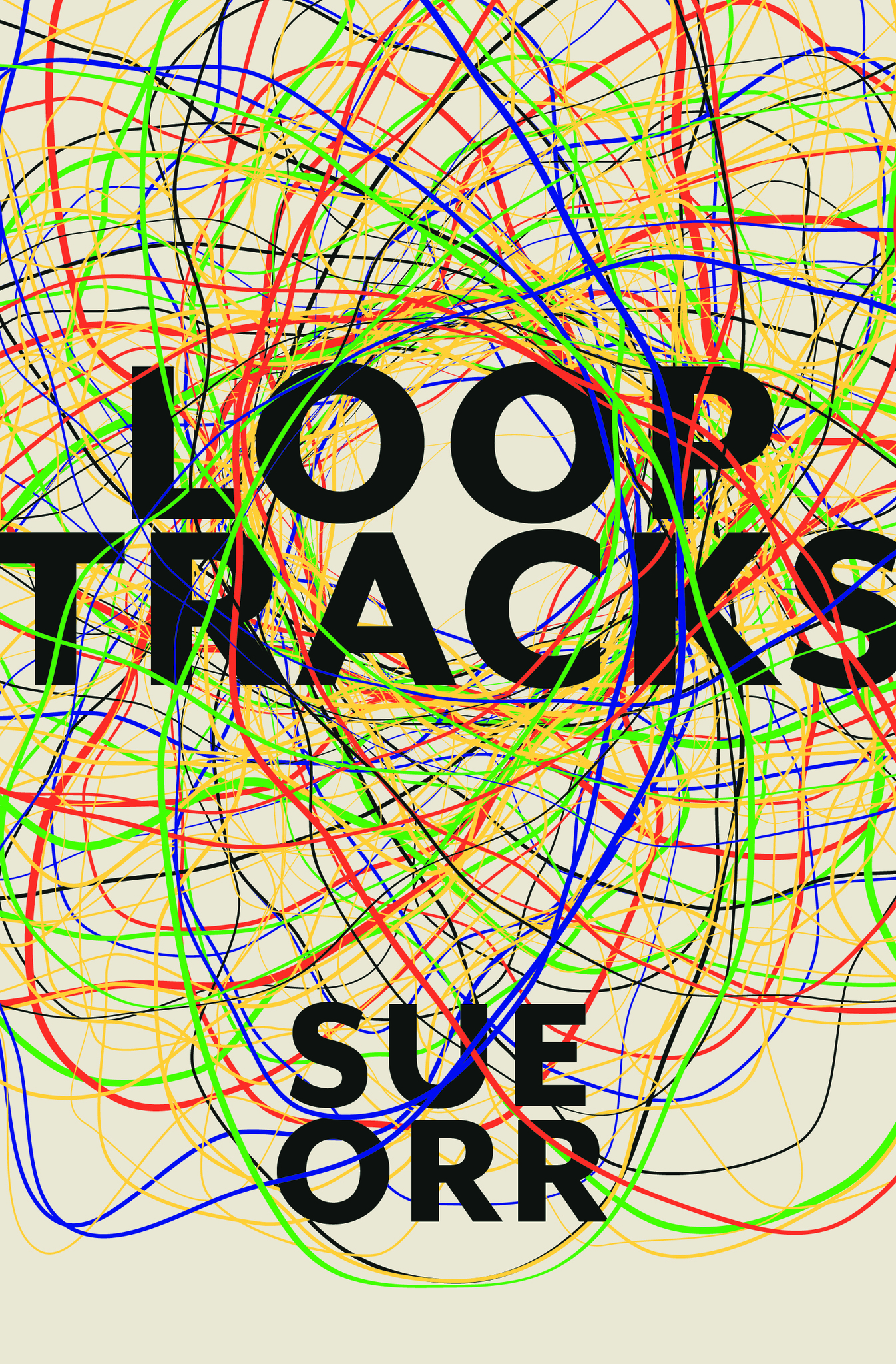
Loop Tracks by Sue Orr – 2021

Charlie Lowry was fifteen-years-old in the late seventies – full of dreams and fantasies, and concerns about her peeling toenail varnish. She wanted boys to notice her, and they sometimes did, but for her fascination with words – she was always one for the funny pun – they didn’t see her potential for glamorous romance. One night at a party, a boy did notice her – and she thought she had achieved her dream. But instead, she found herself in a situation that could only be resolved by a quick trip to Sydney, or by her ‘going up North for a while’.

Many years later Charlie is living in Wellington with her grandson, Tommy. She has given up on her wish to study and apply her flair for linguistics, due to experiencing bouts of vocal disfunction. She teaches five-year-olds at a local school. The realisation that Tommy has formed a relationship with a fellow maths student at university, and the unexpected return of her son, Jim, leads Charlie to reassess her life. She considers what information she has shared with her son and grandson, and whether it is time to reveal more. And also whether it is time to be honest with herself about her traumatic past.

If all this sounds a bit heavy going, it isn’t – Loop tracks is honest, compassionate, and compellingly written. It look at generational relationships. It considers what power the State has to interfere in an individual’s life decisions – whether those be decisions a woman makes about her body, or about the agency of some to choose to end their own lives. It considers what right males have to put young girls into situations they have no ability to manage – we see the power to do so developing in the five-year-old bullies in Charlie’s class. And Loop tracks eventually confronts the State’s power to curtail freedoms to protect citizens from a deadly virus, and the obligation of individuals to comply. It highlights the decisions, sometimes immediate, spontaneous, and unconsidered, that send lives on paths that might otherwise have been avoided or missed.

In one section of the book, Charlie goes back to accompany her younger self as her mother takes her to the doctor, her mother suspecting Charlie is pregnant, Charlie thinking that is ridiculous. The reader confronts the absolute naivety of the young Charlie, how impossible for her to relevantly answer her father’s plea: “What were you thinking, Charlie?” Charlie finds herself on a flight bound for Sydney, there being few options for safe abortion in Aotearoa in 1978. Her parents have fallen into debt to fund the trip – her mother leaves the airport jealous of her daughter’s chance of an overseas flight. The reason Charlie makes her decision to leave the plane on the tarmac is pathetic, as in full of pathos – and it is a decision with life-long consequences.

Jim is a monster in many ways, he is a drug peddlar, a manipulator, he carries memories of the bodies of dead young women. Jim is a reason for Charlie to regret her decision to get off the plane. Jim’s son Tommy – abandoned by Jim as a child – is a reason for her to celebrate that same decision. Tommy is beautiful and a wonder to Charlie. He is a mathematician and “… she’s a words girl. Numbers are not her thing.” Tommy is socially awkward and has no filter to his emotions: “he’s so literal, people find that difficult”. He has sudden bouts of fury: “Rage, reflection, remorse. That’s the order, the only way he can process the hard stuff.” Charlie feels she must protect Tommy until someone else can take over. Despite the sacrifices she has made for him, she knows Tommy has no empathy for her – he is brutally judgemental.

Jenna is Tommy’s friend. Her sister, Suzie, plays Loop Track music. Tommy is entranced by the building repetition of Suzie’s music the way he was, and still is, absorbed by Charlie’s old Spirograph machine. Suzie, who we never meet, also knows Jim – and Jim’s dark shadow grows over Charlie’s family. Charlie’s friend and workmate, Adele, is a moderating element – pointing out to Charlie that she is prone to spying on Tommy and Jenna; that she is still trying to control Tommy’s decisions; that she seems not to be acknowledging the reality of what happened to her in 1978.

The arrival of the 2020 Covid-19 lockdown and the Euthanasia Referendum of the same year, pulls the novel into tight focus. Tommy tracks the outbreak, and becomes engrossed in arguments about his responsibilities to protect life at both ends of the life cycle. And his logical un-empathic approach is a challenge to Charlie and her beliefs. The isolation of lockdown (she is both with and apart from Tommy) allows Charlie to become aware that she is lonely, she longs for “the hot rush of human touch”. Lockdown provides yet another set of opportunities for Charlie, and decisions that will either fulfil or deny those opportunities.

Loop tracks is a brutal book in many ways, but it glows with humanity. It suggests the importance of being honest about memory, about beliefs. It emphasises being kind to yourself, but also the importance of thinking beyond yourself when considering the decisions you make and the paths you choose. A very powerful Aotearoa read.                

Posted in Book Review | 2 Comments

Two Truths by Dana C. Carver – 2020

If you love books about secret societies,  The holy blood and the holy grail–type conspiracies, ancient treasure hunts, von Däniken–adjacent human origin stories, New Age science and history, and grand unified theories of, well, everything … Two truths is the book for you. A woman and her three daughters set out on different quests to find the ‘truth’, all for different reasons, and possibly searching for different truths. They discover a power that could be the salvation or the end of humanity.

Renee had an experience with a strange (but literarily familiar) man as a teenager that changed the course of her life. She dissented from that course eventually, but had to pay a price, and in doing so fulfilled the prediction of the man: that she would have three daughters. Scott, Renee’s husband, has prepared the eldest daughter, Brett, for a life as part of The Order, an elite exclusive cabal. Sara is a social-media-addicted teenager, slightly goth, naturally dismissive and rebellious. And Hadley, the youngest daughter, floats through life with her head full of bible verses and dreams

Sara bumps into Penny, the daughter of a colleague of her father’s, at the colleague’s funeral. Penny, with whom Sara becomes slightly besotted, warns Sara that their fathers had discovered something that had put them in great danger: her father had been murdered and Sara’s father was next. Dismissing the claims, Sara explains that she is being bundled off to New Zealand: “Do they speak English there?” All but Brett, who is estranged from her family, go to the far-off country.

It is in Aotearoa that Scott dies, but not before realising he has been cultivating the wrong daughter. Sara becomes intent on revenging Scott’s death. Hadley, who is brought back from death at the accident that kills her father, loses her ability to speak and her will to live. Renee takes the girls back to their home in Cincinnati, where Sara searches out Penny. Sara and Penny start on a quest to find out about the deaths of their fathers. Hadley meets up with a mysterious man and eventually “She had found the Truth, and in doing so, had lost her religion”. Renee gets involved with Jonas, a beautiful young basketball player. And Brett becomes more and more embroiled in the machinations of The Order: “Silly game or not, she had no other option but to play it.”

To say anything else about who, or what, everyone is; or, how the quests of the four women come together, would be to spoil the plot. It covers so many familiar tropes it is fascinating to read how they are all woven together. There is the power-hungry triumvirate of The Order, the Catholic Church and the “money launderers” – AKA big business tycoons and their political henchmen. The seemingly inevitable development of hierarchies: of beings, of classes, of blood. The spiritual quests of individuals who fall by the way, as they fail to see that their goal is right before their eyes the whole time. The dangers of actions that are taken “for the greater good” …

Chapters are told from the point of view of different characters, which gives the narrative great texture. From the outset you are in a strange but oddly familiar world – Hadley being accompanied by a ghost and an angel, Renee acting on her attraction to Jonas – who is reminiscent of the biblical Nephilim. The use of biblical texts to prove the ancient use of nuclear technology, and the genetic manipulation of humans. Saint Germain still wandering the streets of Paris. And there are the more sinister themes: older men coaching teenaged girls. The head of the secret society using sex to manipulate his followers: “The only answer is to submit.” The casual suggestion of eugenics.

The mistake the two fathers made was in intending to enlighten the uninitiated masses by informing them of what they had discovered. We learn there are those who are living lives that have lasted for millennia. Those who have lived through many lives – some who remember them, some who can be encouraged to remember them, and those who will always be ignorant. These latter are the Masses. There are parties who think “The Masses pose a threat”, and there are parties who think the Masses are our only hope: “This is the world I love, the world I see every day and that most people walk by without noticing. If you do not love what the world is in its simplest form, you will not be able to save it.”

There is whimsy to some of the writing: “The countertop was bright orange and the curtains were yellow and pulled back with a piece of lace. On the wall was a black clock shaped like a cat, with eyes that rolled back and forth with each tick.” However, the themes are dark: the attraction of suicide – Ernest, Renee’s initial awakener in this life, commits suicide; Hadley must be constantly encouraged to focus on life, not death. And insanity is always hovering, as a place to hide – Renee “how easy to blame delusion.”

The two truths of the title refer to an empirical truth and a transcendental truth – and the confusion as to which is the more powerful, the more dangerous. The paradox flows through the text – one of the ‘higher level’ beings is always cooking, gardening, or making things from wood. Humans are cast as both the playthings of the gods, and those some gods love so much they can’t desert them. The story works its way towards a great reunion as the climax – and there is a challenge – which way will be chosen? Power and exclusion, or the realisation of connectedness and opportunity for all?  

I read this book as COP26 is being held in Glasgow. Once again, the world’s leaders are discussing how to address the ecological and climatic disasters the ‘money launderers’ have wrought. It would be good to think when asked the question posed in The two truths – “And do you know what each of us will choose?”, they would choose the better path. Yet as Renee observes of herself and Jonas, they have become aware of so much “Yet we stroll on an autumn evening as if nothing is different”. An interesting, entertaining, and enjoyable read.


Posted in Book Review | Leave a comment

Crazy Love by Rosetta Allan – 2021

Crazy love is about addiction, art, love with no boundaries, and the burden of mental illness. It is sad, beautiful, frustrating, and tantalising. It is about survival and despair and mundanity. It is about Vicky Miller and the destructive love of her life, Billy Cooper. It is semi-autobiographical and totally charming and totally worrying at the same time. It is extraordinarily honest, and a perfect example of how messy life can be.

Vicky had a far-from-ideal upbringing: “Weird to have such a disappointing mother be disappointed in me”. She has a microsecond stint in the army, where she learns to make a tight bed, but doesn’t find Richard Gere (it is the 1980s). A post-abortion infection means she returns to her hometown, Napier. After some dead-end jobs, she washes up in Art Deco ‘Dire Straits’ – a living complex full of the unemployed, partially employed, and dodgily employed, all with no families to fall back on.

Crazy love evokes the 1980s with song lyrics interspersed in the narrative and descriptions of the unique fashions of the time. It is an interesting time in Aotearoa’s political history, but Vicky is only mildly interested in politics – she is too disenfranchised to take much notice. She does write to Robert Muldoon to voice her frustration at only having enough money for one pie a day – she gets a response: $1 for one extra pie. It is a funny/not funny moment but also prefigures the struggles Vicky will have later, with a bureaucracy that, in aiming to help all, struggles to help each. Like many women in a society where social support reinforces female financial dependence on partners, Vicky must put up with a ‘loser-boyfriend’ to survive.

The reply to her letter to Muldoon heralds the unconnected arrival of Billy – and her life is never the same again. Billy is beautiful, “…this punk, he had my attention”. He is a punk, but in a stylish way. He is a high-flyer with big plans. Billy is unpredictable, unreliable, a bit of a grifter, with mercurial moods. He is enticing, and Vicky and Billy get married. Vicky knows that Billy’s successes are mostly mirages. However, initially they do find financial success as a married couple. They have a lovely big house, plenty of money, and two children. They both have the continual need for affirmation, but their financial stability satisfies that.

The reader looks back on this time of success obliquely. Vicky enjoys writing poetry. She raises her children and helps Billy with his business. “Billy and I had big plans over the years. Some succeeded, some didn’t.” Then it all crumbles. Fortunately, the children have left home. Vicky and Billy move to a house with Dawn Raid hideouts under the floorboards and in the roof cavity. Vicky finally admits that the exciting rhythms of Billy’s life: “He’s my yoyo man”, are due to serious mental illness. Vicky is small. She knows she is vulnerable. Due to the many dangerous situations she has been in, she has learned the art of running away. She doesn’t run from Billy.

We pick up the current narrative with Billy living like a wild man outside in the garden, with Vicky inhabiting the house. She finds official help is hard if not impossible to find. She finds out who her friends are – almost all women – the men are afraid of Billy. Billy’s behaviour is manipulative, passive-aggressive, and often pathetic. It makes you wonder if all abusive partners have a serious mental illness! “We are the beautiful-bold. Strong as long as we are together. Billy and I. Only, he has been such an arse lately.” Vicky has always known Billy has viewed her as a wife to look after him while he flourishes. At one point she proves to herself she could kill Billy if she wanted.

Vicky starts writing a novel, it is a long process – she is working on Purgatory, a novel I still think about often even though I read it seven years ago. She is functioning well, while she lies for Billy and complies with his illegal flurries. He is overweight, smelly, yet still strangely attractive. She decides if he commits suicide, so will she. Her children are ciphers for the way she sees herself and Billy. The son is ‘eat-and-run-son’, always leaving and far away yet emotionally closer to her than to Billy. The daughter is ‘surly-girl’, always judging and blaming Vicky. “What if I was to blame for stopping Billy from being the wondrous Billy he used to be?”

“He forgets he’s not the young punk who took on a carload of young dicks sassing him at the burger bar in Napier.” When Vicky decides she is damaging Billy more by covering for him that by asking authorities for help, she provokes a response that illustrates the lack of help for those with mental illness – a ‘riot squad’ arrives. Despite Billy almost avoiding it through his charm, he ends up in an acute mental health unit. They communicate via haiku-like missives. Vicky is alone, grieving for the baby she lost before joining the army, for her beloved dog, for the cat she left behind in ‘Dire Straits.’ She wonders if splitting from Billy would be the best thing for him.

Move to the present: Billy is still Vicky’s “Strange man. Strange, strange man.” He is a conspiracy theorist, but he is taking his medication. During Covid (“a hoax to disguise the fact that there are intergalactic space travellers on earth for negotiations …”), they panic buy wine and tealight candles, not toilet rolls. They have survived, and will continue to survive, as they have the most astounding unconditional love. The reader is left puzzled yet comforted, and at the same time very uneasy, “the perimeter is never secure, really, is it?” A powerful piece of Aotearoa fiction/not fiction.

Posted in Book Review | Leave a comment

The Last Guests by J.P. Pomare – 2021

“Someone else is out there, watching, waiting. Terrorising us.”

Lina is an ambulance driver, dealing with emergencies for a living. She is also dealing with Cain, her husband of seven years, who is still having nightmares after returning injured from serving in Afghanistan. Lina worries about money and about her marriage. Cain wants easy money not “a boring job”. Lina agrees to his easy-money scheme of renting out her family lakehouse at Tarawera via the WeStay app. Lina uses another kind of app. to take desperate measures to save her marriage …

Cain’s injuries were sustained during a botched special forces raid. He and his mate Axel were to testify at the enquiry, until the man facing charges – their comrade, Trent – committed suicide. Cain was seen as a hero, until the enquiry put a shadow over his tour. He has turned to gambling in the past to make money when his personal-trainer business failed to take off. And Lina fears that’s what he is doing again. He wants to be a hero again. He wants to be her saviour.

Lina spends her life proving she is not like her alcoholic mother, “I’m nothing like her”. She was raised by her grandparents in the lakehouse, and carries her memories, both good and bad “Mum turning up, eyes bloodshot, haggard. The screaming. Grandma sweeping up the broken glass”. She is also haunted by a miscarriage she had when she and Cain lived at the lakehouse. She knows a baby will give her a chance to prove she is not her mother. And will give Cain purpose, a reason to move on from the war.

When they list the lakehouse, Lina and Cain engage in ‘innocent’ online stalking of potential renters – finding how easy it is to see their personal details. They have sex, both enjoying imagining Lina is one of their guests. The reader already knows there is a far more sinister form of surveillance going on in WeStay houses – and Lina finds out the hard way, when she visits a WeStay property in Auckland. She ends up being pursued by someone, someone who has information that could ruin her marriage. They also, symbolically, have her heirloom wedding ring.

Lina and the reader end up suspecting everyone, even those trying to help. She falls into a nightmare of demanding honesty from Cain – and getting more than she bargained for – while keeping secrets from him. She thinks all her decisions are for the best, but many come back to damage her. Her medical training (she was in med. school before dropping out to be a paramedic) means she is inured to death and injury similar to the way Cain is – “Soldiers being blooded by killing prisoners. You’re never the same, I’ll never be the same.”

“Even the best photos of the view miss the smell, the air” – the lakehouse is idyllic, but turns to a house of horror for Lina. She is put in extreme danger but gets help from a very strange source. And she, not Cain, ends up the hero. In the aftermath they have to suffer journalists and interviewers. The media is not out for truth, but for click-bait and public attention. Cain and Lina see the ‘good bloke defence’ potentially obscuring the crime. Then when Axel and his wife Claire travel with them to the lakehouse, Lina starts to realise the nightmare might not be over. She still has some big decisions to make. “Everything is wrong.” What decision will make their world right?

The last guests is a gripping thriller in a world where ease of surveillance has lead to voyeurism being a commodity, and where a dulling pragmatism leads to people doing extreme things to secure their ideal lives. It is a tense read, and the reader is guessing the whole way through. Lina is a complex and interesting character – who makes morally ambiguous choices. Excellent!

Posted in #yeahnoir, Book Review | Leave a comment

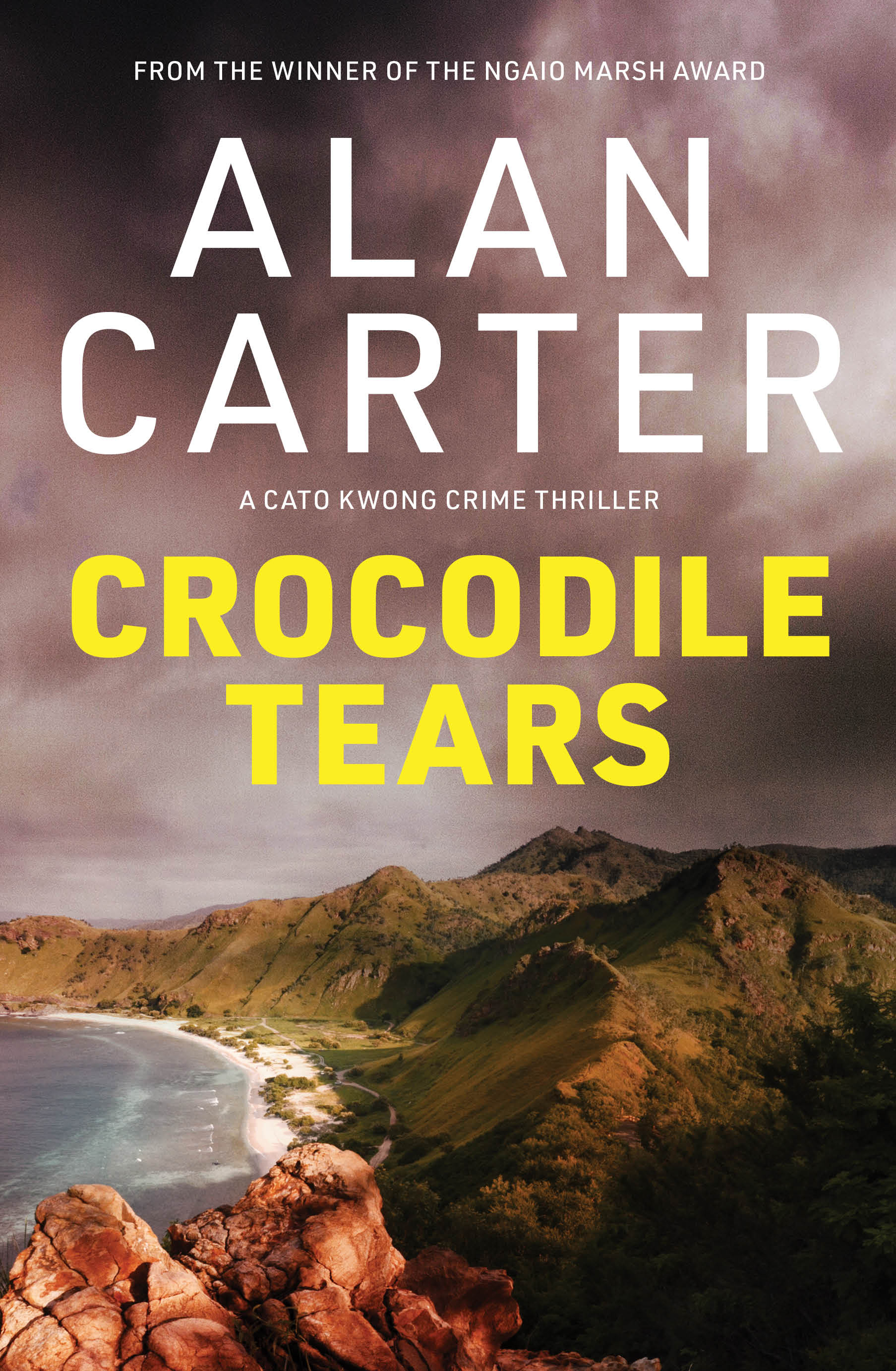
Crocodile Tears by Alan Carter – 2021

Philip ‘Cato’ Kwong, now part of the Major Crime Unit in Perth, is dealing with two, apparently unrelated, mutilated bodies – one an ex-cop one an ex-schoolteacher. Sharon Wang, his wife, is a federal agent, working nights at the international airport. She deals with an unruly passenger off a flight from Darwin, who is later discovered hanging under a bridge in Freemantle, with Kwong’s details in his pocket. Rory Driscoll (who we first met in Bad seed) leaves his quiet life as a “simple fisherman out Woop Woop”, when his name appears on a hit list along with three others, and he has no idea why. Kwong, Wang, and Driscoll all work separately and then together to try and work out how all is connected. They end up in the murky world of corruption, conflict atrocities, retribution, big business, and unholy alliances.

Kwong is “looking older, carrying a bit more weight, had some grey at the temples”. Due to their work, he only sees Sharon briefly each day. Ella, their daughter, is at the quicksilver terrible-twos stage. Kwong keeps going by using anti-depressants more frequently than prescribed. It shows – as Sharon observes: “Sometimes you seem like the old you. Other times, I don’t know. You seem flattened out. No edges, no highs, no lows. Not present.” He wonders why he is still on the job, but this latest case is intriguing, he keeps getting text messages telling him he is on the wrong track – and has no idea who is sending them.

When Kwong finally sees Driscoll “he detected a certain mellowing with age, nothing specific, but not quite the man he recalled”. Driscoll has been dragged into the story and is finding it harder and harder to discern who the good guys are, who the bad guys, and who the ‘not-quite-so-bad guys’. It is a confusion Kwong and the reader shares with him. The two men progress through complicated territory. In each of the Cato Kwong novels, a social issue is explored. In Crocodile tears it is the involvement of governments in inciting or suppressing internal conflicts in other countries, the aftermath of atrocities, the role of business interests in controlling government policy, the dangers arising from governments outsourcing their security work, and the migrant crises that arise from international conflicts.

The conflicts in question are the many that took place in Timor-Leste – the struggle for independence from Portugal in 1975 and then from Indonesia in 2002. The ongoing struggles arising from outsiders trying to make a buck and enjoy their positions of privilege. Kwong discovers the connection between his victims goes back to their volunteer work in Timor-Leste, and then their later work at the Christmas Island Detention Centre – holding asylum seekers, plus ‘501s’, ex-prisoners awaiting deportation to Aotearoa or the UK. There is also a connection between Sharon’s unruly passenger and one of the people on the hit list with Driscoll – both connected to Timor-Leste. The connections keep falling into place, but clarity takes a long time to emerge.

What starts to become clear is the far from noble role that Canberra has been, and is, playing in the region. That massacres and atrocities were committed, and the skulduggery continues. And that Kwong and Driscoll have no idea who they can trust – or whether they can even trust each other. Driscoll, when trying to keep safe the ‘hit list’ group (all but him due to be witnesses at a Hague committee on Timor-Leste) finds they are being tracked – but by whom, and how did they always know where the group would be? Kwong starts to think he is being used – but by whom, and for what? Sharon has her fair share of action – “Give me some credit. Why’s it always about you?” – when she tries to investigate the man she dealt with at the airport, and becomes a person of interest, and embroiled in violence.

All the clues lead to a past militia-leader and long-time liurai (district lord). He is a man guilty of heinous crimes, who turned out to be on the wrong side of history. But he is now connected to people in high places. He is certainly guilty of past crimes, but is he guilty of Kwong’s cases, or has he been set up? “It had spooks written all over it – but whose?” And for some does it matter if he is guilty of current crimes or not? Those who feel safe in the present often leave the past behind, however there are those whose lives have been so damaged they can’t forget the past. For some it is all a game, but “The game didn’t seem so great once you saw it from the point of view of its innocent victims”.

Kwong and Driscoll are not friends, but they do arrive at a partnership: “Should you be telling me this?”, “Probably not, I think it might be an official secret”. Driscoll’s controller, Aunty, “a taxpayer funded mandarin”, is an ambiguous character – Driscoll comments: “Sometimes Aunty, I wonder if you’re making this up as you go along, do you even know whose side you’re on?” Kwong proves good at left-field distractions in times of crisis. But both men are wondering why they are doing what they are doing. Those who have been immediately and involuntarily damaged have a clearer view – they want revenge, or they are “trying to see a way forward that doesn’t involve violence. We’ve seen enough.”

Crocodile tears involves an endless circle of Big Oil, private and corporate greed, and personal retribution. There are the dangers from “The pathological need to win at all costs” and the numbness of an age where “Nothing is shocking anymore”. With a horrible twist on the modern phrase, amorphous alliances are described as heralding “a less binary future”. In the face of implacable power, going back to Woop Woop or taking your kid to the beach seem sensible options. At the heart of the novel are the personal stories we hear along the way.

Crocodile tears is phenomenally well plotted, and it is a darker read than the previous Kwong outings. There is plenty of action – bombs exploding, throats being cut, guns being held to heads – and the voracious crocodiles are never far away. The story ranges through Western Australia, Tasmania, the Northern Territory, and Timor-Leste. Although a hard political thriller – full of agency abbreviations; ASIO BIT AFP PNTL DFAT … – the novel is an intelligent and moving read. Carter has presented some clear messages, for example asking if remaining “silent and inactive if you really despise the things governments do in your name” is conscionable.

This is the last in the Cato Kwong series, and it is a fitting ending. Although I would have liked to follow Sharon Wang in her new position in the AFP – maybe she’ll pop up in a future series. Crocodile tears is reviewed here as Alan Carter was part of the #YeahNoir scene for a while and continues to be part of the Kiwi mob. I think the takeaway line of the novel for me would be: “All this knowing and still the world would turn as it always had.” A great read.

Posted in #SouthernCrossCrime, Book Review | 1 Comment

The Animals In That Country by Laura Jean McKay – 2020

I think anthropomorphism is useful when it enables people, and researchers, to see non-human animals as thinking feeling beings with a sense of their place in the world. I think anthropomorphism is a bad thing when it entails the animals thinking and speaking from the point of view of humans – i.e., with a Disneyesque view of their happy lives. Laura Jean McKay has given us a new form of anthropomorphism; she writes of a dystopia caused by a disease that enables humans to hear what non-human animals might really think, and it’s not pretty.

Jean is an aging, hard drinking, straight-talking guide in an animal park in the Australian north. The park is run by her ex-daughter-in-law, Angela. Jean wants to be a ranger, but she drives Angela crazy with her behaviour – for example going into the dingo enclosure to help Sue the dingo, who thanks her by biting her hand. Jean is kept on at the park mainly to mind Angela’s daughter, Kimberly, allowing Angela some freedom. Angela’s husband – Jean’s son, Lee – and Jean’s husband both took off some time ago. Jean and Kimberly have a very close relationship, they constantly tell each other what the park animals are saying, complete with silly voices, and they covertly plan their own animal sanctuary, named “Come to Kim and Granny’s Animal Place”.

There are fleeting mentions on the news of H7N7, Zooflu, in the south. Angela is worried she might have to close the park – there are activists, farmers, and pet-owners, liberating animals from farms, homes, sanctuaries, and zoos. The disease spreads north, and Angela does close the park. Things start out OK – Jean and Kimberly even take on some ranger duties for a while. And then Kimberly slips up. Jean’s son Lee turns up yearning for the sound of the southern whales. Kimberly and Jean get the Zooflu. Jean’s hand becomes badly infected. Angela becomes very sick. And Lee and Kimberly disappear.

From here the novel takes on the shape of a typical dystopian road story. Jean takes off to find Lee and Kimberly. There are fuel shortages, food shortages, fighting over resources, suspicion of strangers. There are parallels with the Covid pandemic: the rush to find a cure, people resorting to extreme treatments – the reader wonders why there is a shortage of hand drills! – conspiracy theories, people in denial, instant judgements depending on mask-wearing or the lack of. The non-religious thinking Zooflu is the work of God, the religious doubting that.

Yes, it might be a typical dystopian tale, but this one is accompanied by constant non-human commentary. And one of the two main protagonists is Sue the dingo. Jean’s condition allows her, and the reader, to ‘hear’ Sue, who suggests, “The best plan is a plan.” Jean agrees and they travel together. Jean slowly starts to make more sense of Sue’s comments, seeing the unique view of another creature, and, miraculously, so does the reader.

Sue and Jean’s journey takes us to the residential care home where Jean’s mother lives, various small towns where we meet characters in passing, to the farm where Jean’s ex-husband lives, and where we find out large secrets about Jean and her family. We pass horrendous sights and sad sounds. There is an encounter with pigs freed from a truck – I’ll just say I’m glad I don’t eat pork. We visit a small, abandoned animal park full of misery. We hear the confusion and desperation of the domestics, the psychoses of the captive, and the cacophony of the wild.

Jean gets sicker and sicker, her infected hand not helping, we hear more classes of animals: the birds, the insects …, all distinguished by font style. The writing and the structure of the novel relentlessly takes us towards the sea and the whales – who also have an ambiguous but compelling opinion. The title of the novel comes from a Margaret Atwood poem, where animals are distinguished geographically by how humans view them, and how they kill them. McKay’s novel provides another perspective, that of the other-than-human. And it is presented so enthrallingly that when human law intervenes, and we come to the end, we are left breathless and bereft.

The animals in that country won Best Science Fiction Novel in the Aurealis Awards, and recently won the 2021 Arthur C. Clarke Award. The bond between Jean and Sue will stay with me for a long time – “Even while her body is bursting with messages, there are still things in her head. Dingo things I don’t know about. I’ve got human things she doesn’t know about either, even though I can’t remember any of them right now”. I absolutely loved this book!

Posted in Book Review, Science Fiction | Leave a comment

Before You Knew My Name by Jacqueline Bublitz – 2021

Jennifer Beard, Monica Cantwell, Heidi Paakkonen, Mellory Manning, Grace Millane … just some of the women’s names we in Aotearoa know because they died brutally at the hands of men. Their names are all most of us do know about these women – that and the circumstances of their deaths. Jacqueline Bublitz has framed Before you knew my name around this sad fact – and the fact that women develop “Self-preservation as a replacement for instinct”.

Alice Lee, for much of the novel named ‘Jane Doe’, narrates the novel: “But here I am, still unseen. Who killed Alice Lee? is not really a question about me, is it?” Alice arrived in New York from the Midwest, fleeing a controlling schoolteacher with whom she was having an affair. She had led a constantly changing life, her mother moving on from various abusive partners, until she made a decision that traumatised her 14-year-old daughter.

The wisdom her mother passed on to Alice was: “They never doubt we need them more than they need us.” She told Alice she was strong, that women were made of metal. But what does that mean for Alice? Especially given her mother’s final choice. It isn’t until after Alice’s death that she learns her mother’s full story. She observes a world where all women are at risk. Where they are confused about what will keep them safe. Compliance? Resistance? Alice did find someone in New York she could trust: Noah. Noah who told Alice about nebulae – “Stardust, then, is both the end and the beginning of things.”

Ruby arrived in New York on the same day as Alice. Ruby is the jogger, as in “Her body was found by a jogger”. Ruby’s life is irrevocably changed by finding Alice – another thing that isn’t explored by news articles, or TV crime dramas; the impact of finding the ruined body of another. Ruby is from Australia and fleeing a dead end but compelling relationship with a man soon to be married to someone else; “Ash remained the lump in her throat, the ache in her bones”. She feels out of place but occasionally “to be found odd in New York feels like a triumph”.  

Alice tries to steer the investigation into her rape and murder towards vital clues but “they don’t teach you how to be out of the world any more than they teach you how to be in it”. She has an ally in Ruby, who becomes obsessed with finding out about ‘Jane Doe’. Ruby finds herself first focussing on what kind of man could do such awful things, but then she realises the more important question is “Who on earth was the girl he did those awful things to?”. Alice tries to be more in touch with Ruby but “When the dead speak back, we are seldom heard over the clamour of all that living going on”.

Ruby encounters creeps on online dating sites, she talks to Tom – “another man fascinated with dead girls for all the wrong reasons”, she realises she was so close to being the body she found rather than the jogger. She becomes hyper-vigilant to the dangers around her, she doesn’t know how to react to men who talk to her – “It is never just one life these men destroy”. Ruby seeks help. She goes to an unhelpful support group “a Jenga tower of misery just waiting to topple”. She finally finds the Death Club, a small group of people who have tired of the superficial gloss of most conversation and want to discuss the serious things.

Ruby initially takes solace from the Death Club. Lennie, who works in a mortuary, and who lives amidst the chaos of the shattered lives of those whose bodies she reconstructs. Sue, who still grieves over her daughter who died in a car crash. And Josh, who came close to death when he came off his bike. Even though “We think in years”, people lives are changed in much smaller measures of time. Lennie advises: “intensity, not time, is what connect us.” But Ruby still finds it hard to accept that she has found some trustworthy people.

Before you knew my name, tells well known stories with a different perspective. The perspective of women: “Do you know how aware we have to be? Girls like me. The man ahead who slows down, who disappears into doorways. The man close behind who walks too fast, his encroachment felt on your skin, creeping …” In one way Alice and Ruby are living clichés, arriving in New York naïve and hopeful: “To think Ruby and I both thought this was the adventure. We really had no idea.”

Although using common tropes, there is nothing clichéd about the writing of this novel. The narration is stark and distressing: “There was an I, and it was me. I was at the centre, looking out. Until someone decided to enter the space I had created for myself, take it over.” It is an exploration of how women navigate the minefield of life. It is a murder mystery, with clues and red herrings. The resolution is a testament to the strength of many women and the weakness of many men: “Men … betray their own secrets, because they so desperately want to stay at the centre of things.”

Before you knew my name is tragic but warm-hearted, and Alice and Ruby are wonderful characterisations. Alice wasn’t murdered because she should have behaved differently to keep herself safe. She was murdered because in our society men are dangerous. “I suppose I let my guard down. At the end. … It surprised me. The shock of how little you can mean to another person. How an entire world can be discarded so quickly. I was right to think I would never be safe, that I needed to be wary. But it still surprised me. At the end.” A superb debut novel.

Posted in #yeahnoir, Book Review | 1 Comment

Double Helix by Eileen Merriman – 2021

Jake and Emily were childhood friends and neighbours. Now in his early twenties, Jake returns to Dunedin from Auckland, where he has been studying after failing to get into medical school. Jake will finally start his medical training, which Emily started a few years before. Emily is now in a relationship with a first-year doctor. Jake and Emily have an enduring attraction. The scene is set for a medical romance. However, Jake and Emily share a secret – one that continues to both bind them together and push them apart – the scene is also set for a harrowing novel about the cruelty of fate and the despair of those at its mercy.

Emily escapes her anxieties by sketching. She wants to create a graphic novel called Double helix dragon – with a heroic main character who can face fate without fear. There is internal fate – the fate of genetics, of blood clots and intercranial haemorrhaging, and miscarriages – intertwined with external fate, the fate of flash floods, suicide, and random accidents. Like Emily, Jake has an escape – surfing: “the ocean moving beneath him, like the ebb and flow of his heart, until he felt as if he and the sea were one and the same, no beginning and no end”. Even in a glass of beer Jake sees the scud of foam as “an outgoing tide”.

Double helix has a romance novel arc: a lost letter, constant misunderstandings over suspected infidelities, over secrets kept and revealed – but through this arc are tragedies. Emily has a hard time at med. school, she has panic attacks, she faints in front of a patient, walks out of her viva. She is haunted by the memory of what she had been able to do as a teenager. Jake takes some energy from the same incident; he copes with the insane stress young doctors are put under. He becomes a conscientious and kind practitioner – the kindness extending to decisions made about patients in pain with no hope of recovery. He sometimes crosses the line of impartiality.

The novel has excruciating depictions of family toxicity. Jake’s father abandoned him when he was eight, leaving him with an ill mother. Emily’s father is controlling and manipulative. Her mother is generous and caring, but there is a sharp side to her, as Jake finds out in a show-down. Emily thinks Jake abandoned her when he went to Auckland all those years ago. But Double helix is not a simple tale – there are always at least two sides to every story. At the heart of everything is the Damocles sword hanging over Jake and Emily. “What you don’t know can hurt you. A lot.

Both Jake and Emily flirt with suicide – Emily in a hot bath “contemplating the thin blue veins beneath her milky skin”. And when Jake is surfing, he knows it would be as easy to surrender to the sea as ride it. Their characterisations are engaging and moving. And there are other great characters – Kylie, a fellow student and then a firm friend. Jake’s Aunt Ngaire, who shows the calm nurturing side of families. Despite Double helix being unflinching in its depictions of Jake and Emily’s journey, it is a hopeful book with buckets of heart, and I loved it. If it has one message, it is probably that voiced by Kylie: “Fuck fate.”

Posted in Book Review | Leave a comment

Things I Learned At Art School by Megan Dunn – 2021

Megan Dunn takes you on a journey – from her first infatuation with Strawberry Shortcake dolls, through her fixations on various other mass-produced toys, later wearing them on clothing as “beacons of burgeoning sexuality”. She attends Elam School of Fine Arts, the Intermedia department, she accrues a whopping student loan and becomes a video artist. She founds an avant-garde gallery in Auckland. She has waitressing jobs, and then is a receptionist/bartender at various massage parlours. She farewells Aotearoa – and then comes back for the heart of the story. Megan Dunn appropriates and edits her own life to create a resonating work of art.

Like the author’s brilliant Tinderbox, Things I learned at art school defies classification. It is a memoir, an essay collection, and a novel. It is full of facts. Facts about the conception and production or various toys, about the making of Splash and other movies, facts about TV themes and popular songs, about famous works of art. It describes what it was like to be a conforming non-conformist at art school. Where she and her cohort were unoriginally intent on deconstructing (ripping off) the originality of others to give the finger to the establishment. To be fair they were living in a time where a model of a balloon artist’s dog could sell at auction for US$58 million.

The book has a beginning, two middles, and an end. Many essays are structured into a narrative with characters. Her character lives through various guises, she is Alice in Wonderland, a massage parlour logo, Patricia Arquette, a mermaid. The narrator writes in the rhythms of the Jabberwocky, in the style of Genesis. Growing up she is bullied, and she has a sad view of the desires of ‘old’ people. Later she has fluctuating weight. She is hyper-impressionable to certain movies and authors. She is insecure, realising at best as an artist she is someone else’s “leap of faith”. She recognises public self-harm might not be an artistic statement but rather an expression of private self-hate. She breaks down during a psychosynthesis course, and she’s never been able to “feign affection” for herself.

Megan the character grows up with wisdom posters: Desiderata, The Serenity Prayer. She lives by appropriated catch phrases: “Are we having fun yet?”, “You’ll smurf what to do when the time comes, Smurfette”. “Everything retro can be brought back, thinner the second time around.” She has the required snobbery for art school: “art like so much else in our society has its hierarchy” and her cohort thought the mainstream was “beneath us, intellectually and emotionally”. The bubble of creating art works purely from appropriating the works of other artists, sometimes themselves appropriated, finally pops. The narrator becomes a reviewer and essayist. Her father describes an early piece as “a bit of a word soup” – “I’ve been making it ever since”.

After her time working in massage parlours, the author packs up for London. Saying goodbye to the beginning and two middles. And then there’s the end. Things I learned at art school says much about art, and true works of art are found adorning hospital walls, created by people in memory of their dead. She spends time with her mother, and the book falls into perspective. Her mother, who was always there when she needed her, despite her daughter ignoring her, or even disparaging her. Her mother sent the author a poem when she finally left home: “One / Lonely / Toothbrush”.

“Art is about everything surplus to requirements – that’s what makes it so essential”, a line that reminded me of Ryūnosuke Akutagawa: “there will always be those that say that art is excess and surplus to existence … Yet surely what makes humans human is always this excess and this surplus we create”. Things I learned at art school is wonderfully created surplus. I admit to being one of those thinking this was going to be Dunn’s ‘mermaid novel’, and quickly found it wasn’t. But in a way it is – with the author describing the emerging and submerging of artists, events, lives. I absolutely loved this book: “I’m drawing a picture from life. See?”

Posted in Book Review | Leave a comment

The Leaning Man by Anne Harré – 2021

Solace in the Wind is a Wellington waterfront statue, nicknamed The Leaning Man. Stella Weston loves the statue, wanting herself to be able to “lean fearlessly into the unknown, forge ahead, get things done”. But Stella is still traumatised by the incident that caused her to flee her hometown some years before, and Wellington is full of haunting memories. Excruciating toothache and jet lag add to her feeling “unsettled”. She is starting to doubt that her return for her parents’ 40th anniversary was wise. Then one of her best friends, Teri, is found dead in an alley, she discovers a body floating in the harbour, rough sleepers start falling victim to brutal attacks, and she reconsiders her view that “This wasn’t London or New York, for god’s sake. Things don’t happen here”.

Mad-Dog is a rough sleeper, he busks, playing angelic music on his expensive violin. He was once a classical performer, but after the death of his wife and child, he had a breakdown and has ended up on the streets. He keeps himself well groomed, but he is in constant pain and has a nasty cough. He has a few friends: a fellow rough sleeper, a luthier named Gus, who takes care of his violin while Mad-Dog is not busking, and one of the librarians at the central library. He tingles at the rare touch of another human. He muses “It’s all we want really … warmth, kindness, someone to believe we’re worthwhile.” Stella wonders “How can one man be so invisible” but “Mad-Dog had cultivated invisibility, turning it into an art form”.

Stella wants to find Mad-Dog, as he has a vital piece of evidence relating to Teri’s death, and she worries he might be the next victim of the rough sleeper attacks. The librarian Mad-Dog is friendly with is Stella’s Aunt Rita, so it should be easy to find him. Especially as Stella used to be a Wellington cop, on the fast track up the ranks to detective. She should go to the Police, but her guilt and self-loathing spills into her views of how others see her – old colleagues are the last people she wants to talk to. This drives Lassie, her lawyer friend Mitchell Lassiter, to distraction. He, and almost everyone else, thinks Teri committed suicide, but Stella is sure she didn’t. Mad-Dog might have the evidence to prove it.

Running parallel to the lives of the rough sleepers and Stella’s dishevelment, is the flow of affluent life around Wellington. For those readers who know Wellington, The Leaning Man is full of local references and familiar types. But Stella ends up descending into a nightmare world: she (perhaps too coincidentally) finds the floating body of a young girl in the harbour, she blunders upon suspicious goings on at a Kāpiti Coast day spa. Then she visits an exclusive night club where another friend entertains, and where Teri used to work – more strange encounters lead to Stella getting an awful inkling of what Teri might have discovered. The Leaning Man is a tense read, using that great technique where there are enough clues for the reader to be slightly ahead of the sleuth, knowing when they are heading towards danger not safety.

Stella is a great character, rough, clever, sad, and likeable. She finds out things about her family that she feels she should have been told about: her sister wants a child, her brother has gone off the grid, her mother has had a health scare. She finds it hard to realise life has gone on without her. This adds an interesting slant to the story, a haunted insecure woman determined to solve the mystery on her own – why was Teri killed, how does the body in the harbour fit in, who will get to Mad-Dog first? There are plenty of suspects, red-herrings, and psychopaths in the narrative. The reader starts suspecting what’s at the heart of the sequence of events, and it’s awful – but not as awful as when the truth is revealed!

“Like the fall of the Roman Empire, we are in decline”, the rational for the atrocities – things are falling apart so why worry about right or wrong? What gives this book its heart is that someone unhesitatingly does – I hope we see more of Stella Weston. The Leaning Man is a great debut crime novel.

Posted in #yeahnoir, Book Review | Leave a comment