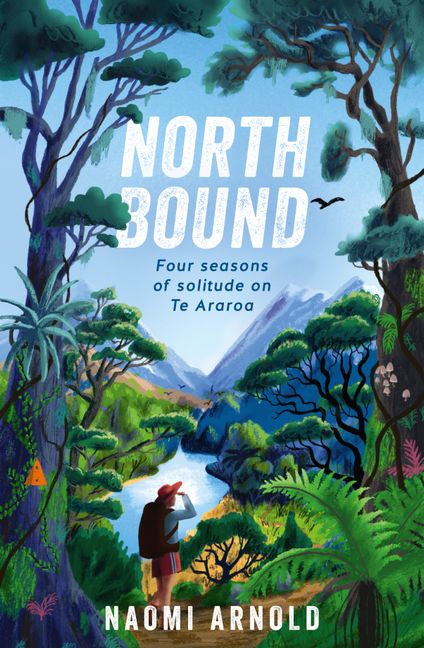
“It was at once too universal and too personal to put into words, an experience of awe and devastation known only to those who shared it …” Naomi Arnold walking the Te Araroa trail, which spans the length of Aotearoa, over 20 years after she first determined to do so – after reading Geoff Chapple’s Te Araroa: One Man Walks His Dream.
Northbound is far from a work of fiction, but I am reviewing it here as it is one of those wonderful books that resonates on so many levels beyond that of a travelog.
There are exquisite descriptions of the Aotearoa wilderness, its wildlife, its parks and reserves, beaches, and its urban landscapes …
“The beaches were a mosaic of stones and shells, scraps of broken-up pink and white sea creatures I had never seen before. There were giant kina skeletons, huge slabs of kelp slumped on the shore like elephant trunks, scatterings of mauve and fuchsia seaweed. The waves were crashing eggshell blue, dragging the pebbles back to themselves, sorting them according to size.”
It includes histories of some of the areas Arnold walks through, and of the trail itself – meeting those whose idea it was, who helped make parts of it more navigable. And it describes Arnold meeting others walking the trail, those whose paths intersect with hers. She becomes part of a community who have developed their own lore, their own acronyms: They are walking the TA; Arnold is a NOBO – walking bound for the north, passing SOBOs as she does; all who agreed that people should HYOH, Hike Your Own Hike; Arnold is an Effer, she had decided to walk EFI “Every Fucking Inch”.
Northbound is a love song to Aotearoa, to its beauty, its dangers, and its people. She encounters non-hikers of every political viewpoint, but all she meets are the same in their generosity and kindness. On the actual trail she meets very few people, especially in the North Island, and is shocked, even scared, when entering populated areas: “I felt scared of people now, yet craved to be around them.” It is a cliché, but the book is an account of a journey of self-discovery – she notices and documents the changes in herself, both physical and psychological.
Arnold’s tale is the inverse of a glorification of a woman alone in the wilderness – she is often scared, often angry, and she cries a lot. She is frequently slogging through mud – over her boots, up to her knees, up to her waist. It reminds her of The Piano, a movie so Kiwi she can imagine it vividly – despite having never seen it. She weathers horrendous storms, including electrical storms: “Well, it forked right down on me.”
“Each day, I set off alone and walked with no one. I don’t remember what I thought about.” The retelling occasionally evokes a numbness, a weather-blasted fugue-state where she observes rather than experiences herself. However, there is one consistent anchor that steadies her – her husband Doug is tracking her and can guide her remotely to safer ground when she despairs. Doug is only an occasional presence the book, but is a crucial one.
Arnold notices the treatment of solo women hikers, the older ones for the most part ignored, the younger patronised. Yet the book it full of anecdotes showing the intimacy of total strangers – how not knowing someone, and knowing you will never see them again, encourages confessions. “I knew this was just the immediate, short-term closeness of strangers thrown together for a short time.”
At the end of the trail – as ‘2400 kilometres’ nears, Arnold ricochets between extreme experiences: boredom to intense excitement, energy to lethargy, starvation yet not bothering to eat to gorging on junk food – she is both figuratively and literally fraying at the edges. And it is in this state she again encounters tear-inducing kindnesses. Arnold at one point asks in frustration: “Where is this transcendence that is meant to happen on the trail?” – and answers it herself with this remarkable book, which generously allows others to share her journey and her insights. Highly recommended.
 alysontheblog