
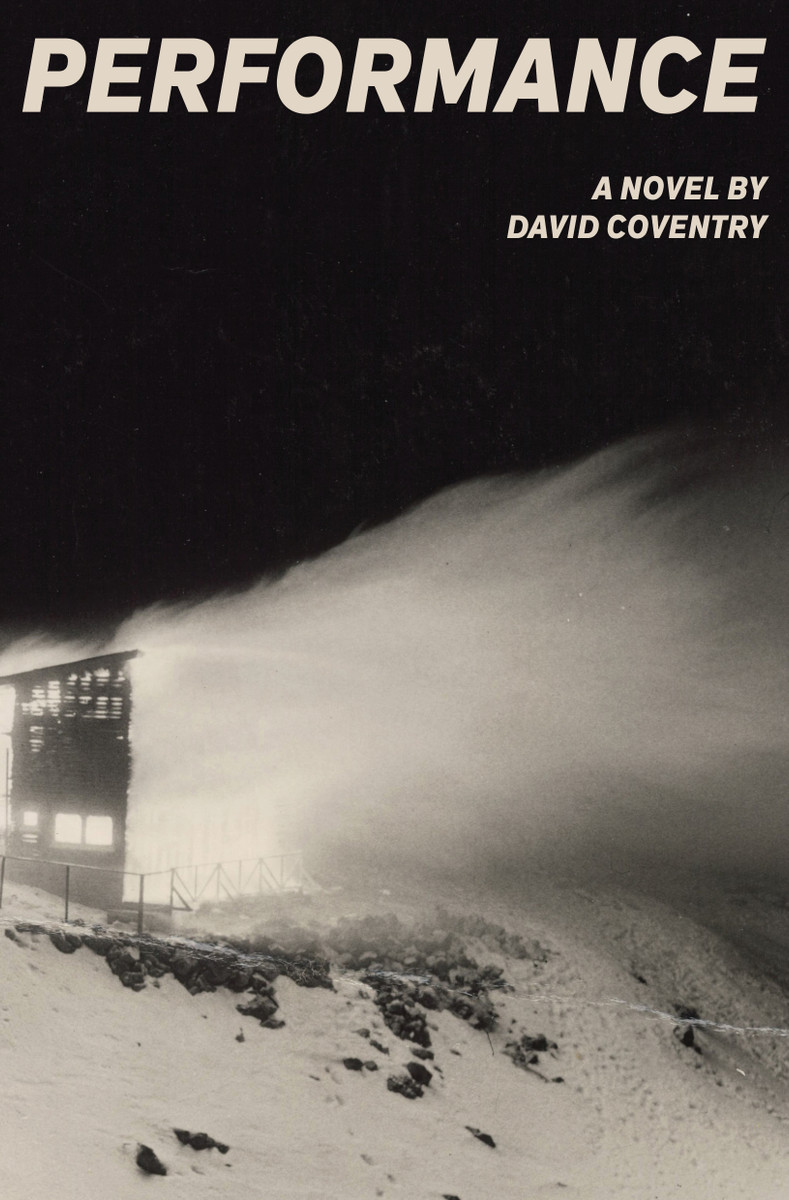
David Coventry is from a family of mountain climbers, like Edmund Hillary: “someone whose body seemed permanently full of oxygen.” Coventry used to be fast, “I had speed, just a natural event amongst my genes”- then he was struck with depression, and then Epstein-Barr, and eventually that “cracker of a disease” myalgic encephalomyelitis, ME. To this dismal cocktail add ADD and you get a life that doesn’t cohere, a parallel life to that of the counterfactual Coventry, a doppelganger who remains able: “I can’t imagine illness without my twin. I just can’t do it.”
Performance is Coventry’s life story to date, or a version of it. It is made up of his memories, and his experiences of living with his conditions. It includes anecdotes of his travels around Europe, to literary events and to visit the places of his colonising forebears, and of his travels with a punk rock band. The travel sequences reminded me of W.G. Sebald’s The Rings of Saturn, in which a depressed Sebald wanders around Suffolk, ruminating.
Performance is a jumble: the Acknowledgements, Notes, and List of Illustrations all appear before the end – it is as confused as Coventry’s life is, a life with which he has a love/hate relationship, as he does with language, and with being an author. A life entangled with the perversities of ME: “The cranium awash with a viscous brine.”
A few parts of the novel are written from the point of view of his wife, Laura, the woman who helps him persist, and who herself has recently fallen ill. And others from that of Rachel, his cousin, who also is living with ME. As is often the case with the chronically ill, Coventry pays close attention to the deaths and sicknesses that surround him. Friends, relatives, acquaintances are all struck down. Strangers who give you a lift, passing drivers, mates waiting in vans, all die unexpectedly in front of you.
Coventry deceives the reader, killing off characters for a while just to see what it does to the narrative, and in some of the anecdotes swapping the main players with those he would rather write about. Two whole sections are repeated in different voices long after they first appear. The book is like the author’s fractured life, his inflamed brain – it won’t draw together. Coventry writes as though bordering on Cotard’s syndrome – not believing he is dead but believing he can “die just by thinking about it”. Both Coventry and another character voice the thought that “to die unwillingly, it seems such a waste, you know, of volition”.
Performance details the known science of ME: abnormalities of the brain, blood, gut, genes, and muscle. But this knowledge refuses to coalesce into a ‘known’ disease, into a cure, even into how to alleviate symptoms in a systematic and reliable way, “There are still no doctors for this.” The disease isn’t even named yet – one offering, CFS, chronic fatigue syndrome: “Which would be a fine term if it were merely fatigue that affects us”. Another, myalgic encephalomyelitis: “almost as cruel in its medical appellation as it is in physical form.” There are other options out there, not yet adopted. Coventry quotes psychiatrist Bluma Zeigarnik: “when one refrains from naming a phenomenon, the idea of it stays dynamic in your thoughts.”
The incessant chatter of the scientists, including those who dismiss the disease as a form of female hysteria (the majority of those living with ME being women), carries on behind Coventry’s conversations on trains, planes, beaches, in pubs … All his conversational partners are bestowed with Coventry’s own eloquence and fascination with disease and death. The life of a person living with ME is one of being overwhelmed by the condition, or the relief of feeling able to do a little, but always fearful of the next descent into pain and “obliterating tiredness”.
At one point Coventry wonders, since people comment that he seems well when presenting his books to the public, whether he would be “no longer sick” if he were a more prolific, or better, author. He is closer to his doppelganger’s reality when performing like this, whilst knowing performing will have the consequence of experiencing the grim reality of his illness. He worries whether using a wheelchair at an airport to avoid severe symptoms, rather than because he is experiencing them, is a performative manipulation of the strangers who sympathise and are kind to him.
Many of Coventry’s family and friends are understanding and supporting – he doesn’t appear to have the problem of many with living with ME of family and friends being sceptical, constantly asking ‘are you better yet?’ – finally giving up and drifting away. In the strange void he lives in, there are those who talk to him, remember with him, even those who share his illness. Despite the dismal subject matter, Performance is a mesmerising and at times beautiful read, albeit tragic.
A consistent trope throughout Performance is that of falling – falling off mountains, off cliffs, off a red Vespa, down stairs, off steep paths, or off flat paths. Or the falling sensation of “height vertigo” – viscerally and vicariously falling whilst observing high-wire artists or “a person climbing to lofty spaces”. Even the disease: “The materials of living matter in free fall from some height.” And the ever-present expectation of falling into the dimness of ME: “hanging in the air, desperate for handholds, no hope of traction.”
The reader too feels a sense falling into Coventry’s world as they read this extraordinary book. Coventry looks out at the Remutaka ranges: “I stare out there each day, promise myself that when I’m well I’ll climb it.”
Highly recommended.
 alysontheblog