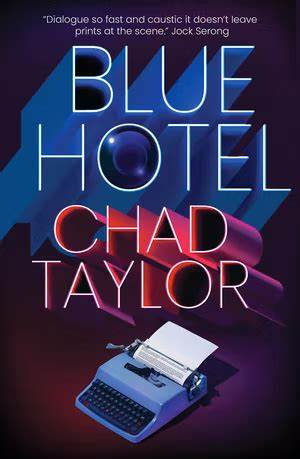
If you want to cruise through a tale of classic noir, Blue Hotel is the book for you. The late 1980s, a busted up “old fashioned reporter”, an underbelly of sex-traps and blackmail, characters being hidden away in a mysterious psychiatric hospital. The privileged rich paying their way out of grief and covering for damaged children, and a plot so complex you lose it before it is all drawn together. The plot including a ‘vamp’ – a goth, or maybe a series of them: Blanca, Krystal, Amber, Cherry, Veronica …
The first to lure Ray Moody into the story, is Blanca Nul. She is Danish and makes herself memorable before disappearing, and her disappearance causes quite a stir for journalists, “a missing female tourist was gold”. Most leads as to her whereabout are to nowhere, and the story dies. Then a year later a woman looking and acting like Blanca Nul is seen again – but is it her? Ray, in a characteristic slump, is determined to find out the truth – mainly as a distraction from the wreck of his life.
Ray is pining after his wife, Eva. Is she dead, with someone else, just somewhere else? Her story drips into the main plot from time to time, and she is never far from Ray’s mind. Ray finds solace in drink, before getting badly injured in a car accident. He tries going straight, attending meetings set up by the charitable Welkin Foundation. A lawyer connected to the Foundation has helped him and many of his fellow addicts. Ray continues with his enquiries into Blanca’s disappearance, despite having lost his respectable job for the Examiner and then his less respectable job for the Beacon.
Ray hobbles around on a bum leg, wearing a wrecked overcoat, driving his beat-up car through “New Zealand … a series of wildernesses connected by fast roads”. He has some helpers, such as a librarian who works late watching porn on a computer. Ray prefers microfiche when looking for links between players – he’s got no time for computers and is glad the “news would always be in print”. Another of those who help Ray is an ex-cop, bearing the consequences of living a double life. He’s working for a security company, the same company that seems to turn up everywhere Ray does.
Ray follows the leads he finds, and he ends up in some strange places: in abandoned night clubs, in the homes of the wealthy, in a soup kitchen, in a BDSM dungeon that used to be a pet shop – the owners making the logical shift when they noticed some of their customers were “looking at the large breed gear”. He starts linking people, companies, and proclivities together. “The world was nothing more than gradations of shade: one big long slide from light to dark.”
Ray is careful not to fall into the trap of inadvertently being bribed or being played, but maybe … The plot has people taking on others’ identities, people who have made one bad decision that repeats until they find they are a person they don’t know anymore. People who are addicted, desperate, scared. The title of the book is yet another ambiguity, is it a code for suicide, the scene of a crime, or a place of hiding?
The characters in Blue Hotel are great, finely drawn, and you wouldn’t want to spend time with any of them – unless perhaps the kind-hearted vampire who works as a minder for one of the goths. It is a pacy novel with plenty of tense moments, some in fast cars on wet greasy streets, others in very dark places. The rain is relentless, and the run-down environments are tactile. The plotting builds, goes haywire, and then gets pulled together.
The reader starts to think there are maybe a few too many coincidences, and then remembers the novel is set in Aotearoa and “New Zealand’s such a small country sometimes all you need to do to create a conflict of interest is walk into a room”. And more sinister is the fact that there may be strands of the story that are manipulating Ray, rather than him driving the plot. And who cares anyway when we happen upon lines such as: “In this business it’s all about being close to the ground and Richard could crawl under a snake.”
I loved reading Blue Hotel #YeahNoir!
 alysontheblog